Bhattacharjee Ananya, Haque S M Taiabul, Hady Md Abdul, Alam S M Raihanul, Rabbi Mashfiqui, Kabir Muhammad Ashad, Ahmed Syed Ishtiaque
Department of Computer Science, University of Toronto, Toronto, ON, Canada.
School of Computer Science and Mathematics, University of Central Missouri, Warrensburg, MO, United States.
JMIR Form Res. 2021 Nov 2;5(11):e27114. doi: 10.2196/27114.
The undergraduate student population has been actively studied in digital mental health research. However, the existing literature primarily focuses on students from high-income nations, and undergraduates from limited-income nations remain understudied.
This study aims to identify the broader social determinants of mental health among undergraduate students in Bangladesh, a limited-income nation in South Asia; study the manifestation of these determinants in their day-to-day lives; and explore the feasibility of self-monitoring tools in helping them identify the specific factors or relationships that affect their mental health.
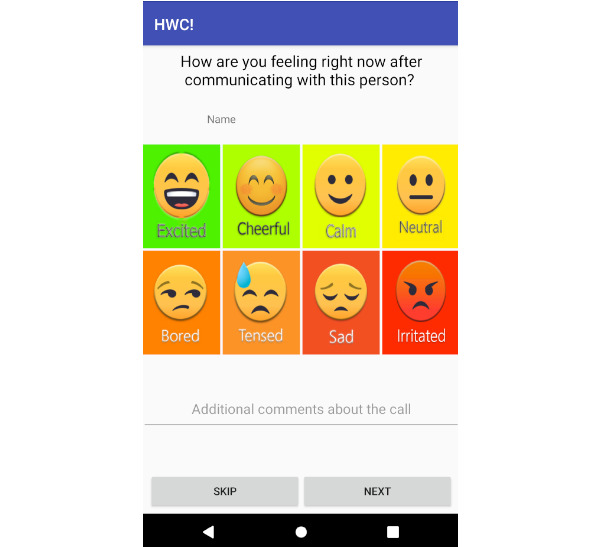
We conducted a 21-day study with 38 undergraduate students from 7 universities in Bangladesh. We conducted 2 semistructured interviews: one prestudy and one poststudy. During the 21-day study, participants used an Android app to self-report and self-monitor their mood after each phone conversation. The app prompted participants to report their mood after each phone conversation and provided graphs and charts so that the participants could independently review their mood and conversation patterns.
Our results show that academics, family, job and economic condition, romantic relationship, and religion are the major social determinants of mental health among undergraduate students in Bangladesh. Our app helped the participants pinpoint the specific issues related to these factors, as the participants could review the pattern of their moods and emotions from past conversation history. Although our app does not provide any explicit recommendation, the participants took certain steps on their own to improve their mental health (eg, reduced the frequency of communication with certain persons).
Although some of the factors (eg, academics) were reported in previous studies conducted in the Global North, this paper sheds light on some new issues (eg, extended family problems and religion) that are specific to the context of the Global South. Overall, the findings from this study would provide better insights for researchers to design better solutions to help the younger population from this part of the world.
本科生群体一直是数字心理健康研究的活跃对象。然而,现有文献主要关注高收入国家的学生,来自低收入国家的本科生仍未得到充分研究。
本研究旨在确定南亚低收入国家孟加拉国本科生心理健康的更广泛社会决定因素;研究这些决定因素在他们日常生活中的表现;并探索自我监测工具在帮助他们识别影响其心理健康的具体因素或关系方面的可行性。
我们对来自孟加拉国7所大学的38名本科生进行了为期21天的研究。我们进行了两次半结构化访谈:一次是研究前访谈,一次是研究后访谈。在为期21天的研究中,参与者使用一款安卓应用程序在每次电话交谈后自我报告和自我监测他们的情绪。该应用程序促使参与者在每次电话交谈后报告他们的情绪,并提供图表,以便参与者能够独立回顾他们的情绪和交谈模式。
我们的结果表明,学业、家庭、工作和经济状况、恋爱关系以及宗教是孟加拉国本科生心理健康的主要社会决定因素。我们的应用程序帮助参与者确定了与这些因素相关的具体问题,因为参与者可以从过去的交谈历史中回顾他们的情绪和情感模式。尽管我们的应用程序没有提供任何明确的建议,但参与者自行采取了某些措施来改善他们的心理健康(例如,减少与某些人的交流频率)。
尽管之前在全球北方进行的一些研究中报告了某些因素(例如学业),但本文揭示了一些特定于全球南方背景的新问题(例如大家庭问题和宗教)。总体而言,本研究的结果将为研究人员提供更好的见解,以设计更好的解决方案来帮助世界这一地区的年轻人群体。