Bőthe Beáta, Baumgartner Christian, Schaub Michael P, Demetrovics Zsolt, Orosz Gábor
1 Département de Psychologie, Université de Montréal, Montréal, Canada.
2 Institute of Psychology, ELTE Eötvös Loránd University, Budapest, Hungary.
J Behav Addict. 2021 Oct 29;10(4):1015-35. doi: 10.1556/2006.2021.00070.
Despite problematic pornography use (PPU) being prevalent, no previous study has examined the effectiveness of evidence-based interventions for PPU, using rigorous methods. Using a two-armed randomized controlled trial study design, we examined the feasibility and initial effectiveness of a six-week online PPU intervention.
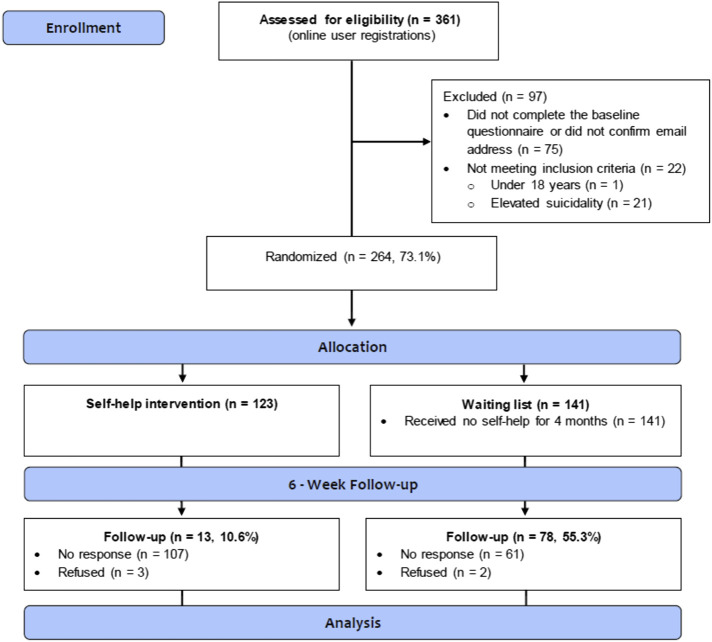
We recruited 264 participants (3.8% women, M age = 33.2, SD = 10.6) who were randomized and assigned to either the self-help intervention (n = 123) or waitlist control condition (n = 141), and completed self-report questionnaires at baseline and after the end of the intervention (six-week follow-up). Multivariable linear regression models were generated and tested on a complete case basis to investigate possible treatment effects. Participants provided quantitative and qualitative feedback regarding the intervention's content and appearance.
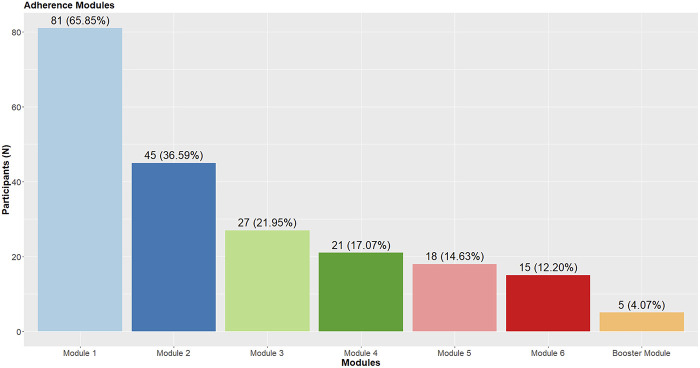
Participants evaluated all modules positively in the intervention in general. There were differential dropout rates (89.4% in intervention vs. 44.7% in control group) with an overall follow-up rate of 34.5%. The intervention group reported significantly lower levels of PPU (P < 0.001, d = 1.32) at the six-week follow-up. Moreover, they reported lower pornography use frequency (P < 0.001, d = 1.65), self-perceived pornography addiction (P = 0.01, d = 0.85), pornography craving (P = 0.02, d = 0.40), and higher pornography avoidance self-efficacy (P = 0.001, d = 0.87) at the six-week follow-up.
The present study was only a first step in rigorous treatment studies for PPU, but the findings are promising and suggest that online interventions for PPU might help reduce PPU in some cases, even without the guidance of therapists, by reducing treatment barriers.
尽管问题性色情内容使用(PPU)普遍存在,但此前尚无研究采用严格方法检验基于证据的PPU干预措施的有效性。我们采用双臂随机对照试验研究设计,检验了为期六周的在线PPU干预措施的可行性和初步有效性。
我们招募了264名参与者(女性占3.8%,年龄中位数=33.2,标准差=10.6),他们被随机分配到自助干预组(n=123)或等待名单对照组(n=141),并在基线和干预结束后(六周随访)完成自我报告问卷。生成多变量线性回归模型,并在完整病例基础上进行检验,以研究可能的治疗效果。参与者对干预措施的内容和形式提供了定量和定性反馈。
参与者总体上对干预措施的所有模块评价积极。两组的退出率存在差异(干预组为89.4%,对照组为44.7%),总体随访率为34.5%。在六周随访时,干预组报告的PPU水平显著较低(P<0.001,d=1.32)。此外,他们在六周随访时报告的色情内容使用频率较低(P<0.001,d=1.65)、自我感知的色情成瘾程度较低(P=0.01,d=0.85)、对色情内容的渴望较低(P=0.02,d=0.40),以及避免接触色情内容的自我效能较高(P=0.001,d=0.87)。
本研究只是PPU严格治疗研究的第一步,但研究结果很有前景,表明PPU的在线干预措施在某些情况下可能有助于减少PPU,即使没有治疗师的指导,也能通过减少治疗障碍来实现。