Department of Orthopaedics, Leiden University Medical Center, Albinusdreef 2, Postzone J-11-S, P.O. Box 9600, 2300 RC, Leiden, The Netherlands.
Directorate of Research Policy (Formerly: Walaeus Library), Leiden University Medical Centre, Leiden, The Netherlands.
Sci Rep. 2021 Nov 2;11(1):21522. doi: 10.1038/s41598-021-00726-4.
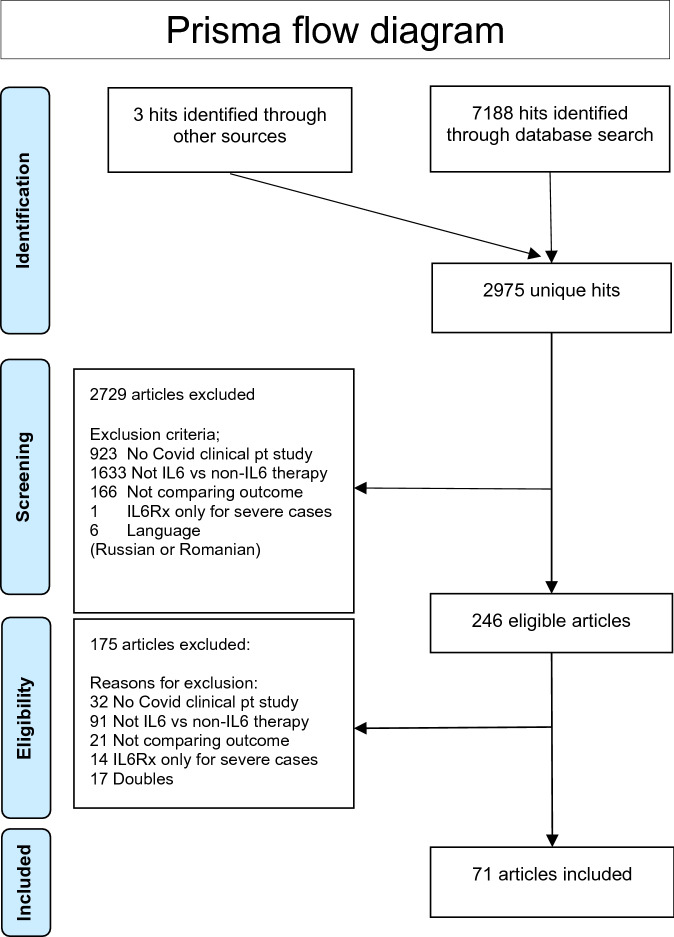
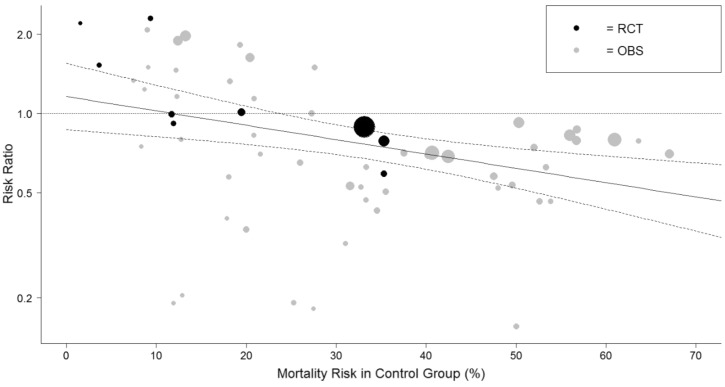
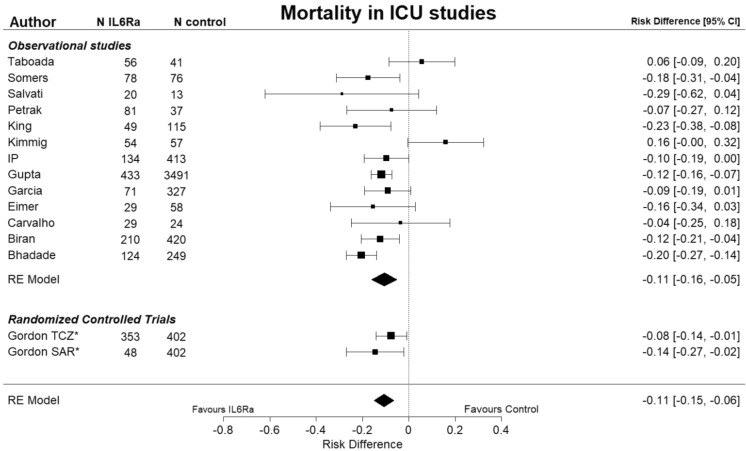
There is controversy whether IL-6 (receptor) antagonists are beneficial in treating COVID-19 patients. We therefore update our systematic review to answer the following research questions: (1) Do patients hospitalized for COVID-19 treated with IL-6 (receptor) antagonists have lower mortality compared to standard of care? (2) Do patients hospitalized for COVID-19 treated with IL-6 (receptor) antagonists have more side effects compared to standard of care? The following databases were search up to December 1st 2020: PubMed, PMC PubMed Central, MEDLINE, WHO COVID-19 Database, Embase, Web-of-Science, COCHRANE LIBRARY, Emcare and Academic Search Premier. In order to pool the risk ratio (RR) and risk difference of individual studies we used random effects meta-analysis. The search strategy retrieved 2975 unique titles of which 71 studies (9 RCTs and 62 observational) studies comprising 29,495 patients were included. Mortality (RR 0.75) and mechanical ventilation (RR 0.78) were lower and the risk of neutropenia (RR 7.3), impaired liver function (RR 1.67) and secondary infections (RR 1.26) were higher for patients treated with IL-6 (receptor) antagonists compared to patients not treated with treated with IL-6 (receptor) antagonists. Our results showed that IL-6 (receptor) antagonists are effective in reducing mortality in COVID-19 patients, while the risk of side effects was higher. The baseline risk of mortality was an important effect modifier: IL-6 (receptor) antagonists were effective when the baseline mortality risk was high (e.g. ICU setting), while they could be harmful when the baseline mortality risk was low.
关于白细胞介素 6(受体)拮抗剂是否有益于治疗 COVID-19 患者存在争议。因此,我们更新了系统评价,以回答以下研究问题:(1)与标准治疗相比,因 COVID-19 住院的患者接受白细胞介素 6(受体)拮抗剂治疗后死亡率是否更低?(2)与标准治疗相比,因 COVID-19 住院的患者接受白细胞介素 6(受体)拮抗剂治疗后副作用是否更多?截至 2020 年 12 月 1 日,我们检索了以下数据库:PubMed、PMC PubMed Central、MEDLINE、世界卫生组织 COVID-19 数据库、Embase、Web-of-Science、Cochrane 图书馆、Emcare 和学术搜索高级版。为了汇总个体研究的风险比(RR)和风险差异,我们使用了随机效应荟萃分析。检索策略共检索到 2975 个独特的标题,其中有 71 项研究(9 项 RCT 和 62 项观察性研究)共纳入 29495 例患者。与未接受白细胞介素 6(受体)拮抗剂治疗的患者相比,接受白细胞介素 6(受体)拮抗剂治疗的患者死亡率(RR0.75)和机械通气(RR0.78)较低,中性粒细胞减少症(RR7.3)、肝功能损害(RR1.67)和继发感染(RR1.26)的风险更高。我们的结果表明,白细胞介素 6(受体)拮抗剂可有效降低 COVID-19 患者的死亡率,但其副作用风险更高。死亡率的基线风险是一个重要的效应修饰因素:当基线死亡率高(例如 ICU 环境)时,白细胞介素 6(受体)拮抗剂有效,而当基线死亡率低时,白细胞介素 6(受体)拮抗剂可能有害。