Institute of Immunology and Immunotherapy (III), College of Medical and Dental Sciences, University of Birmingham, Birmingham, England, UK.
Sengenics Corporation, Level M, Plaza Zurich, Damansara Heights, Kuala Lumpur, 50490, Malaysia.
Br J Cancer. 2022 Feb;126(2):238-246. doi: 10.1038/s41416-021-01572-x. Epub 2021 Nov 2.
Lung cancer is the leading cause of cancer-related death worldwide. Surgical resection remains the definitive curative treatment for early-stage disease offering an overall 5-year survival rate of 62%. Despite careful case selection, a significant proportion of early-stage cancers relapse aggressively within the first year post-operatively. Identification of these patients is key to accurate prognostication and understanding the biology that drives early relapse might open up potential novel adjuvant therapies.
We performed an unsupervised interrogation of >1600 serum-based autoantibody biomarkers using an iterative machine-learning algorithm.
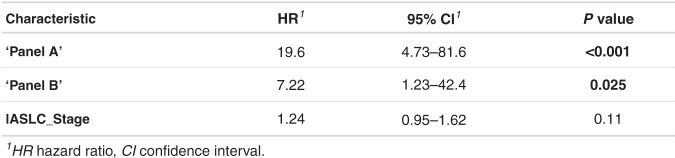
We identified a 13 biomarker signature that was highly predictive for survivorship in post-operative early-stage lung cancer; this outperforms currently used autoantibody biomarkers in solid cancers. Our results demonstrate significantly poor survivorship in high expressers of this biomarker signature with an overall 5-year survival rate of 7.6%.
We anticipate that the data will lead to the development of an off-the-shelf prognostic panel and further that the oncogenic relevance of the proteins recognised in the panel may be a starting point for a new adjuvant therapy.
肺癌是全球癌症相关死亡的主要原因。手术切除仍然是早期疾病的明确治愈性治疗方法,总体 5 年生存率为 62%。尽管进行了仔细的病例选择,但仍有相当一部分早期癌症在术后第一年复发。识别这些患者是准确预测预后的关键,了解导致早期复发的生物学机制可能为潜在的新辅助治疗开辟途径。
我们使用迭代机器学习算法对 >1600 种基于血清的自身抗体生物标志物进行了无监督检测。
我们确定了一个 13 种生物标志物的特征,该特征对术后早期肺癌的生存预测具有高度预测性;这优于目前在实体瘤中使用的自身抗体生物标志物。我们的结果表明,该生物标志物特征高表达者的生存情况显著较差,总体 5 年生存率为 7.6%。
我们预计这些数据将导致开发即用型预后面板,并且该面板中识别出的蛋白质的致癌相关性可能是新辅助治疗的起点。