Division of Gastroenterology, Duke University School of Medicine, 3100 Tower Blvd, Durham, NC, 27707, USA.
IBM Watson Health, 75 Binney St, Cambridge, MA, 02142, USA.
Int J Colorectal Dis. 2022 Mar;37(3):719-721. doi: 10.1007/s00384-021-04055-w. Epub 2021 Nov 2.
This study examined adherence to screening for fecal immunochemical test (FIT).
Adults (≥ 50-75) with a FIT between 1/1/2014 and 6/30/2019 in MarketScan administrative claims were selected (index = earliest FIT). Patients were followed for 10 years pre- and 3 years post-index. Patients at increased risk for CRC or with prior screening were excluded. Year over year adherence was measured post-index.
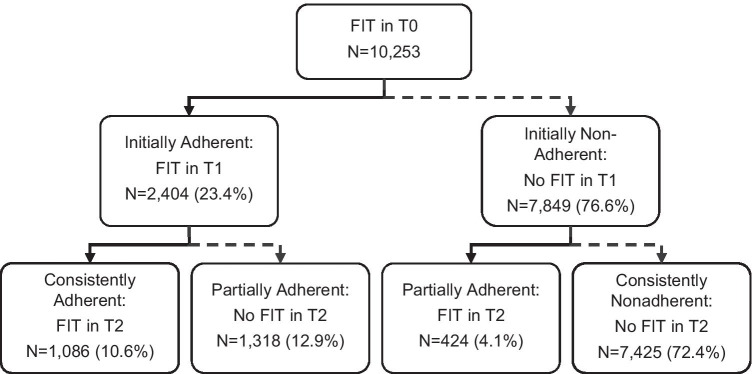
Of 10,253 patients, the proportion adherent to repeat testing at year 2 was 23.4% and 10.6% at year 3. Of 76.6% not adherent in year 2, 5.4% were adherent in year 3.
Results suggest adherence to FIT tests is poor, minimizing potential benefits. Future studies are needed to consider alternative test options and whether more choice will improve long-term adherence.
本研究旨在调查粪便免疫化学检测(FIT)筛查的依从性。
选择 2014 年 1 月 1 日至 2019 年 6 月 30 日期间 MarketScan 行政索赔中 FIT 介于 1/1/2014 至 6/30/2019 的成年人(≥50-75 岁)作为研究对象(指数=最早的 FIT)。在指数前的 10 年和指数后的 3 年对患者进行随访。排除 CRC 风险增加或有既往筛查的患者。在指数后,每年测量依从性。
在 10253 名患者中,第 2 年重复检测的依从率为 23.4%,第 3 年为 10.6%。在第 2 年不依从的 76.6%的患者中,有 5.4%在第 3 年依从。
结果表明 FIT 检测的依从性较差,从而降低了潜在的获益。需要进一步研究来考虑替代检测选项,以及更多的选择是否会提高长期依从性。