Department of Biomedical Engineering, School of Life Science and Technology, Huazhong University of Science and Technology, Wuhan, China.
Department of Neurosurgery, Changhai Hospital, Second Military Medical University, Shanghai, China.
CNS Neurosci Ther. 2022 Jan;28(1):64-76. doi: 10.1111/cns.13735. Epub 2021 Nov 2.
To study the effect of pharmacological inhibition of epidermal growth factor receptor (EGFR) on intracranial aneurysm (IA) initiation.
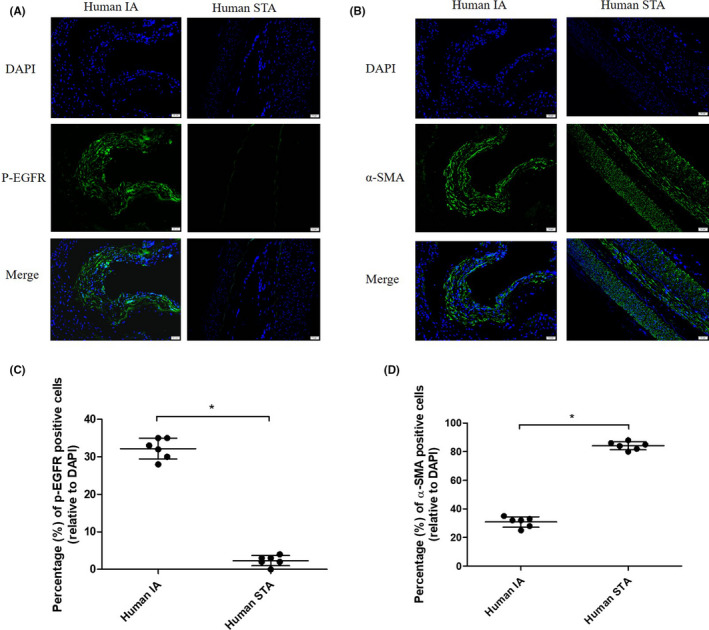
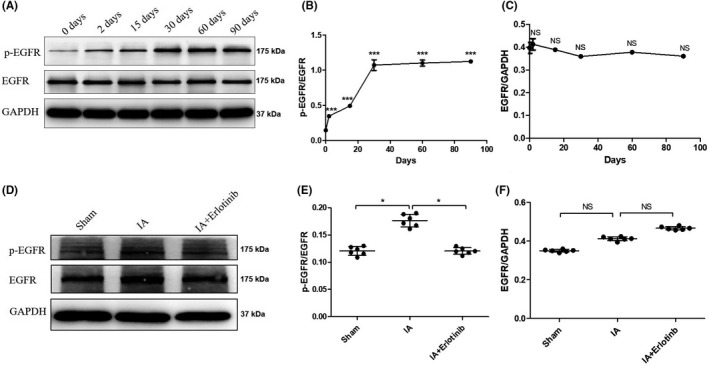
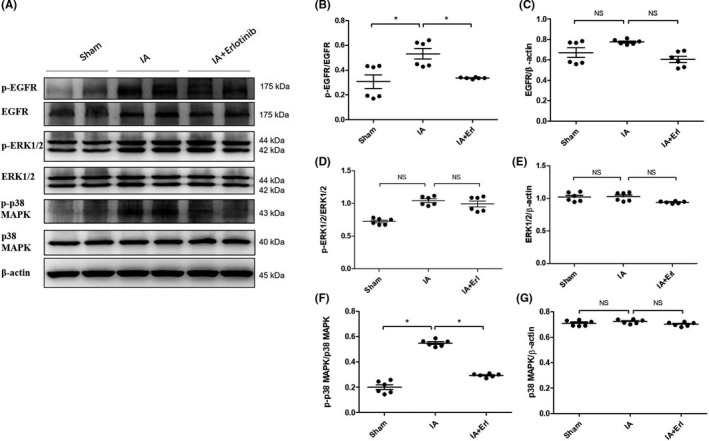
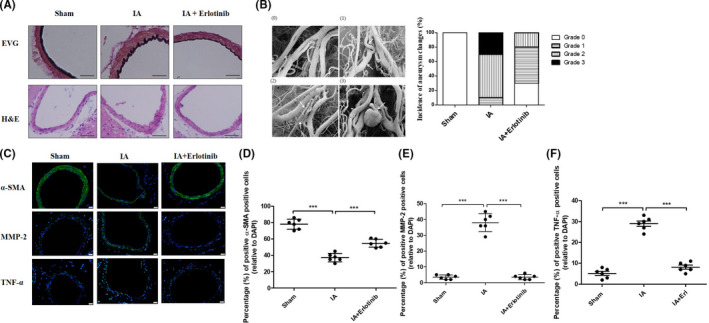
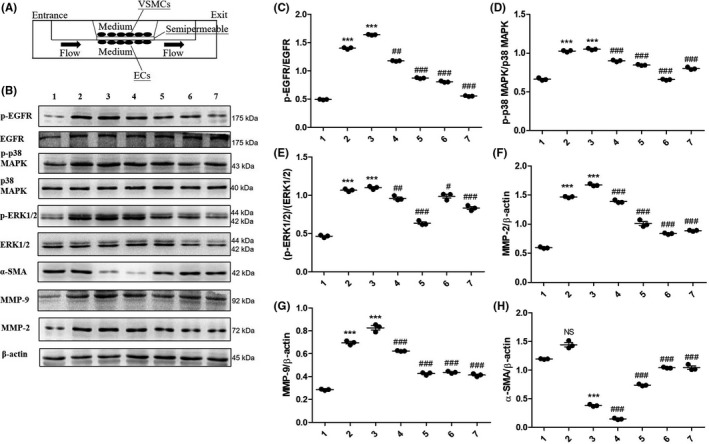
Human IA samples were analyzed for the expression of p-EGFR and alpha smooth muscle actin (α-SMA) by immunofluorescence (IF). Rat models of IA were established to evaluate the ability of the EGFR inhibitor, erlotinib, to attenuate the incidence of IA. We analyzed anterior cerebral artery tissues by pathological and proteomic detection for the expression of p-EGFR and relevant proteins, and vessel casting was used to evaluate the incidence of aneurysms in each group. Rat vascular smooth muscle cells (VSMCs) and endothelial cells were extracted and used to establish an in vitro co-culture model in a flow chamber with or without erlotinib treatment. We determined p-EGFR and relevant protein expression in VSMCs by immunoblotting analysis.
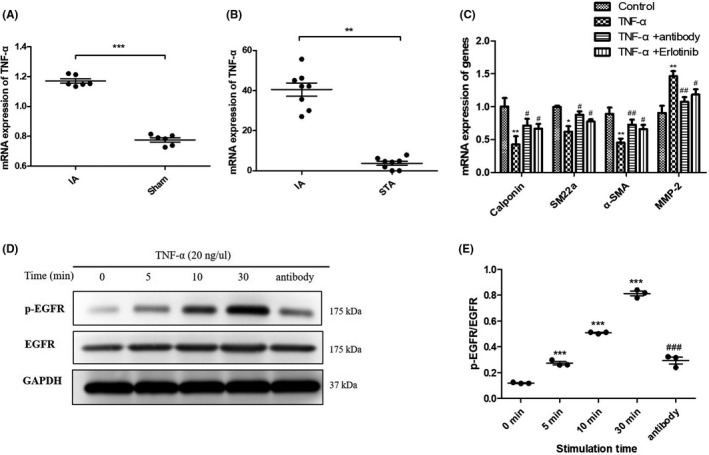
Epidermal growth factor receptor activation was found in human IA vessel walls and rat anterior cerebral artery walls. Treatment with erlotinib markedly attenuated the incidence of IA by inhibiting vascular remodeling and pro-inflammatory transformation of VSMC in rat IA vessel walls. Activation of EGFR in rat VSMCs and phenotypic modulation of rat VSMCs were correlated with the strength of shear stress in vitro, and treatment with erlotinib reduced phenotypic modulation of rat VSMCs. In vitro experiments also revealed that EGFR activation could be induced by TNF-α in human brain VSMCs.
These results suggest that EGFR plays a critical role in the initiation of IA and that the EGFR inhibitor erlotinib protects rats from IA initiation by regulating phenotypic modulation of VSMCs.
研究表皮生长因子受体(EGFR)的药理学抑制对颅内动脉瘤(IA)发生的影响。
通过免疫荧光(IF)分析 IA 组织中 p-EGFR 和 α 平滑肌肌动蛋白(α-SMA)的表达。建立 IA 的大鼠模型,以评估 EGFR 抑制剂厄洛替尼对 IA 发生率的抑制作用。通过病理和蛋白质组学检测分析大脑前动脉组织中 p-EGFR 和相关蛋白的表达,并用血管铸型评估各组动脉瘤的发生率。提取大鼠血管平滑肌细胞(VSMCs)和内皮细胞,在有无厄洛替尼处理的流室中建立体外共培养模型。通过免疫印迹分析确定 VSMCs 中 p-EGFR 和相关蛋白的表达。
在人类 IA 血管壁和大鼠大脑前动脉壁中发现了 EGFR 激活。厄洛替尼治疗通过抑制血管重构和大鼠 IA 血管壁中 VSMC 的促炎转化,显著降低了 IA 的发生率。EGFR 在大鼠 VSMCs 中的激活及其表型改变与体外切应力强度相关,厄洛替尼治疗降低了大鼠 VSMCs 的表型改变。体外实验还表明,EGFR 可被 TNF-α在人脑血管平滑肌细胞中激活。
这些结果表明 EGFR 在 IA 的发生中起关键作用,EGFR 抑制剂厄洛替尼通过调节 VSMC 的表型改变来保护大鼠免受 IA 的发生。