Department of Pediatrics, Rhode Island Hospital and Brown University, Providence, Rhode Island.
Division of Transplant Surgery, Massachusetts General Hospital, Boston, Massachusetts.
Am J Physiol Gastrointest Liver Physiol. 2022 Jan 1;322(1):G21-G33. doi: 10.1152/ajpgi.00266.2021. Epub 2021 Nov 3.
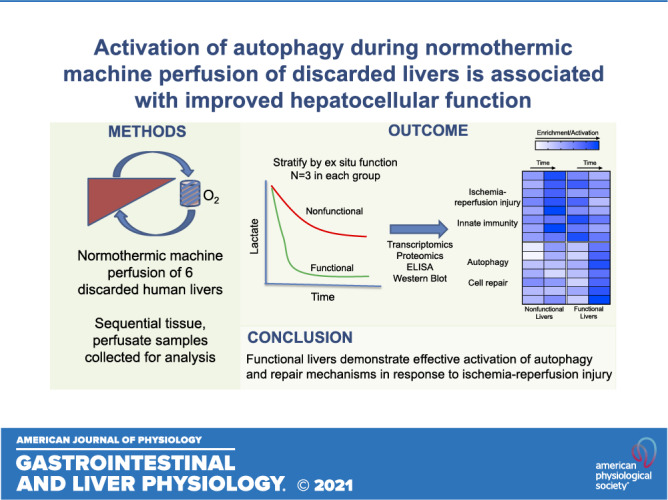
Liver transplantation is hampered by a severe shortage of donor organs. Normothermic machine perfusion (NMP) of donor livers allows dynamic preservation in addition to viability assessment before transplantation. Little is known about the injury and repair mechanisms induced during NMP. To investigate these mechanisms, we examined gene and protein expression changes in a cohort of discarded human livers, stratified by hepatocellular function, during NMP. Six human livers acquired through donation after circulatory death (DCD) underwent 12 h of NMP. Of the six livers, three met predefined criteria for adequate hepatocellular function. We applied transcriptomic profiling and protein analysis to evaluate temporal changes in gene expression during NMP between functional and nonfunctional livers. Principal component analysis segregated the two groups and distinguished the various perfusion time points. Transcriptomic analysis of biopsies from functional livers indicated robust activation of innate immunity after 3 h of NMP followed by enrichment of prorepair and prosurvival mechanisms. Nonfunctional livers demonstrated delayed and persistent enrichment of markers of innate immunity. Functional livers demonstrated effective induction of autophagy, a cellular repair and homeostasis pathway, in contrast to nonfunctional livers. In conclusion, NMP of discarded DCD human livers results in innate immune-mediated injury, while also activating autophagy, a presumed mechanism for support of cellular repair. More pronounced activation of autophagy was seen in livers that demonstrated adequate hepatocellular function. We demonstrate that ischemia-reperfusion injury occurs in all livers during NMP, though there are notable differences in gene expression between functional and nonfunctional livers. We further demonstrate that activation of the liver's repair and homeostasis mechanisms through autophagy plays a vital role in the graft's response to injury and may impact liver function. These findings indicate that liver autophagy might be a key therapeutic target for rehabilitating the function of severely injured or untransplantable livers.
肝移植受到供体器官严重短缺的阻碍。常温机器灌注(NMP)除了在移植前进行生存能力评估外,还允许对供体肝脏进行动态保存。关于 NMP 过程中诱导的损伤和修复机制知之甚少。为了研究这些机制,我们研究了一组废弃的人类肝脏在 NMP 过程中,根据肝细胞功能进行分层,基因和蛋白质表达的变化。通过循环死亡后捐献(DCD)获得的六个人类肝脏接受了 12 小时的 NMP。在这六例肝脏中,有三例符合肝细胞功能充足的既定标准。我们应用转录组谱分析和蛋白质分析来评估功能和非功能肝脏在 NMP 过程中基因表达的时间变化。主成分分析将两组分开,并区分了不同的灌注时间点。对功能正常的肝脏活检进行转录组分析表明,NMP 后 3 小时内固有免疫被强烈激活,随后富含促修复和生存机制。非功能肝脏则表现出固有免疫标志物的延迟和持续富集。功能正常的肝脏表现出有效的自噬诱导,自噬是一种细胞修复和动态平衡途径,与非功能肝脏形成对比。总之,DCD 人类废弃肝脏的 NMP 导致固有免疫介导的损伤,同时还激活了自噬,这被认为是支持细胞修复的机制。在表现出足够肝细胞功能的肝脏中,自噬的激活更为明显。我们证明,在 NMP 过程中,所有肝脏都会发生缺血再灌注损伤,尽管在功能正常和功能异常的肝脏之间存在显著的基因表达差异。我们进一步证明,通过自噬激活肝脏的修复和动态平衡机制在移植物对损伤的反应中起着至关重要的作用,并且可能影响肝功能。这些发现表明,肝脏自噬可能是恢复严重损伤或无法移植的肝脏功能的关键治疗靶点。