The University of Sydney, Sydney Medical School, Discipline of Ophthalmology, Save Sight Institute, Sydney, Australia.
Department of Ophthalmology, Dijon University Hospital, Dijon, France.
Transl Vis Sci Technol. 2021 Nov 1;10(13):5. doi: 10.1167/tvst.10.13.5.
To report the 36-month treatment outcomes of eyes with neovascular age-related macular degeneration (nAMD) receiving vascular endothelial growth factor (VEGF) inhibitors in daily practice who did not develop either subretinal fibrosis (SRFi) or macular atrophy (MA).
This is a retrospective analysis of data from the Fight Retinal Blindness registry. Treatment-naïve eyes starting intravitreal injection of VEGF inhibitors for nAMD from January 1, 2010, to September 1, 2017, and did not have SRFI and MA at baseline were tracked.
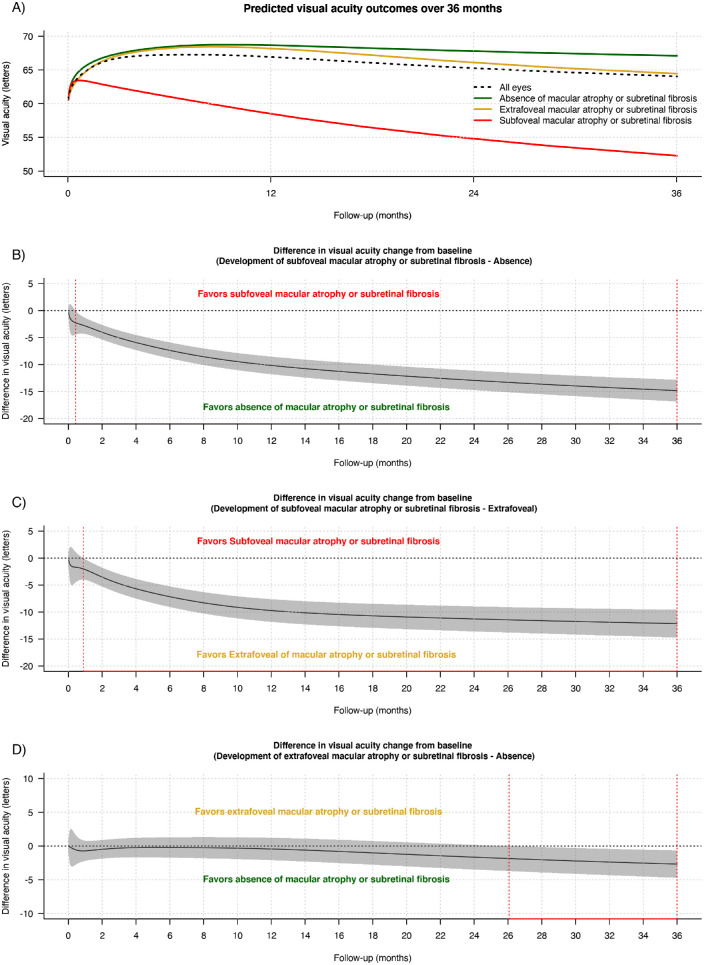
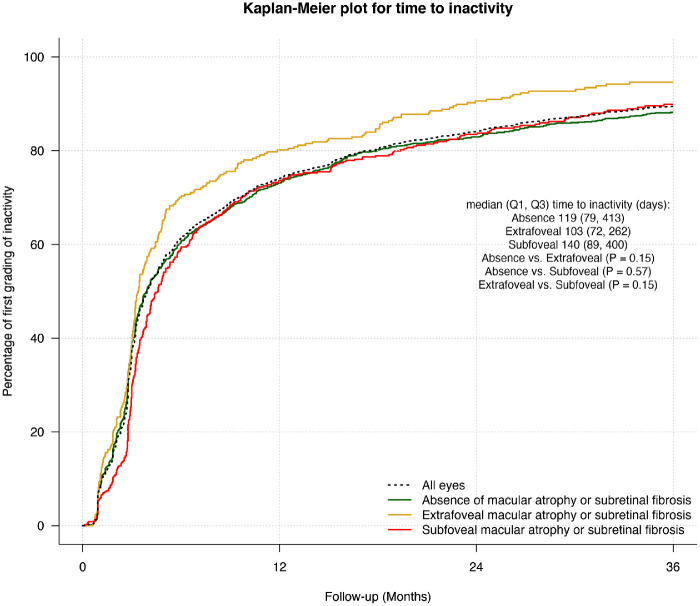
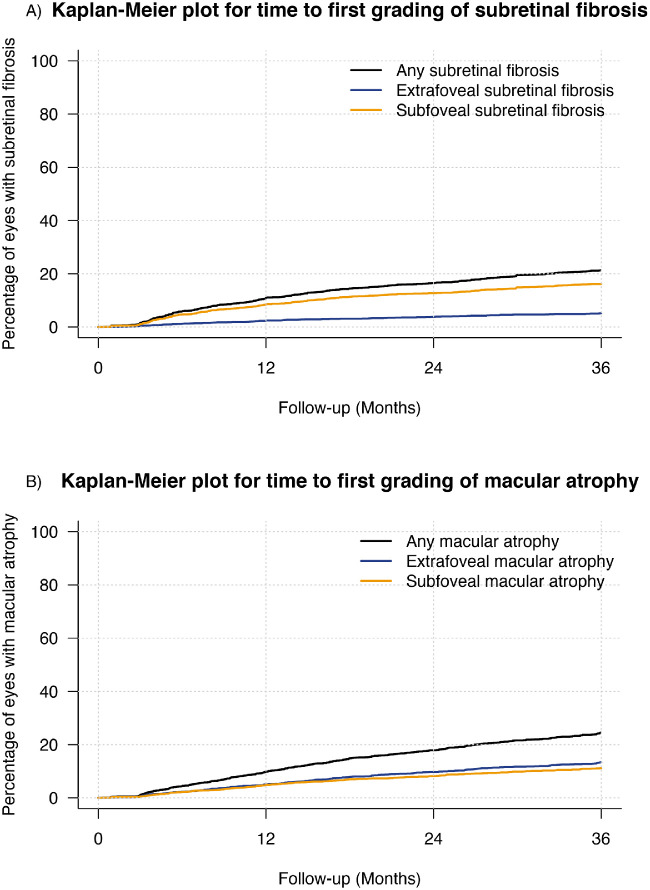
We identified 2478 eligible eyes, of which 1712 eyes did not develop SRFi or MA, 291 developed extrafoveal SRFI or MA, and 475 developed subfoveal SRFi or MA over 36 months. The estimated visual acuity stabilized from 6 months to 36 months in eyes that did not develop SRFI or MA with a mean (95% confidence interval [CI]) change in VA of -1 (-2, 0) letters, whereas eyes that developed extrafoveal (-3 [-5, -2] letters) or subfoveal (-10 [-11, -8] letters) SRFi or MA declined in vision in the same period. Eyes with no or extrafoveal SRFi or MA over 36 months were more likely to maintain their visual improvement from six months to 36 months (odds ratio [OR; 95% CI] = 2.3 [1.5, 3.3] for absence vs. subfoveal SRFi or MA, P ≤ 0.01 and OR = 2.0 [1.2, 3.4] for extrafoveal vs. subfoveal MA or SRFi, P = 0.01).
Treatment-naïve nAMD eyes receiving VEGF inhibitors maintain their initial six-month visual improvement over three years if they do not develop SRFI or MA.
The nAMD is still a major cause of blindness despite antiangiogenic treatments. We found that eyes that did not develop subretinal fibrosis or macular atrophy maintained their initial vision improvement for at least three years, suggesting that identifying treatments for these complications is the final barrier to achieving excellent outcomes in nAMD.
报告在日常实践中接受血管内皮生长因子(VEGF)抑制剂治疗的新生血管性年龄相关性黄斑变性(nAMD)患者 36 个月的治疗结果,这些患者既没有发生视网膜下纤维化(SRFi)也没有发生黄斑萎缩(MA)。
这是对 Fight Retinal Blindness 注册中心数据的回顾性分析。2010 年 1 月 1 日至 2017 年 9 月 1 日,开始接受玻璃体内 VEGF 抑制剂治疗 nAMD 的未经治疗的初治眼,且在基线时没有 SRFi 和 MA,对这些患者进行了跟踪。
我们确定了 2478 只符合条件的眼,其中 1712 只眼未发生 SRFi 或 MA,291 只眼发生了中心凹外 SRFi 或 MA,475 只眼发生了中心凹下 SRFi 或 MA。在 36 个月的时间里,在未发生 SRFi 或 MA 的眼中,视力稳定,平均(95%置信区间[CI])VA 变化为-1(-2,0)个字母,而发生中心凹外(-3[-5,-2]个字母)或中心凹下(-10[-11,-8]个字母)SRFi 或 MA 的眼在同一时期视力下降。在 36 个月时没有或仅有中心凹外 SRFi 或 MA 的眼更有可能从 6 个月到 36 个月保持其视力改善(无中心凹下 SRFi 或 MA 的优势比[OR;95%CI]为 2.3[1.5,3.3],P ≤ 0.01,而中心凹外 MA 或 SRFi 的 OR 为 2.0[1.2,3.4],P = 0.01)。
在没有发生 SRFi 或 MA 的情况下,接受 VEGF 抑制剂治疗的初治 nAMD 眼可保持最初 6 个月的视力改善,持续 3 年。
这是一项回顾性研究,对接受抗血管内皮生长因子(VEGF)治疗的新生血管性年龄相关性黄斑变性(nAMD)患者进行了 36 个月的随访。结果显示,未发生视网膜下纤维化或黄斑萎缩的患者在 3 年内能够保持最初 6 个月的视力改善。
这意味着,识别治疗这些并发症的方法是实现 nAMD 治疗效果的最后一道障碍。