Department of Neurology, Tangdu Hospital, Air Force Medical University, Xi'an, 710038, Shaanxi Province, China.
Department of Intensive Care Unit, Xi'an No.3 Hospital, Xi'an, 710018, Shaanxi Province, China.
BMC Neurol. 2021 Nov 4;21(1):428. doi: 10.1186/s12883-021-02439-7.
To summarize the clinical characteristics of patients with muscle-specific kinase antibody-associated myasthenia gravis (MuSK-MG) and to evaluate the therapeutic responses to different treatment regimes.
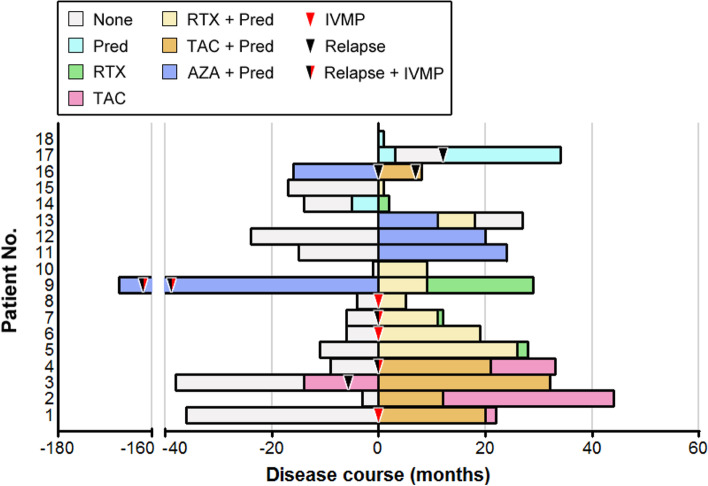
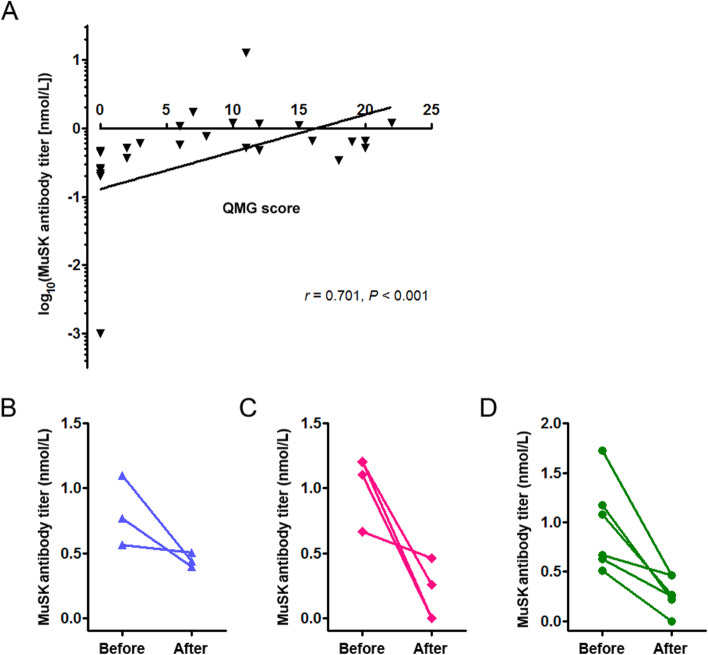
Eighteen MuSK-MG patients admitted in our department between October 2017 and September 2020 were included. Clinical parameters were collected and the responses to different immunosuppressive drugs were assessed by MGFA Postintervention Status (MGFA-PIS). Meanwhile, the correlation between QMG scores and MuSK antibody titers were analyzed and MuSK antibody (MuSK-ab) titers were compared before and after therapy based on different immunosuppressive treatment regimes.
Female predominance (ratio of females to males, 15:3) was evident in the study population, with the average onset age of (40.28 ± 18.57) years and the median disease course of 30.50 months (interquartile range [IQR], 17.50-44.75 months). Ocular manifestation was the most common onset symptom (11/18; 61.11%), and mild symmetrical ptosis was most frequent. Bulbar symptoms had the highest incidence of 88.89% over the entire disease course. Abnormal responses to RNS test were recorded most frequently on the musculus deltoideus (83.33%). All patients were treated with prednisone (Pred) alone or plus azathioprine (AZA), tacrolimus (TAC) or low-dose rituximab (RTX), and 17 (94.44%) of them achieved a favorable outcome defined as minimal manifestation (MM) or better. In general, an obvious positive correlation between QMG score and MuSK-ab titer (r = 0.710, P < 0.001) were found in all patients. A more significant reduction of MuSK-ab titers was observed in patients receiving TAC or RTX plus Pred than those receiving AZA plus Pred.
The prominent clinical manifestations of ocular and bulbar muscles involvements, together with abnormal RNS response mostly recorded on the musculus deltoideus and better efficacy associated with TAC or low-dose RTX plus Pred, provide a more exhaustive picture of MuSK-MG, particularly in Northwest China.
总结肌肉特异性激酶抗体相关重症肌无力(MuSK-MG)患者的临床特征,并评估不同治疗方案的治疗反应。
纳入 2017 年 10 月至 2020 年 9 月在我院就诊的 18 例 MuSK-MG 患者。收集临床参数,并通过重症肌无力基金会干预后状态(MGFA-PIS)评估不同免疫抑制剂的治疗反应。同时,分析 QMG 评分与 MuSK 抗体滴度的相关性,并根据不同的免疫抑制治疗方案,比较治疗前后 MuSK 抗体(MuSK-ab)滴度。
研究人群中女性占优势(女性与男性之比为 15:3),平均发病年龄为(40.28±18.57)岁,中位病程为 30.50 个月(四分位距[IQR],17.50-44.75 个月)。眼肌表现为最常见的首发症状(11/18;61.11%),且以轻度对称性上睑下垂最为常见。在整个病程中,球部症状的发生率最高,为 88.89%。RNS 检查异常反应最常发生在三角肌(83.33%)。所有患者均单独或联合使用泼尼松(Pred)、硫唑嘌呤(AZA)、他克莫司(TAC)或低剂量利妥昔单抗(RTX)治疗,17 例(94.44%)患者达到最小表现(MM)或更好的疗效。总体上,所有患者 QMG 评分与 MuSK-ab 滴度呈明显正相关(r=0.710,P<0.001)。与接受 AZA 联合 Pred 治疗的患者相比,接受 TAC 或 RTX 联合 Pred 治疗的患者 MuSK-ab 滴度降低更明显。
眼肌和球部肌肉受累的突出临床表现,以及 RNS 检查主要记录在三角肌上的异常反应,以及与 TAC 或低剂量 RTX 联合 Pred 相关的更好疗效,为 MuSK-MG 提供了更详尽的描述,特别是在中国西北地区。