Kang Seon Mee, Park Jeong Hyun
Department of Internal Medicine, College of Medicine, Inje University, Busan, Republic of Korea.
Paik Institute for Clinical Research, Inje University, Busan, Republic of Korea.
Clin Med Insights Endocrinol Diabetes. 2021 Oct 28;14:11795514211051698. doi: 10.1177/11795514211051698. eCollection 2021.
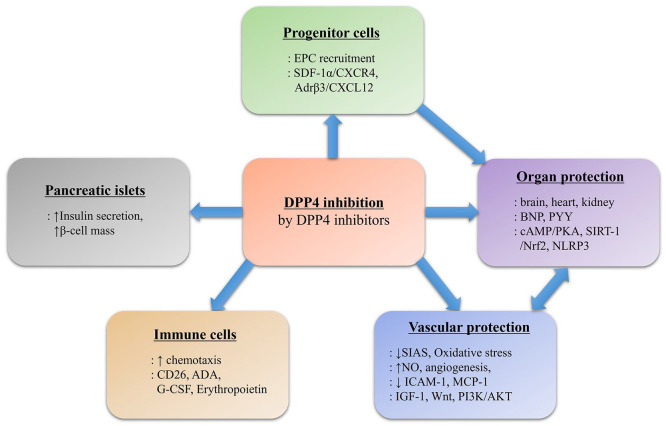
Dipeptidyl peptidase (DPP)-4 inhibitors are oral anti-diabetic medications that block the activity of the ubiquitous enzyme DPP-4. Inhibition of this enzyme increases the level of circulating active glucagon-like peptide (GLP)-1 secreted from L-cells in the small intestine. GLP-1 increases the glucose level, dependent on insulin secretion from pancreatic β-cells; it also decreases the abnormally increased level of glucagon, eventually decreasing the blood glucose level in patients with type 2 diabetes. DPP-4 is involved in many physiological processes other than the degradation of GLP-1. Therefore, the inhibition of DPP-4 may have numerous effects beyond glucose control. In this article, we review the pleiotropic effects of DPP-4 inhibitors beyond glucose control, including their strong beneficial effects on the stress induced accelerated senescence of vascular cells, and the possible clinical implications of these effects.
二肽基肽酶(DPP)-4抑制剂是一类口服抗糖尿病药物,可阻断普遍存在的酶DPP-4的活性。抑制该酶可提高小肠L细胞分泌的循环活性胰高血糖素样肽(GLP)-1的水平。GLP-1可提高血糖水平,这依赖于胰腺β细胞分泌胰岛素;它还可降低异常升高的胰高血糖素水平,最终降低2型糖尿病患者的血糖水平。DPP-4除了参与GLP-1的降解外,还参与许多生理过程。因此,抑制DPP-4可能会产生除血糖控制之外的众多影响。在本文中,我们综述了DPP-4抑制剂在血糖控制之外的多效性作用,包括它们对压力诱导的血管细胞加速衰老的强大有益作用,以及这些作用可能的临床意义。