Huang Shasha, Zhao Guihu, Wu Jie, Li Kuokuo, Wang Qiuquan, Fu Ying, Zhang Honglei, Bi Qingling, Li Xiaohong, Wang Weiqian, Guo Chang, Zhang Dejun, Wu Lihua, Li Xiaoge, Xu Huiyan, Han Mingyu, Wang Xin, Lei Chen, Qiu Xiaofang, Li Yang, Li Jinchen, Dai Pu, Yuan Yongyi
College of Otolaryngology Head and Neck Surgery, Chinese PLA General Hospital, Chinese PLA Medical School, Beijing, China.
National Clinical Research Center for Otolaryngologic Diseases, State Key Lab of Hearing Science, Ministry of Education, Beijing, China.
Front Genet. 2021 Oct 18;12:773009. doi: 10.3389/fgene.2021.773009. eCollection 2021.
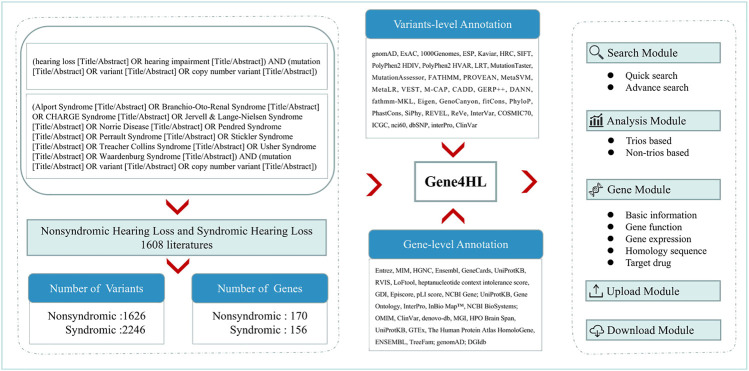
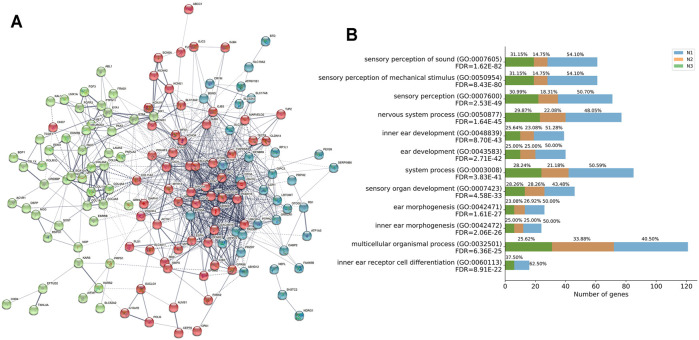
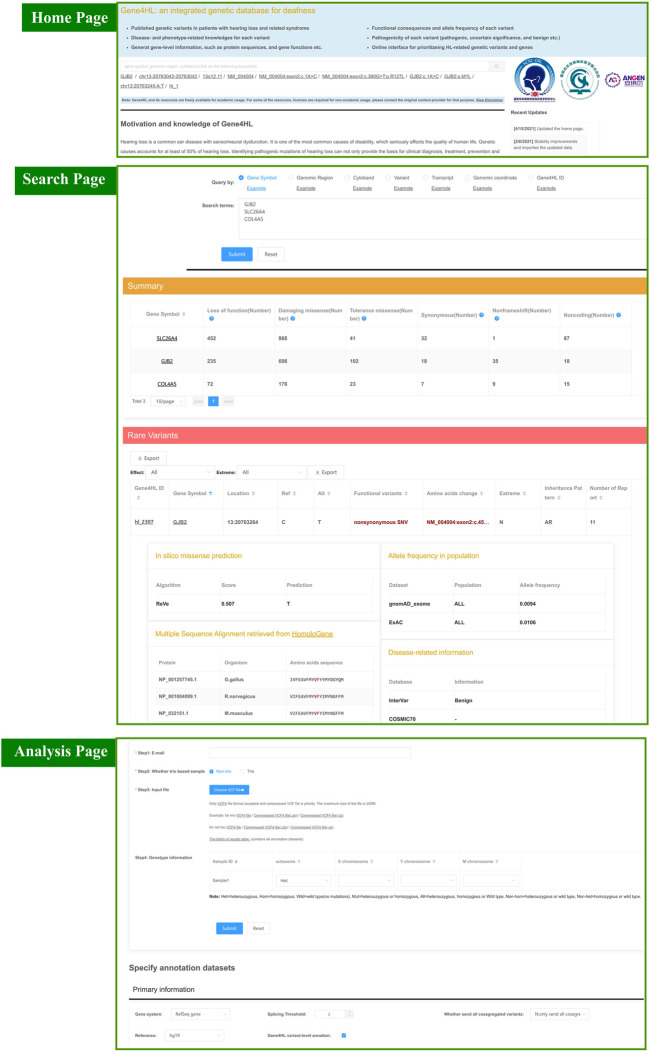
Hearing loss (HL) is one of the most common disabilities in the world. In industrialized countries, HL occurs in 1-2/1,000 newborns, and approximately 60% of HL is caused by genetic factors. Next generation sequencing (NGS) has been widely used to identify many candidate genes and variants in patients with HL, but the data are scattered in multitudinous studies. It is a challenge for scientists, clinicians, and biologists to easily obtain and analyze HL genes and variant data from these studies. Thus, we developed a one-stop database of HL-related genes and variants, Gene4HL (http://www.genemed.tech/gene4hl/), making it easy to catalog, search, browse and analyze the genetic data. Gene4HL integrates the detailed genetic and clinical data of 326 HL-related genes from 1,608 published studies, along with 62 popular genetic data sources to provide comprehensive knowledge of candidate genes and variants associated with HL. Additionally, Gene4HL supports the users to analyze their own genetic engineering network data, performs comprehensive annotation, and prioritizes candidate genes and variations using custom parameters. Thus, Gene4HL can help users explain the function of HL genes and the clinical significance of variants by correlating the genotypes and phenotypes in humans.
听力损失(HL)是世界上最常见的残疾之一。在工业化国家,每1000名新生儿中就有1 - 2人患有HL,并且大约60%的HL是由遗传因素引起的。新一代测序(NGS)已被广泛用于识别HL患者中的许多候选基因和变异,但数据分散在众多研究中。对于科学家、临床医生和生物学家来说,从这些研究中轻松获取和分析HL基因及变异数据是一项挑战。因此,我们开发了一个与HL相关的基因和变异一站式数据库Gene4HL(http://www.genemed.tech/gene4hl/),便于对遗传数据进行编目、搜索、浏览和分析。Gene4HL整合了来自1608项已发表研究的326个与HL相关基因的详细遗传和临床数据,以及62个流行的遗传数据源,以提供与HL相关的候选基因和变异的全面知识。此外,Gene4HL支持用户分析自己的基因工程网络数据,进行全面注释,并使用自定义参数对候选基因和变异进行优先级排序。因此,Gene4HL可以通过关联人类的基因型和表型,帮助用户解释HL基因的功能和变异的临床意义。