Zhou Chuang, Chen Song, Xu Fei, Wei Jinwang, Zhou Xiaoyu, Wu Zhiqiang, Zhao Longshuan, Liu Jun, Guo Wenbo
Department of Hepatobiliary Pancreatic Surgery, the First Affiliated Hospital of Zhengzhou University, Zhengzhou, China.
Department of Radiation Oncology, the First Affiliated Hospital of Sun Yat-sen University, Guangzhou, China.
Ann Transl Med. 2021 Sep;9(18):1437. doi: 10.21037/atm-21-4227.
Tumor mutational burden (TMB) is emerging as a promising biomarker in immune checkpoint inhibitor (ICI) therapy. Despite whole-exome sequencing (WES) being the gold standard for quantifying TMB, TMB is determined by selected targeted panels in most cases, and WES-derived TMB data are lacking due to the greater cost and complexity. Determining TMB thresholds is another issue that needs attention.
A total of 309 patients who had received ICI therapy, representing five cancers (listed in "Results"), were recruited. Among them, 269 patients were evaluable for survival analysis. Tumor and matched blood samples from the patients were analyzed using WES and somatic mutations were determined. TMB is defined as the total number of somatic nonsynonymous mutations in the tumor exome in our study. The patients were divided into different TMB subgroups according to a common fixed number (10 mutations/Mb) or the top tertile within each tumor type.
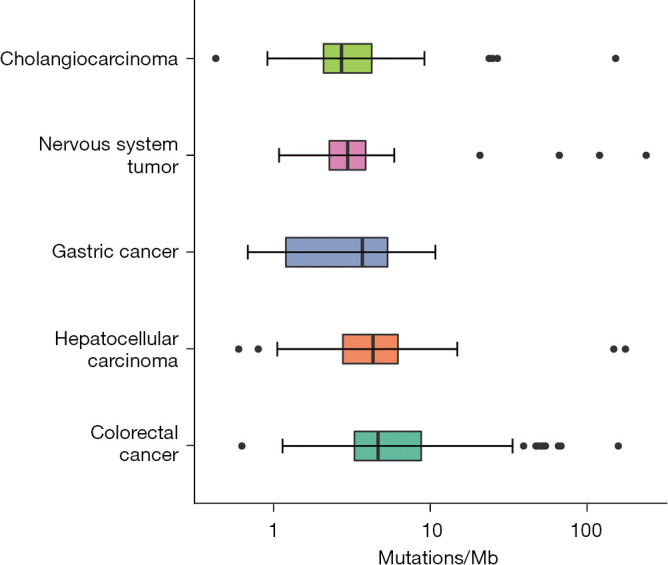
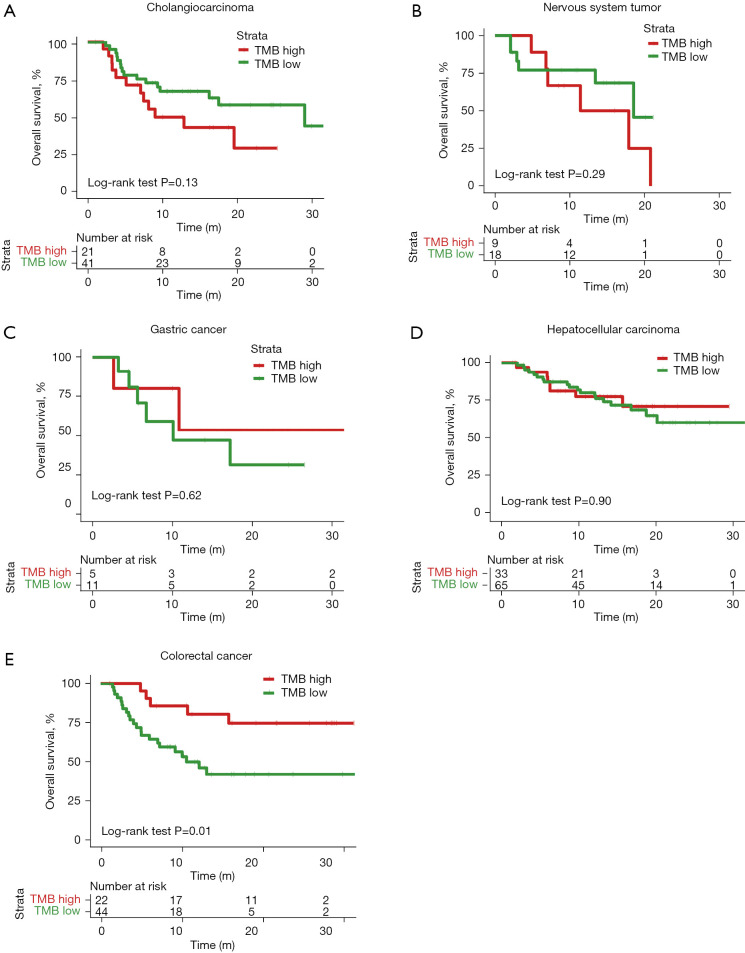
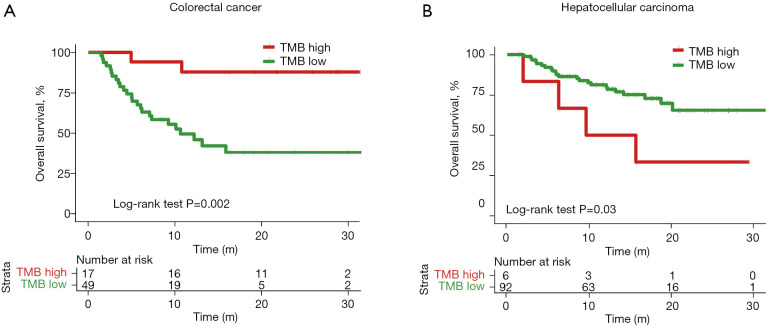
The distribution of WES-derived median TMBs was highly variable across different tumor types, ranging from 2.71 (cholangiocarcinoma) to 2.97 (nervous system tumor), 3.69 (gastric cancer), 4.31 (hepatocellular carcinoma), and 4.64 [colorectal cancer (CRC)] mutations/Mb. In CRC, the survival benefit of TMB-high patients was significant using both the top tertile and the 10 mutations/Mb threshold. In hepatocellular carcinoma, the 10 mutations/Mb threshold showed an advantage over the top tertile threshold. Among patients with nervous system tumors, cholangiocarcinoma, and gastric cancer, no obvious survival differences were observed between the TMB-high and TMB-low groups with either TMB stratification approach.
The TMB threshold criterion may vary for different cancers. Our data suggest that TMB is unable to predict ICI benefit across all cancer types in Chinese patients. However, it may be an effective biomarker for predicting the clinical benefit of ICI therapy for patients with CRC.
肿瘤突变负荷(TMB)正在成为免疫检查点抑制剂(ICI)治疗中一个有前景的生物标志物。尽管全外显子组测序(WES)是量化TMB的金标准,但在大多数情况下TMB是由选定的靶向基因 panel 确定的,并且由于成本更高和操作更复杂,缺乏WES衍生的TMB数据。确定TMB阈值是另一个需要关注的问题。
招募了总共309例接受ICI治疗的患者,代表五种癌症(列于“结果”中)。其中,269例患者可进行生存分析。使用WES分析患者的肿瘤和匹配的血液样本,并确定体细胞突变。在我们的研究中,TMB定义为肿瘤外显子组中体细胞非同义突变的总数。根据共同的固定数量(10个突变/Mb)或每种肿瘤类型内的最高三分位数将患者分为不同的TMB亚组。
WES衍生的中位TMBs在不同肿瘤类型中的分布差异很大,范围从2.71(胆管癌)到2.97(神经系统肿瘤)、3.69(胃癌)、4.31(肝细胞癌)和4.64[结直肠癌(CRC)]个突变/Mb。在CRC中,使用最高三分位数和10个突变/Mb阈值时,TMB高的患者的生存获益均显著。在肝细胞癌中,10个突变/Mb阈值比最高三分位数阈值显示出优势。在神经系统肿瘤、胆管癌和胃癌患者中,无论采用哪种TMB分层方法,TMB高和TMB低的组之间均未观察到明显的生存差异。
不同癌症的TMB阈值标准可能不同。我们的数据表明,TMB无法预测中国患者所有癌症类型的ICI获益。然而,它可能是预测ICI治疗对CRC患者临床获益的有效生物标志物。