Department of Medical Oncology, State Key Laboratory of Oncology in South China, Collaborative Innovation Center for Cancer Medicine, Sun Yat-Sen University Cancer Center, Guangzhou, 510060, People's Republic of China.
Bioinformatics Platform, Department of Experimental Research, State Key Laboratory of Oncology in South China, Collaborative Innovation Center for Cancer Medicine, Sun Yat-Sen University Cancer Center, Guangzhou, 510060, People's Republic of China.
J Immunother Cancer. 2019 Aug 6;7(1):206. doi: 10.1186/s40425-019-0681-2.
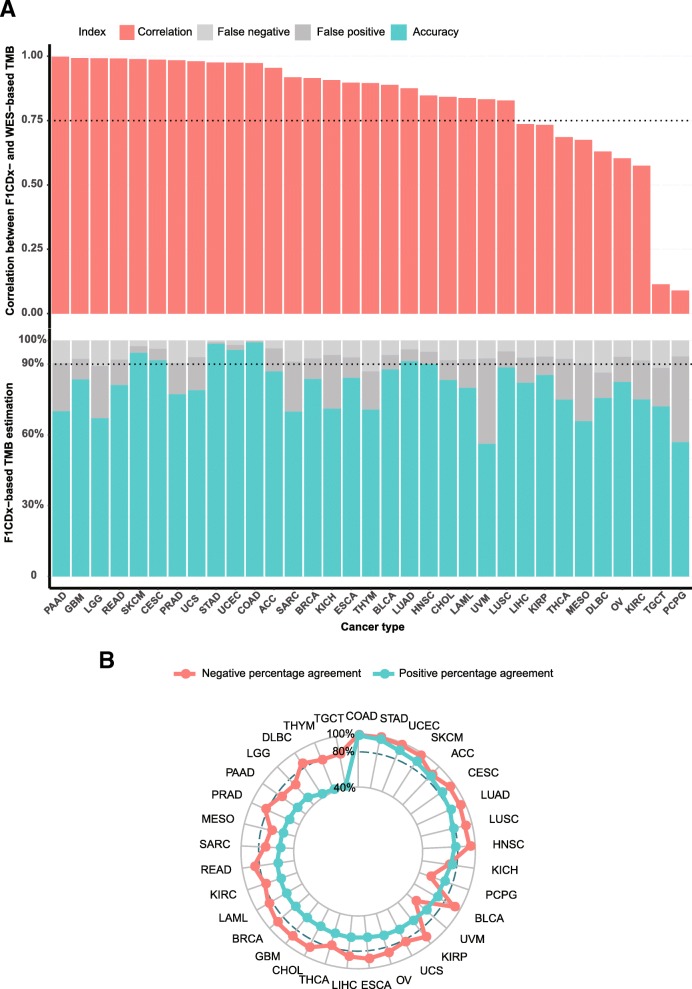
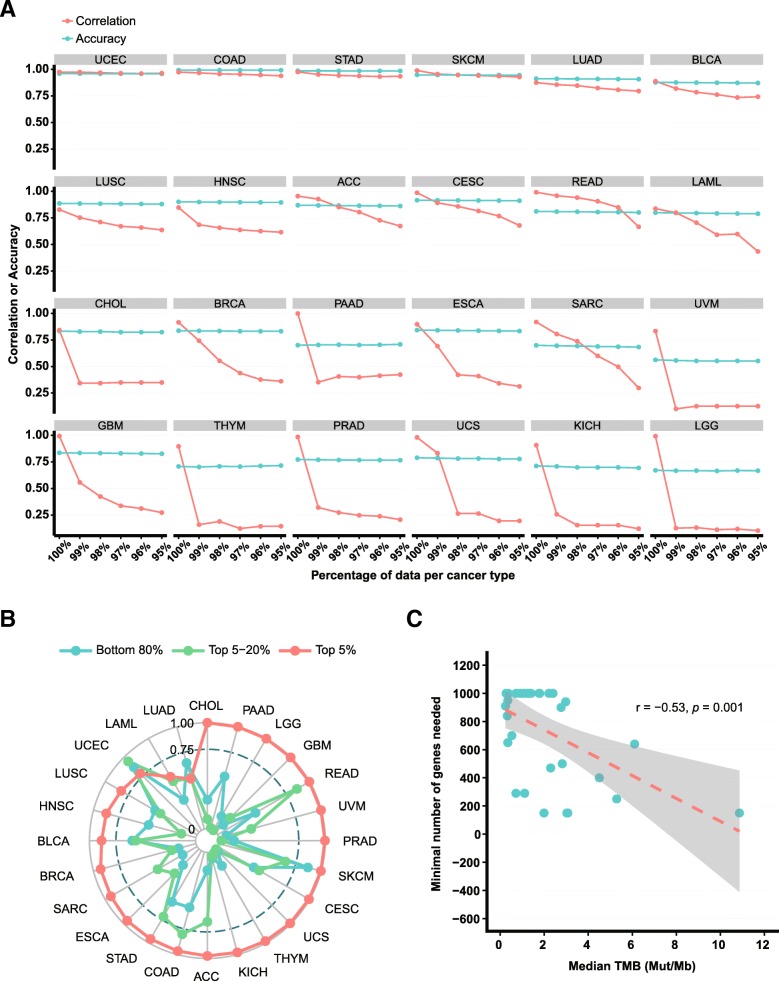
Tumor mutational burden (TMB) assessment is at the forefront in precision medicine. The TMB could represent a biomarker for immune checkpoint inhibitors (ICIs) responses. Whole exome sequencing (WES) is the gold standard to derive the TMB; while targeted next-generation sequencing panels might be more feasible. However, mainstream panels use 'correlation' (R) between panel- and WES-based TMB to validate TMB estimation, which could be vulnerable to be distorted by cases with relatively ultra-high TMB within each cancer type. The FDA-approved FoundationOne CDx (F1CDx) panel-based TMB estimation seemed reliable (R ≥ 0.75) in 24 out of 33 cancer types from the Cancer Genome Atlas, but most of them were overestimated by correlation as only seven cancer types had satisfactory accuracy (the proportion of cases correctly identified as TMB-high or TMB-low using panel-based TMB) above 90%. After removing cases with relatively ultra-high TMB within each cancer type, the correlation (R) in 16 of these 24 cancer types declined dramatically (Δ > 0.25) while all of their accuracy remained generally constant, indicating that accuracy is more robust than correlation. Similar results were also observed in other four panels. Further incorporating accuracy in panel design revealed that the minimal number of genes needed to achieve ≥ 90% accuracy varied among cancer types and correlated negatively with their TMB levels (p = 0.001). In summary, currently available panels can accurately assess TMB only in several particular cancer types; and accuracy outperformed correlation in assessing the performance of panel-based TMB estimation. Accuracy and cancer type individualization should be incorporated in designing panels for TMB estimation.
肿瘤突变负荷 (TMB) 评估是精准医学的前沿领域。TMB 可以作为免疫检查点抑制剂 (ICIs) 反应的生物标志物。全外显子组测序 (WES) 是推导 TMB 的金标准;而靶向下一代测序面板可能更可行。然而,主流面板使用面板和 WES 基于 TMB 的“相关性 (R)”来验证 TMB 估计,这可能容易受到每个癌症类型中相对超高 TMB 病例的影响。美国食品和药物管理局批准的 FoundationOne CDx (F1CDx) 基于面板的 TMB 估计在癌症基因组图谱的 33 种癌症类型中的 24 种中似乎是可靠的 (R≥0.75),但由于只有七种癌症类型的准确性(使用基于面板的 TMB 正确识别 TMB-高或 TMB-低病例的比例)超过 90%,大多数都是通过相关性高估的。在去除每个癌症类型中相对超高 TMB 的病例后,这 24 种癌症类型中的 16 种的相关性 (R) 显著下降(Δ>0.25),而它们的准确性基本保持不变,这表明准确性比相关性更稳健。在其他四个面板中也观察到了类似的结果。进一步将准确性纳入面板设计中表明,实现≥90%准确性所需的最小基因数量因癌症类型而异,并与它们的 TMB 水平呈负相关(p=0.001)。总之,目前可用的面板仅能在几种特定的癌症类型中准确评估 TMB;准确性在评估基于面板的 TMB 估计性能方面优于相关性。准确性和癌症类型个体化应纳入 TMB 估计的面板设计中。