Wang Yao-Ji, Jin Qi-Qi, Zheng Cheng, Lin Jia-Xuan, Lin Yi-Fan, Xu Que, Li Jin, Lin Jia-Feng
Department of Cardiology, The Second Affiliated Hospital and Yuying Children's Hospital of Wenzhou Medical University, Wenzhou, Zhejiang, People's Republic of China.
Int J Gen Med. 2021 Oct 28;14:7337-7348. doi: 10.2147/IJGM.S333093. eCollection 2021.
Coronavirus disease 2019 (COVID-19) was associated with a higher risk of arrhythmia in infected patients. However, there are no reports about the effect of the ongoing pandemic on arrhythmias in the non-infected population. We measured the arrhythmia burden in a non-infected population with cardiac implantable devices.
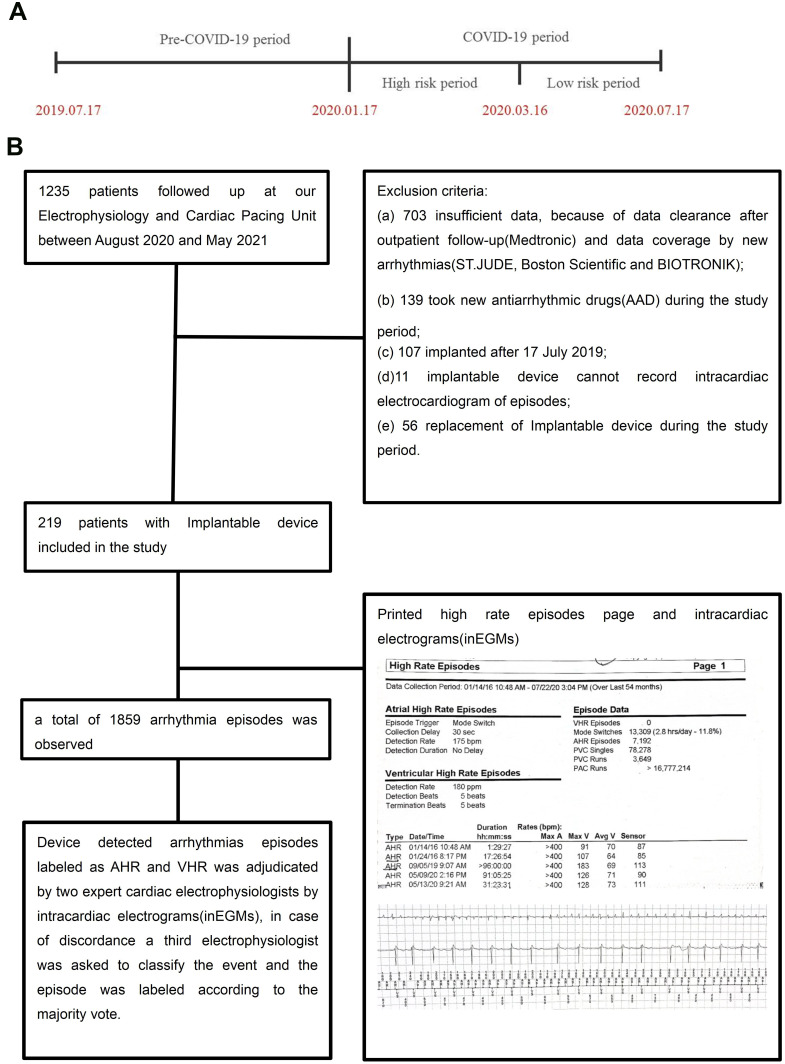
The arrhythmia burden during the COVID-19 pandemic was compared to a 6-month interval in the pre-COVID-19 period. The COVID-19 pandemic was divided into high-risk (17 January 2020 to 16 March 2020) and low-risk periods (17 March 2020 to 17 July 2020) according to whether there were locally infected patients. Arrhythmia burdens were compared among the pre-COVID-19, high-risk, and low-risk periods.
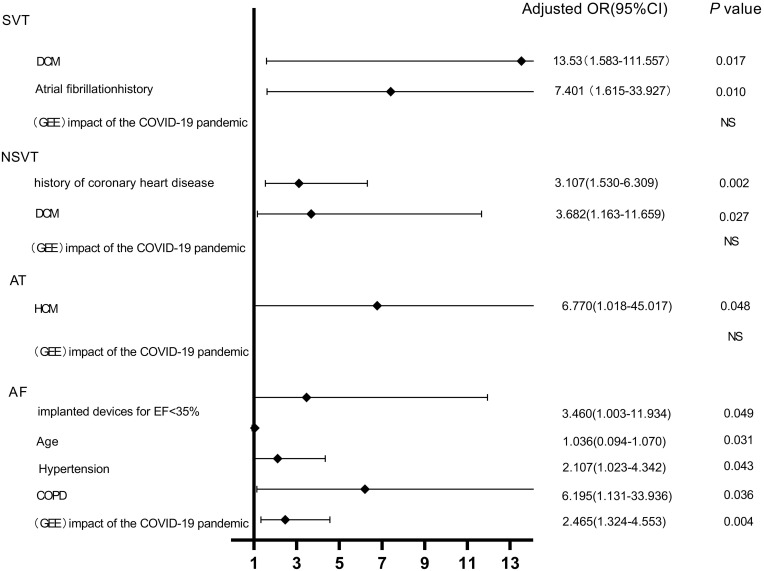
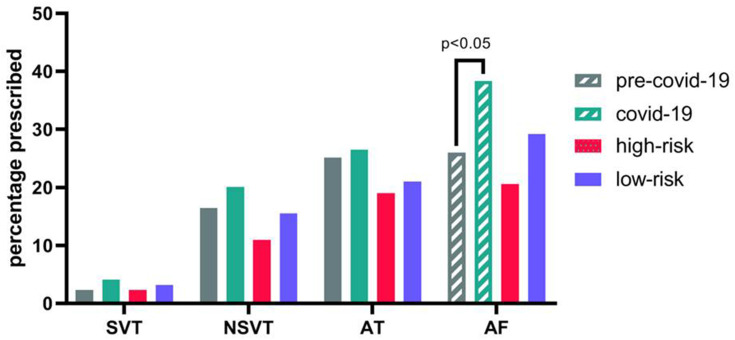
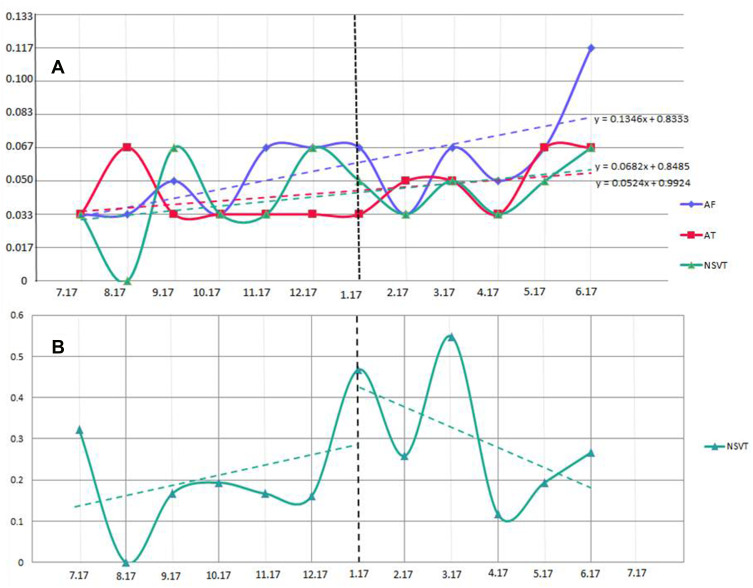
A total of 219 patients with 1859 episodes were included. We observed a larger proportion of patients with atrial fibrillation (AF) during the COVID-19 pandemic (38.36% vs 26.03%, = 0.006). There was not significantly more ventricular arrhythmia during the COVID period than the pre-COVID-19 period ( > 0.05). During the high-risk period, daily frequency of non-sustained ventricular tachycardia (NSVT) (0.0172, 0.0475 vs 0.0109, 0.0164, < 0.05), atrial tachycardia (AT) (0.0345, 0.0518 vs 0.0164, 0.0219 0.05) and AF (0.0345, 0.0432 vs 0.0164, 0.0186, < 0.05) and daily duration of NSVT (0.1982, 0.2845 vs 0.0538, 0.1640 < 0.05) were higher and longer than those in the pre-COVID-19 period. Regression modeling showed that the impact of COVID-19 pandemic lead to an increased onset of AF (odds ratio 2.465; p < 0.01). Patients with paroxysmal AF who had undergone a previous radiofrequency ablation had a lower burden of AF (incidence 21.43% vs 55.00%, = 0.049, daily frequency 0.0000, 0.0027 vs 0.0000, 241.7978, = 0.020) during the pandemic.
The COVID-19 pandemic contributed to a higher burden of arrhythmias in non-infected patients. Patients would experience a lower burden of AF following radiofrequency ablation treatment, and this effect persisted during the pandemic.
2019年冠状病毒病(COVID-19)与感染患者心律失常风险较高相关。然而,尚无关于当前大流行对未感染人群心律失常影响的报道。我们测量了植入心脏植入式设备的未感染人群的心律失常负担。
将COVID-19大流行期间的心律失常负担与COVID-19之前6个月的时间段进行比较。根据是否有本地感染患者,将COVID-19大流行分为高风险期(2020年1月17日至2020年3月16日)和低风险期(2020年3月17日至2020年7月17日)。比较COVID-19之前、高风险期和低风险期的心律失常负担。
共纳入219例患者,发生1859次发作。我们观察到COVID-19大流行期间房颤(AF)患者比例更高(38.36%对26.03%,P = 0.006)。COVID-19期间室性心律失常并不比COVID-19之前显著更多(P>0.05)。在高风险期,非持续性室性心动过速(NSVT)的每日发作频率(0.0172,0.0475对0.0109,0.0164,P<0.05)、房性心动过速(AT)(0.0345,0.0518对0.0164,0.0219,P<0.05)和AF(0.0345,0.0432对0.0164,0.0186,P<0.05)以及NSVT的每日持续时间(0.1982,0.2845对0.0538,0.1640,P<0.05)均高于且长于COVID-19之前的时期。回归模型显示,COVID-19大流行的影响导致AF发作增加(比值比2.465;P<0.01)。既往接受过射频消融的阵发性AF患者在大流行期间AF负担较低(发生率21.43%对55.00%,P = 0.049,每日发作频率0.0000,0.0027对0.0000,241.7978,P = 0.020)。
COVID-19大流行导致未感染患者心律失常负担增加。射频消融治疗后患者AF负担较低,且这种效应在大流行期间持续存在。