Institute for Global Health and Development, The Heller School for Social Policy and Management, Brandeis University, Waltham, Massachusetts, USA.
J Glob Health. 2021 Oct 30;11:04059. doi: 10.7189/jogh.11.04059. eCollection 2021.
Gender inequality and poverty exacerbate the burden of HIV/AIDS among women in Africa. AIDS awareness and educational campaigns have been inadequate in many countries and rates of HIV testing and adherence to condom use remains considerably low, especially among married women. We investigate whether higher HIV knowledge is equally effective in lowering risky behaviors among groups of women with different levels of wealth and agency.
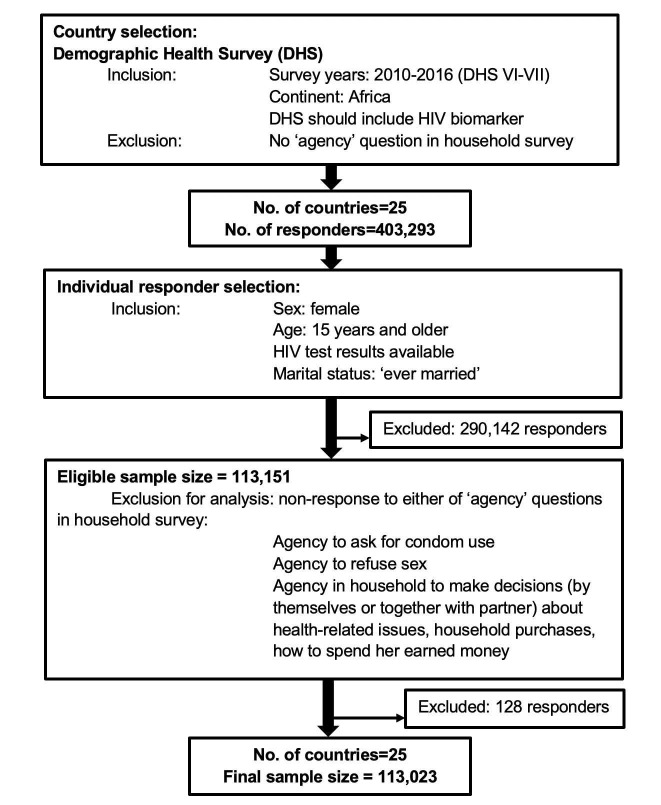
Pooled data on 113 151 adult married women from Demographic and Health Surveys (DHS) in 25 African countries was used (2010 to 2016). Agency was defined as women's ability to refuse sex and ask her partner to use a condom, plus have a role in decision making in household spending and health-related issues. The lowest tertile of DHS wealth index defined poverty. Questions about HIV prevention and mother-to-child transmission were used to create a scale for knowledge (0-5). Use of condom, HIV testing, absence of sexually transmitted disease (STD), and having one partner were dependent variables. Regression models investigated the effect of agency and knowledge as predictors of behaviors. Separate additional models were run to measure associations of each behavior with knowledge scores on groups of women divided by agency and poverty. Analyses were adjusted for demographic factors, history of pregnancy, wife-beating attitude, and country dummies.
Significantly higher risk and lower level of protective factors exist for poor women who lack agency. Knowledge had positive associations with a better score in behavior, higher rate of condom use and testing for HIV both among poor and not poor women. When examining compound effects of agency and poverty, absence of agency reduces the positive effect of knowledge on lowering STD rate and overall behavior score among poor women. It also nullifies the effect of knowledge on condom use in both wealth groups.
Knowledge of HIV does not exert its potential protective effect when women live in poverty compounded with lack of agency. Success of anti-HIV programs should be tailored to dynamics of risk and sociocultural and economic context of target populations.
在非洲,性别不平等和贫困使妇女感染艾滋病的负担更加沉重。许多国家的艾滋病意识和教育活动都不足,艾滋病毒检测率和避孕套使用率仍然相当低,尤其是已婚妇女。我们调查了在财富和代理机构水平不同的妇女群体中,更高的艾滋病知识是否同样能有效降低危险行为的发生。
利用来自 25 个非洲国家的人口与健康调查(DHS)中 113151 名成年已婚妇女的汇总数据(2010 年至 2016 年)。代理机构被定义为妇女拒绝性行为和要求其伴侣使用避孕套的能力,以及在家庭支出和与健康相关的问题上做出决策的角色。DHS 财富指数的最低三分位数定义为贫困。关于艾滋病毒预防和母婴传播的问题被用来创建一个知识量表(0-5)。避孕套使用、艾滋病毒检测、无性传播疾病(STD)和有一个伴侣是因变量。回归模型调查了代理机构和知识作为行为预测因素的影响。另外还单独运行了一些模型,以衡量按代理机构和贫困程度划分的妇女群体中每种行为与知识得分的关联。分析调整了人口因素、怀孕史、打老婆态度和国家哑变量。
缺乏代理机构的贫困妇女面临更高的风险和更低水平的保护因素。知识与行为得分较高、避孕套使用和艾滋病毒检测率较高均呈正相关,无论妇女是否贫困。当考察代理机构和贫困的综合效应时,缺乏代理机构会降低知识对降低 STD 发生率和贫困妇女整体行为得分的积极影响。它还使知识对两个财富群体的避孕套使用的影响无效。
当妇女生活在贫困中且缺乏代理机构时,艾滋病知识并不能发挥其潜在的保护作用。抗艾滋病计划的成功应该根据目标人群的风险动态和社会文化经济背景进行调整。