Department of Pathology and Molecular Diagnostics, Graduate School of Medical Sciences, Nagoya City University, Nagoya, Japan.
Department of Immunology, Nagoya University Graduate School of Medicine, Nagoya, Japan.
Cancer Sci. 2022 Jan;113(1):349-361. doi: 10.1111/cas.15191. Epub 2021 Nov 29.
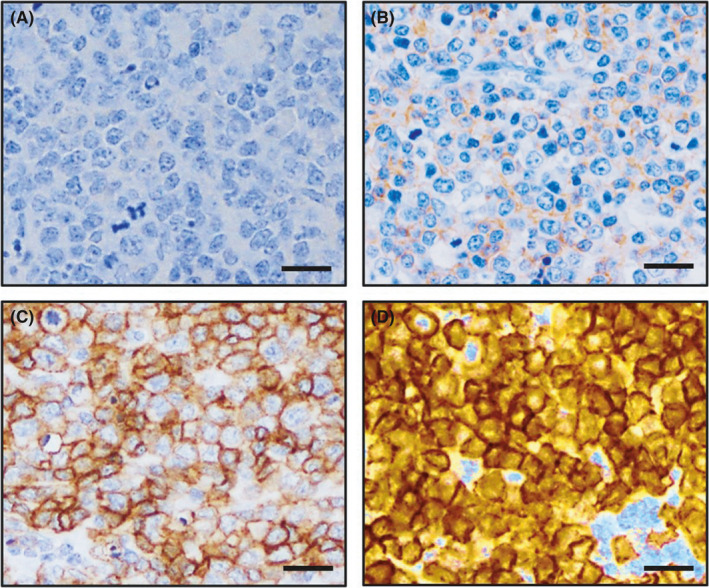
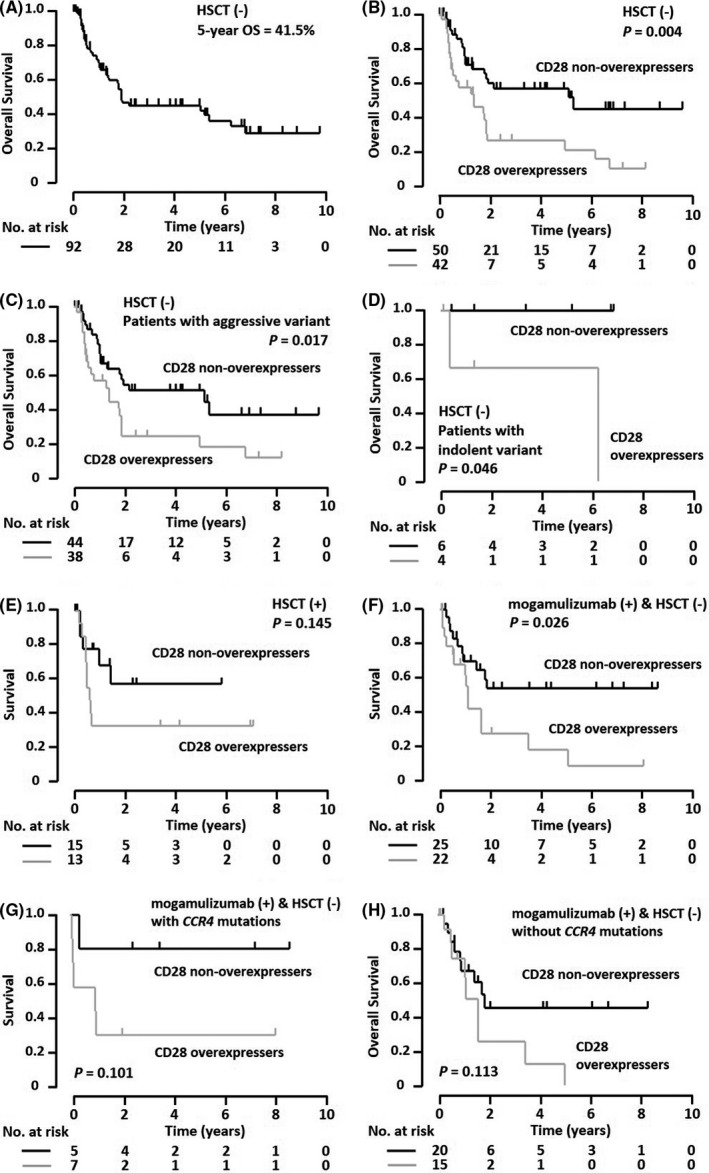
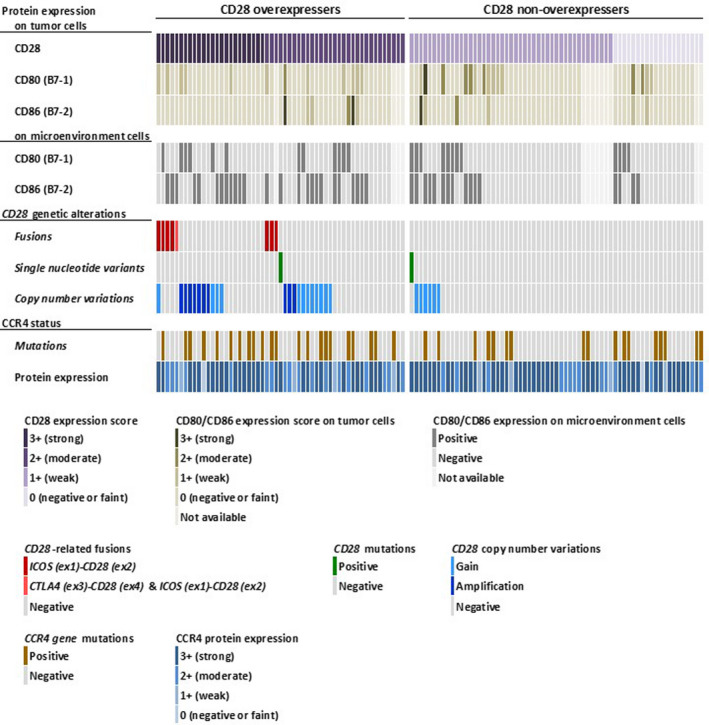
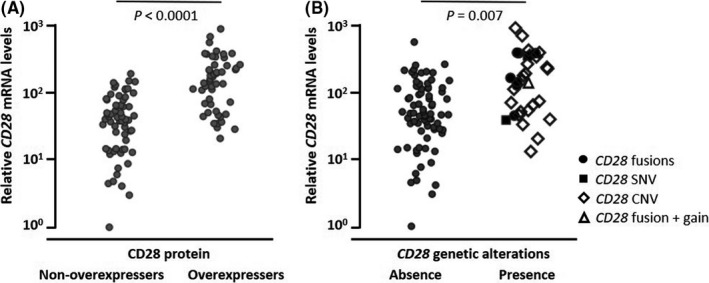
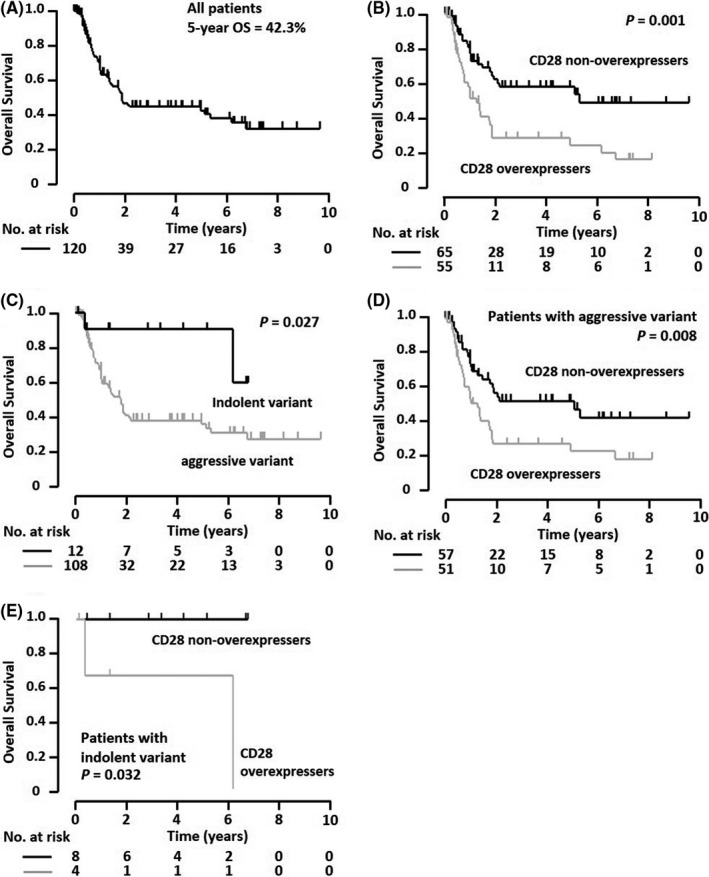
CD28, one of the costimulatory molecules, has a pivotal role in T-cell activation, and its expression is strictly regulated in normal T cells. Gain-of-function genetic alterations involving CD28 have been frequently observed in adult T-cell leukemia/lymphoma (ATLL). These abnormalities, such as CD28 fusions and copy number variations, may not only confer continuous, prolonged, and enhanced CD28 signaling to downstream pathways but also induce overexpression of the CD28 protein. In this study, 120 ATLL cases were examined by immunohistochemistry for CD28 and its ligands CD80 and CD86, and their expression on tumor cells was semiquantitatively evaluated. CD28 was overexpressed in 55 (46%) cases, and CD80 or CD86 (CD80/CD86) was infrequently overexpressed in 12 (11%). Compared with non-overexpressers, CD28 overexpressers showed a higher frequency of CD28 genetic alterations and had an increased number of CD80/CD86-positive non-neoplastic cells infiltrating tumor microenvironment. In the entire ATLL patient cohort, CD28 overexpressers showed a significantly poorer overall survival (OS) compared with non-overexpressers (P = .001). The same was true for a subgroup who were treated with multidrug regimens with or without mogamulizumab. CD28 overexpression had no prognostic impact in the group who received allogeneic hematopoietic stem cell transplantation. In the multivariate analysis for OS, CD28 overexpression was selected as an independent risk factor. These results suggest ATLL patients with CD28 overexpression have more aggressive clinical course and are more refractory to treatment with multidrug chemotherapy. CD28 overexpression appears to be a novel unfavorable prognostic marker in ATLL patients, and further prospective studies are warranted to establish its prognostic significance.
CD28 是一种共刺激分子,在 T 细胞激活中起关键作用,其表达在正常 T 细胞中受到严格调控。在成人 T 细胞白血病/淋巴瘤(ATLL)中,经常观察到涉及 CD28 的功能获得性遗传改变。这些异常,如 CD28 融合和拷贝数变异,不仅可以向下游途径提供持续、延长和增强的 CD28 信号,还可以诱导 CD28 蛋白的过度表达。在这项研究中,通过免疫组织化学检查了 120 例 ATLL 病例的 CD28 及其配体 CD80 和 CD86,并对半定量评估了肿瘤细胞上的表达。CD28 在 55 例(46%)病例中过表达,CD80 或 CD86(CD80/CD86)在 12 例(11%)病例中过表达。与非过表达者相比,CD28 过表达者具有更高频率的 CD28 遗传改变,并且肿瘤微环境中浸润的 CD80/CD86 阳性非肿瘤细胞数量增加。在整个 ATLL 患者队列中,与非过表达者相比,CD28 过表达者的总生存(OS)显著更差(P=.001)。在接受多药方案治疗(联合或不联合 mogamulizumab)的亚组中也是如此。CD28 过表达对接受异基因造血干细胞移植的患者没有预后影响。在 OS 的多变量分析中,CD28 过表达被选为独立的危险因素。这些结果表明,CD28 过表达的 ATLL 患者具有更具侵袭性的临床病程,并且对多药化疗更具抗性。CD28 过表达似乎是 ATLL 患者的一种新的不良预后标志物,需要进一步的前瞻性研究来确定其预后意义。