Department of Medical Oncology, Institut Bergonié, University of Bordeaux, INSERM, Unité ACTION U1218, Bordeaux, France.
University of Bordeaux, Inserm, Bordeaux Population Health Research Center, UMR 1219, CIC-EC 1401/EUCLID Clinical Trials Platform, Bordeaux, France.
BMC Cancer. 2021 Nov 5;21(1):1180. doi: 10.1186/s12885-021-08878-2.
Soft-tissue sarcomas (STS) represent a heterogeneous group of rare tumors including more than 70 different histological subtypes. High throughput molecular analysis (next generation sequencing exome [NGS]) is a unique opportunity to identify driver mutations that can change the usual one-size-fits-all treatment paradigm to a patient-driven therapeutic strategy. The primary objective of the MULTISARC trial is to assess whether NGS can be conducted for a large proportion of metastatic STS participants within a reasonable time, and, secondarily to determine whether a NGS-guided therapeutic strategy improves participant's outcome.
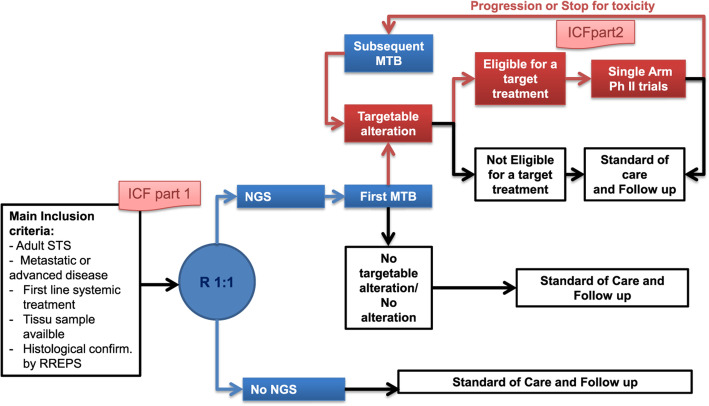
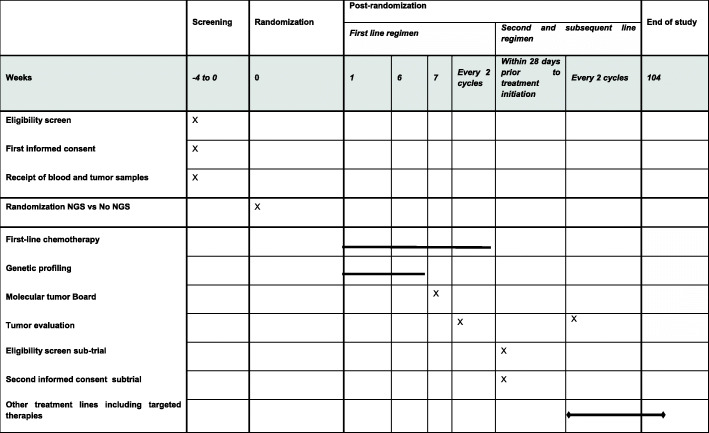
This is a randomized, multicentre, phase II/III trial inspired by the design of umbrella and biomarker-driven trials. The setting plans up to 17 investigational centres across France and the recruitment of 960 participants. Participants aged at least 18 years, with unresectable locally advanced and/or metastatic STS confirmed by the French sarcoma pathological reference network, are randomized according to 1:1 allocation ratio between the experimental arm "NGS" and the standard "No NGS". NGS will be considered feasible if (i) NGS results are available and interpretable, and (ii) a report of exome sequencing including a clinical recommendation from a multidisciplinary tumor board is provided to investigators within 7 weeks from reception of the samples on the biopathological platform. A feasibility rate of more than 70% is expected (null hypothesis: 70% versus alternative hypothesis: 80%). In terms of care, participants randomized in "No NGS" arm and who fail treatment will be able to switch to the NGS arm at the request of the investigator.
The MULTISARC trial is a prospective study designed to provide high-level evidence to support the implementation of NGS in routine clinical practice for advanced STS participants, on a large scale.
clinicaltrial.gov NCT03784014 .
软组织肉瘤(STS)是一组异质性罕见肿瘤,包括 70 多种不同的组织学亚型。高通量分子分析(下一代测序外显子组[NGS])是一个独特的机会,可以识别驱动突变,从而改变通常的一刀切治疗模式,转向基于患者的治疗策略。MULTISARC 试验的主要目的是评估 NGS 是否可以在合理的时间内对大量转移性 STS 参与者进行检测,其次是确定 NGS 指导的治疗策略是否能改善参与者的结果。
这是一项基于伞式和生物标志物驱动试验设计的随机、多中心、二期/三期试验。该试验计划在法国设立多达 17 个研究中心,并招募 960 名参与者。年龄至少 18 岁,经法国肉瘤病理参考网络确认患有不可切除的局部晚期和/或转移性 STS 的参与者,按照 1:1 的比例随机分配到实验组“NGS”和标准组“无 NGS”。如果(i)NGS 结果可用且可解释,以及(ii)从生物病理学平台收到样本后 7 周内,多学科肿瘤委员会提供包括外显子组测序临床建议的报告,则认为 NGS 是可行的。预计可行性率超过 70%(零假设:70%与替代假设:80%)。在护理方面,随机分配到“无 NGS”组且治疗失败的参与者可以根据研究者的要求转至 NGS 组。
MULTISARC 试验是一项前瞻性研究,旨在提供高水平的证据,支持在大规模情况下将 NGS 常规应用于晚期 STS 患者的临床实践。
clinicaltrial.gov NCT03784014。