Mousavi Seyedeh Robab, Amiri-Farahani Leila, Hasanpoor-Azghady Syedeh Batool, Saravi Soghra Omrani
Department of Reproductive Health and Midwifery, School of Nursing and Midwifery, Iran University of Medical Sciences, Tehran, Iran.
Department of Reproductive Health and Midwifery, Nursing Care Research Center (NCRC), School of Nursing and Midwifery, Iran University of Medical Sciences, Tehran, Iran.
Pilot Feasibility Stud. 2021 Nov 5;7(1):194. doi: 10.1186/s40814-021-00933-w.
Childbirth preparation trainings are an important component of prenatal education, and pregnant women are increasingly interested in seeking information from online sources. The aim of this study is to compare the feasibility and the effects of in-person and virtual childbirth preparation training courses on the pregnancy experience, fear of childbirth (FOC), birth preference, and type of delivery among pregnant women.
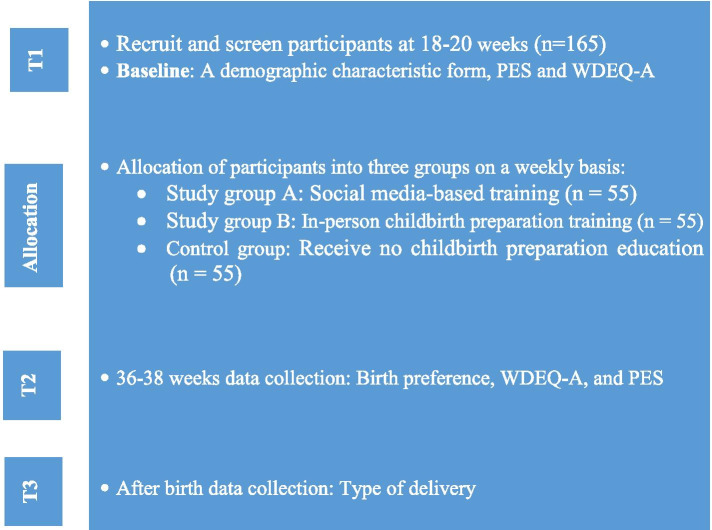
In total, 165 primiparous women referring to a prenatal clinic at Milad Hospital in Tehran, will be included in this study. The subjects will be selected using the convenience sampling method and will be divided into three groups of study A, study B, and control. The study groups A and B will receive virtual and in-person childbirth training with similar content, respectively. The control group will receive only routine prenatal care. In the 18th and 20th weeks of pregnancy, the demographic information, pregnancy experience scale (PES), and version A of the Wijma delivery expectancy/experience questionnaire (WDEQ-A) will be completed, and in the 36th and 38th weeks of pregnancy, the PES and WDEQ-A questionnaires, as well as birth preference form will be completed. The type of delivery will be recorded in the first few days of postpartum.
This quasi-experimental clinical trial will investigate the effect of virtual childbirth preparation training on primiparous women. The expected outcomes will include the difference in pregnancy experience measured by the brief version of PES, the difference in FOC measured by WDEQ-A, the birth preference, and the type of delivery.
IRCT.ir: IRCT20180427039436N2.
分娩准备培训是产前教育的重要组成部分,孕妇越来越有兴趣从在线资源获取信息。本研究的目的是比较面对面和虚拟分娩准备培训课程对孕妇的妊娠体验、分娩恐惧(FOC)、分娩偏好和分娩方式的可行性和效果。
本研究共纳入165名在德黑兰米拉德医院产前诊所就诊的初产妇。采用便利抽样法选取研究对象,并将其分为研究A组、研究B组和对照组。研究A组和B组将分别接受内容相似的虚拟和面对面分娩培训。对照组仅接受常规产前护理。在妊娠第18周和第20周,完成人口统计学信息、妊娠体验量表(PES)和Wijma分娩预期/体验问卷A版(WDEQ-A),在妊娠第36周和第38周,完成PES和WDEQ-A问卷以及分娩偏好表。分娩方式将在产后头几天记录。
这项准实验性临床试验将研究虚拟分娩准备培训对初产妇的影响。预期结果将包括通过PES简版测量的妊娠体验差异、通过WDEQ-A测量的FOC差异以及分娩偏好和分娩方式。
IRCT.ir:IRCT20180427039436N2。