Department of Entomology, The Pennsylvania State University, 501 ASI Bldg., University Park, PA, 16802, USA.
Department of Physiology, Institute of Biosciences, University of São Paulo, Rua do Matão 101, Tv 14, São Paulo, 05508-090, Brazil.
Sci Rep. 2021 Nov 5;11(1):21710. doi: 10.1038/s41598-021-00248-z.
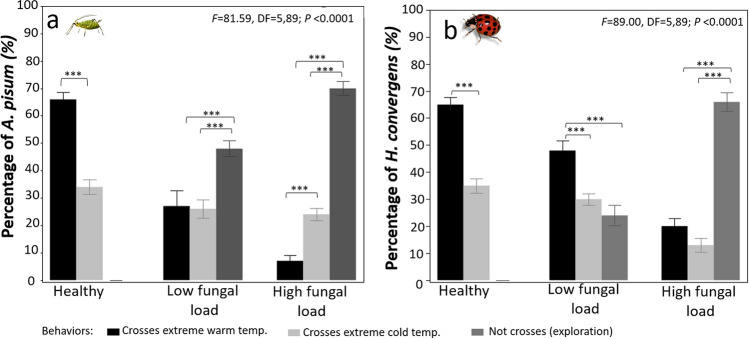
Pathogens can modify many aspects of host behavior or physiology with cascading impacts across trophic levels in terrestrial food webs. These changes include thermal tolerance of hosts, however the effects of fungal infections on thermal tolerances and behavioral responses to extreme temperatures (ET) across trophic levels have rarely been studied. We examined how a fungal pathogen, Beauveria bassiana, affects upper and lower thermal tolerance, and behavior of an herbivorous insect, Acyrthosiphon pisum, and its predator beetle, Hippodamia convergens. We compared changes in thermal tolerance limits (CT and CT), thermal boldness (voluntary exposure to ET), energetic cost (ATP) posed by each response (thermal tolerance and boldness) between healthy insects and insects infected with two fungal loads. Fungal infection reduced CT of both aphids and beetles, as well as CT of beetles. Fungal infection modified the tendency, or boldness, of aphids and predator beetles to cross either warm or cold ET zones (ETZ). ATP levels increased with pathogen infection in both insect species, and the highest ATP levels were found in individuals that crossed cold ETZ. Fungal infection narrowed the thermal tolerance range and inhibited thermal boldness behaviors to cross ET. As environmental temperatures rise, response to thermal stress will be asymmetric among members of a food web at different trophic levels, which may have implications for predator-prey interactions, food web structures, and species distributions.
病原体可以通过级联效应对陆地食物网中的营养级产生影响,从而改变宿主行为或生理的许多方面。这些变化包括宿主的耐热性,然而,真菌感染对热耐受性以及对极端温度(ET)的行为反应的影响在营养级之间很少被研究。我们研究了一种真菌病原体,球孢白僵菌,如何影响草食性昆虫桃蚜及其捕食性甲虫异色瓢虫的上热和下热耐受性以及行为。我们比较了健康昆虫和感染两种真菌负荷的昆虫之间热耐受极限(CT 和 CT)、热勇敢(自愿暴露于 ET)以及每种反应(热耐受和勇敢)的能量成本(ATP)的变化。真菌感染降低了蚜虫和甲虫的 CT,以及甲虫的 CT。真菌感染改变了蚜虫和捕食性甲虫穿越温暖或寒冷 ETZ 的倾向或勇敢程度。在两种昆虫中,ATP 水平随着病原体感染而增加,而在穿越寒冷 ETZ 的个体中发现了最高的 ATP 水平。真菌感染缩小了热耐受范围,并抑制了穿越 ET 的热勇敢行为。随着环境温度的升高,食物网中不同营养级成员对热胁迫的反应将不对称,这可能对捕食者-猎物相互作用、食物网结构和物种分布产生影响。