Department of Psychology, University of Calgary.
Alberta Children's Hospital Research Institute.
Clin J Pain. 2021 Nov 8;38(2):95-107. doi: 10.1097/AJP.0000000000001002.
Adverse childhood experiences (ACEs; ie, exposure to abuse, neglect, household dysfunction in childhood) are associated with poor mental and physical health outcomes across the lifespan. Emerging research suggests parent ACEs also confer risk for poor child outcomes. The relation between parent ACEs and child pain in youth with chronic pain has not yet been examined. The aim of the current longitudinal study was to examine the associations among parent ACEs, parent health, and child pain, in a clinical sample of youth with chronic pain.
In total, 192 youth (75.5% female, 10 to 18 y old) and one of their parents (92.2% female) were recruited from tertiary pediatric chronic pain clinics in Canada. At baseline, parents completed self-report measures of ACEs, chronic pain status, anxiety and depressive symptoms, and posttraumatic stress disorder symptoms. At a 3-month follow-up, youth completed self-report measures of pain intensity and pain interference.
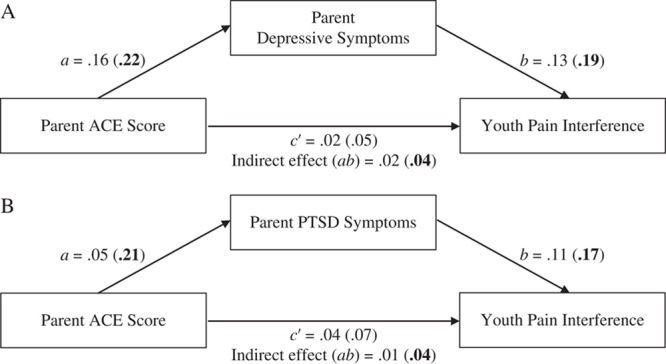
Regression and mediation analyses revealed that parent ACEs significantly predicted parent chronic pain status and depressive symptoms, but not parent anxiety or posttraumatic stress disorder symptoms. Moreover, parent ACEs were not significantly related to youth pain, either directly or indirectly through parent health variables.
Findings suggest that an intergenerational cascade from parent ACEs to parent health to child pain was not present in the current sample. Further research that examines the role of parent ACEs in the development of child chronic pain, as well as other risk and resiliency factors that may mediate or moderate the association between parent ACEs and child chronic pain, is needed.
童年逆境经历(ACEs;即儿童期遭受虐待、忽视和家庭功能障碍)与整个生命周期的身心健康不良结局有关。新出现的研究表明,父母 ACEs 也会给孩子带来不良后果的风险。父母 ACEs 与患有慢性疼痛的青年儿童疼痛之间的关系尚未得到研究。本纵向研究的目的是在患有慢性疼痛的青年临床样本中,研究父母 ACEs、父母健康与儿童疼痛之间的关系。
共有 192 名青少年(75.5%为女性,年龄 10 至 18 岁)及其父母中的一位(92.2%为女性)参加了来自加拿大三级儿科慢性疼痛诊所的研究。在基线时,父母完成了 ACEs、慢性疼痛状况、焦虑和抑郁症状以及创伤后应激障碍症状的自我报告测量。在 3 个月的随访中,青少年完成了疼痛强度和疼痛干扰的自我报告测量。
回归和中介分析显示,父母 ACEs 显著预测了父母的慢性疼痛状况和抑郁症状,但不能预测父母的焦虑或创伤后应激障碍症状。此外,父母 ACEs 与青少年疼痛没有直接或间接的关系,无论是通过父母健康变量还是其他风险和恢复力因素。
研究结果表明,在当前样本中,父母 ACEs 到父母健康到儿童疼痛的代际级联并不存在。需要进一步研究父母 ACEs 在儿童慢性疼痛发展中的作用,以及可能调节父母 ACEs 与儿童慢性疼痛之间关联的其他风险和恢复力因素。