Serra-Pujadas Sara, Alonso-Buxadé Cristina, Serra-Colomer Júlia, Folguera Júlia, Carrilero Neus, García-Altés Anna
Facultat d'Economia i Empresa, Universitat Pompeu Fabra, Barcelona, Spain.
Agència de Qualitat i Avaluació Sanitàries de Catalunya (AQuAS), Barcelona, Spain.
Front Pharmacol. 2021 Oct 21;12:750193. doi: 10.3389/fphar.2021.750193. eCollection 2021.
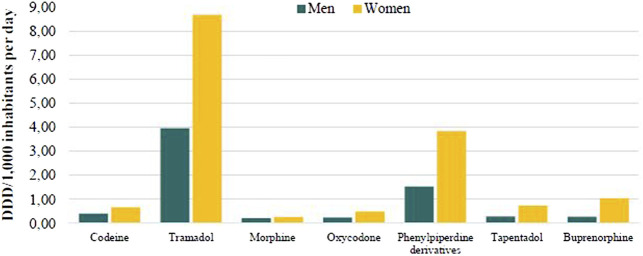
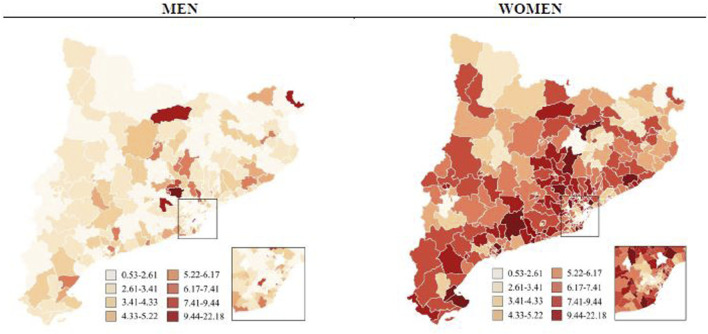
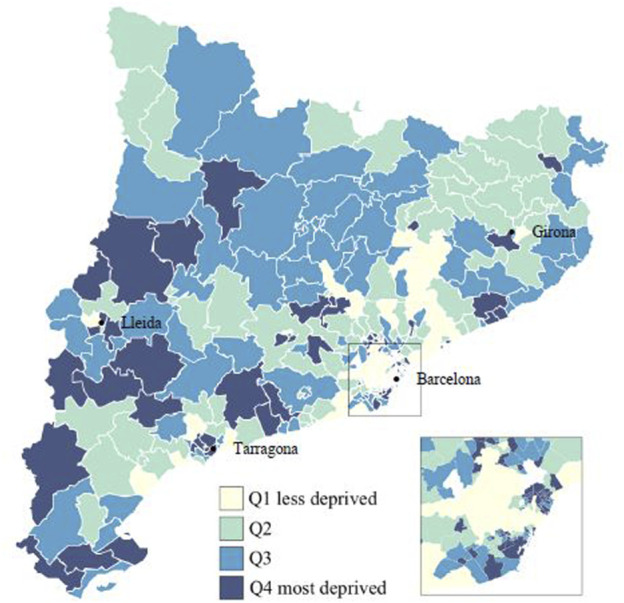
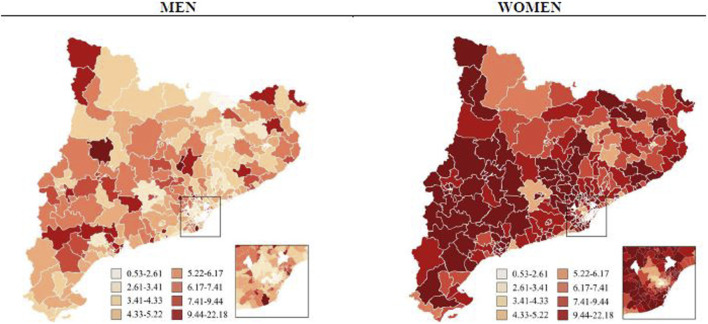
In recent years, worldwide opioid use has seen a sharp increase, especially for the treatment of chronic non-cancer pain. Catalonia is no exception to this trend. However, no recent studies have addressed the socioeconomic and gender inequalities in opioid use in the different geographical areas of Catalonia. We performed an ecological study to analyse the associations between socioeconomic status, gender and the use of opioids in the 372 Health Areas of Catalonia. Robust Poisson models were performed to analyse the data provided from the Central Register of Insured Persons and dispensing data from the Electronic Prescription Database. The results show that socioeconomic status has a major impact on opioid use, with the most deprived areas presenting the highest levels of use. There are major inequalities in the DDD/1,000 inhabitants per areas. Moreover, women have much higher utilization rates than men, especially in more deprived areas. The greatest difference is observed in the use of weak opioids in women: the DDD/1,000 inhabitants per day was 2.34 in the area with the lowest use, compared with 22.18 in the area with the highest use. Our findings suggest that stronger action is needed to promote best practices in prescribing for chronic pain and to reduce socioeconomic and gender variation between geographical areas. This study provides a model for routine monitoring of opioid prescription for targeted interventions aimed at lowering high-dose consumption in specifically identified areas.
近年来,全球阿片类药物的使用急剧增加,尤其是在慢性非癌性疼痛的治疗方面。加泰罗尼亚也不例外。然而,最近尚无研究探讨加泰罗尼亚不同地理区域在阿片类药物使用方面的社会经济和性别不平等问题。我们开展了一项生态研究,以分析加泰罗尼亚372个健康区域的社会经济地位、性别与阿片类药物使用之间的关联。我们运用稳健泊松模型对参保人员中央登记册提供的数据以及电子处方数据库的配药数据进行分析。结果显示,社会经济地位对阿片类药物的使用有重大影响,贫困程度最高的地区阿片类药物使用水平也最高。各区域每1000名居民的限定日剂量(DDD)存在重大不平等。此外,女性的使用率远高于男性,尤其是在贫困程度较高的地区。在弱阿片类药物的使用方面,女性的差异最为明显:日使用量最低的地区每1000名居民的DDD为2.34,而最高的地区为22.18。我们的研究结果表明,需要采取更有力的行动,以推广慢性疼痛处方的最佳做法,并减少不同地理区域之间的社会经济和性别差异。本研究为阿片类药物处方的常规监测提供了一个模型,以便在特定区域进行有针对性的干预,降低高剂量消费。