Nazeri Zahra, Azizidoost Shirin, Cheraghzadeh Maryam, Mohammadi Asma, Kheirollah Alireza
Department of Biochemistry, Medical School, Ahvaz Jundishapur University of Medical Sciences, Ahvaz, Iran.
Department of Biochemistry, Medical School, Cellular & Molecular Research Center, Medical Basic Sciences Research Institute, Ahvaz Jundishapur University of Medical Sciences, Ahvaz, Iran.
Avicenna J Phytomed. 2021 Sep-Oct;11(5):473-483. doi: 10.22038/AJP.2021.17834.
Regulation of cholesterol level is essential for the brain optimal function. The beneficial effect of garlic consumption on cholesterol homeostasis is well known; however, the molecular mechanism to support its properties is unclear. Here, we investigated the beneficial effect of aqueous extract of garlic and allicin on lipid profile and the main players involved in brain cholesterol homeostasis including ABCA1, HMG-CoA reductase, and CYP46A1 in both C57BL/6J mice brain and astrocytes.
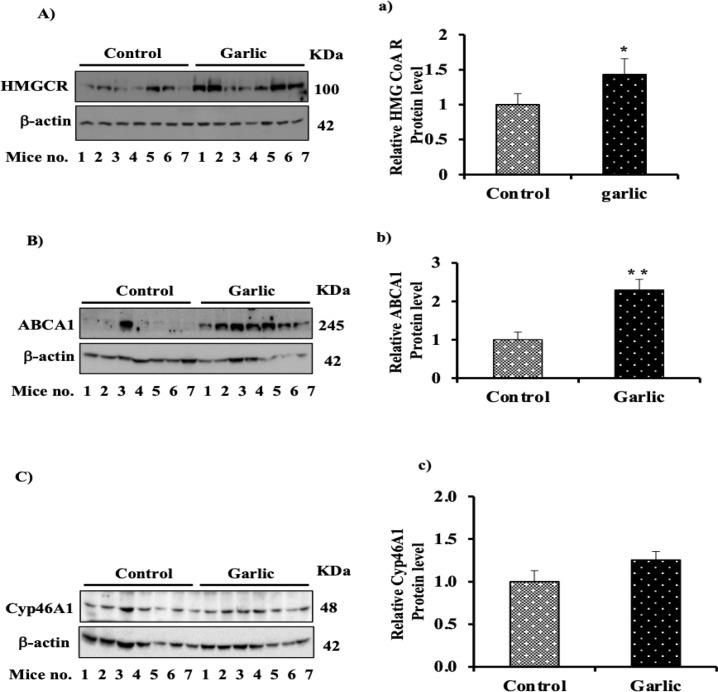
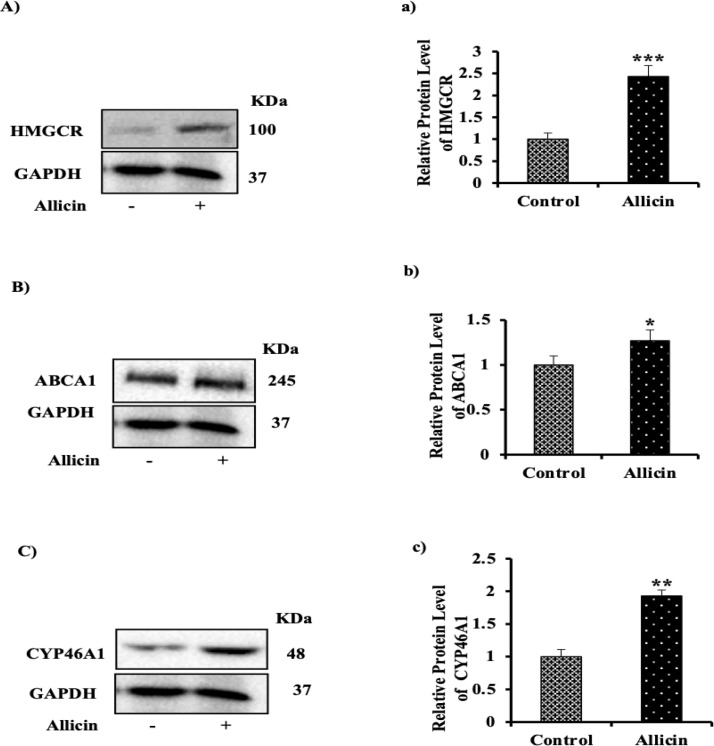
Thirty mice were divided into control and garlic groups. Garlic group was fed with the aqueous extract of garlic. Serum lipids were measured and brain protein levels of ABCA1, HMGCR, and CYP46A1 were determined by western blotting. Changes in these proteins expression were also studied in the presence of allicin in cultured astrocytes.
A moderate decrease in serum total cholesterol and a significant increase in plasma HDL-C levels (p<0.05) were detected. A significant increase in ABCA1, HMGCR, and CYP46A1 protein levels was observed in the garlic group and in the cultured astrocytes treated with allicin by western blotting (p<0.05).
Our findings indicated that the main players involved in cholesterol turnover including HMGCR that is involved in cholesterol synthesis, ABCA1 that is important in cholesterol efflux, and CYP46A1 that is necessary in cholesterol degradation, were up regulated by garlic/allicin in both animal and cell culture model. We concluded that increasing cholesterol turnover is a possible mechanism for the beneficial effects of garlic in cholesterol homeostasis.
调节胆固醇水平对大脑的最佳功能至关重要。食用大蒜对胆固醇稳态的有益作用是众所周知的;然而,支持其特性的分子机制尚不清楚。在这里,我们研究了大蒜水提取物和大蒜素对C57BL/6J小鼠大脑和星形胶质细胞中脂质谱以及参与大脑胆固醇稳态的主要因子(包括ABCA1、HMG-CoA还原酶和CYP46A1)的有益作用。
将30只小鼠分为对照组和大蒜组。大蒜组喂食大蒜水提取物。测量血清脂质,并通过蛋白质印迹法测定大脑中ABCA1、HMGCR和CYP46A1的蛋白质水平。在培养的星形胶质细胞中存在大蒜素的情况下,也研究了这些蛋白质表达的变化。
检测到血清总胆固醇适度降低,血浆HDL-C水平显著升高(p<0.05)。通过蛋白质印迹法观察到大蒜组和用大蒜素处理的培养星形胶质细胞中ABCA1、HMGCR和CYP46A1蛋白质水平显著升高(p<0.05)。
我们的研究结果表明,参与胆固醇周转的主要因子,包括参与胆固醇合成的HMGCR、在胆固醇流出中起重要作用的ABCA1以及胆固醇降解所必需的CYP46A1,在动物和细胞培养模型中均被大蒜/大蒜素上调。我们得出结论,增加胆固醇周转是大蒜在胆固醇稳态中产生有益作用的一种可能机制。