
2019年冠状病毒病大流行对腹腔内感染患者生存的影响。
Impact of the COVID-19 Pandemic on Survival in the Patients With the Intra-Abdominal Infections.
作者信息
Gálvez-Benítez Lydia, Rodríguez-Villodres Ángel, Álvarez-Marín Rocío, Jiménez-Rodríguez Rosa, Lepe-Jiménez José Antonio, Pachón Jerónimo, Smani Younes
机构信息
Clinical Unit of Infectious Diseases, Microbiology and Preventive Medicine, Virgen del Rocío University Hospital, Seville, Spain.
Institute of Biomedicine of Seville (IBiS), Virgen del Rocío University Hospital/CSIC/University of Seville, Seville, Spain.
出版信息
Front Med (Lausanne). 2021 Oct 20;8:687415. doi: 10.3389/fmed.2021.687415. eCollection 2021.
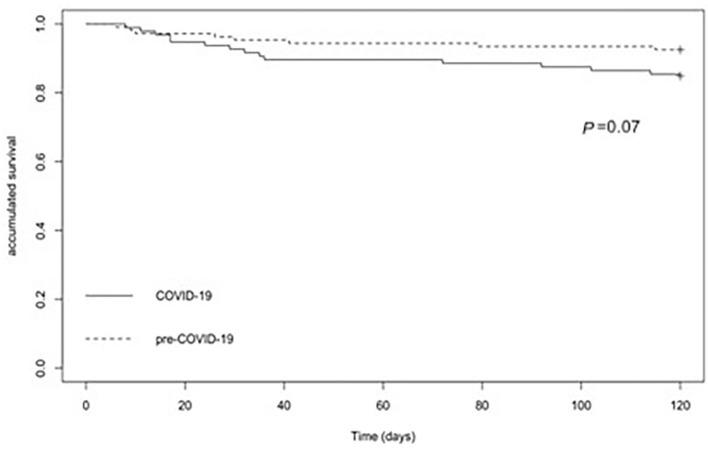
To analyze the availability and access to the hospital for the patients with intra-abdominal infections (IAIs) by as a result of the coronavirus disease 2019 (COVID-19) pandemic and the impact of these changes in the diagnosis and their effects on the death of these patients. Two prospective observational cohorts of the patients with IAI by were conducted in 2016 (the pre-COVID-19, = 108) and in 2020 (during the COVID-19, = 96) at the University Hospital of Seville, Spain. The demographic and clinical variables of the patients were collected and analyzed. The patients were followed-up for 120 days, until the hospital discharge or death. The bivariate and multivariate analyses were performed. Both the cohorts were homogeneous according to age, sex, emergency surgery cause, immunosuppression, neutropenia, acquisition type, and previous intervention. The patients attended during the COVID-19 had significantly higher Charlson comorbidity index and the more McCabe score, required more emergency surgery, had more severe infections with the higher rates of septic shock and sepsis, and the presence of additional care support such as a nasogastric tube. They were diagnosed later; the time intervals between the symptoms onset (SO) to the first medical contact or surgical intervention (SI) and between the first medical contact to the admission or SI were significantly higher. The death rates during the COVID-19 and the pre-COVID-19 were 16.7 and 6.5%, respectively ( = 0.02). Finally, the multivariate analysis in both the cohorts together identified the patients diagnosed during the COVID-19, the longer period from SO to SI, septic shock, and the Charlson comorbidity index as the independent factors associated with death. This study showed the impact of the COVID-19 pandemic on the clinical outcome and death due to IAI with an extension of the time between SO and SI.
分析2019年冠状病毒病(COVID-19)大流行导致腹腔内感染(IAIs)患者前往医院就诊的可及性及机会,以及这些变化对诊断的影响及其对这些患者死亡的影响。2016年(COVID-19之前,n = 108)和2020年(COVID-19期间,n = 96)在西班牙塞维利亚大学医院对IAIs患者进行了两个前瞻性观察队列研究。收集并分析了患者的人口统计学和临床变量。对患者进行了120天的随访,直至出院或死亡。进行了双变量和多变量分析。两个队列在年龄、性别、急诊手术原因、免疫抑制、中性粒细胞减少、感染获得类型和既往干预方面均具有同质性。COVID-19期间就诊的患者Charlson合并症指数显著更高,McCabe评分更高,需要更多的急诊手术,感染更严重,感染性休克和脓毒症发生率更高,并且存在如鼻胃管等额外的护理支持。他们的诊断时间更晚;症状发作(SO)至首次医疗接触或手术干预(SI)之间以及首次医疗接触至入院或SI之间的时间间隔显著更长。COVID-19期间和COVID-19之前的死亡率分别为16.7%和6.5%(P = 0.02)。最后,两个队列的多变量分析共同确定COVID-19期间诊断的患者、从SO到SI的较长时间、感染性休克和Charlson合并症指数为与死亡相关的独立因素。本研究显示了COVID-19大流行对IAIs导致的临床结局和死亡的影响,表现为SO和SI之间时间的延长。
 Zotero 插件