Au Kin Pan, Chok Kenneth Siu Ho
Department of Surgery, Queen Mary Hospital, The University of Hong Kong, Hong Kong, China.
Department of Surgery and State Key Laboratory for Liver Research, The University of Hong Kong, Hong Kong, China.
World J Gastrointest Surg. 2021 Oct 27;13(10):1267-1278. doi: 10.4240/wjgs.v13.i10.1267.
There is limited evidence on the safety of immunotherapy use after liver transplantation and its efficacy in treating post-liver transplant hepatocellular carcinoma (HCC) recurrence.
To assess the safety of immunotherapy after liver transplant and its efficacy in treating post-liver transplant HCC recurrence.
A literature review was performed to identify patients with prior liver transplantation and subsequent immunotherapy. We reviewed the rejection rate and risk factors of rejection. In patients treated for HCC, the oncological outcomes were evaluated including objective response rate, progression-free survival (PFS), and overall survival (OS).
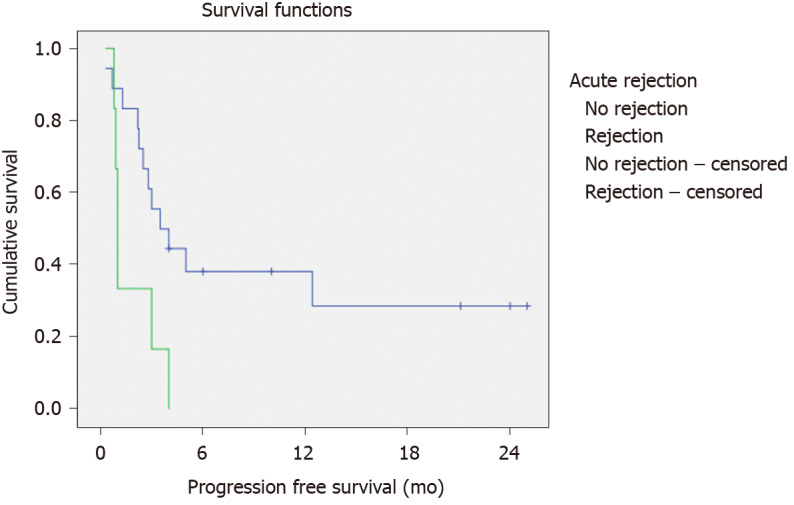
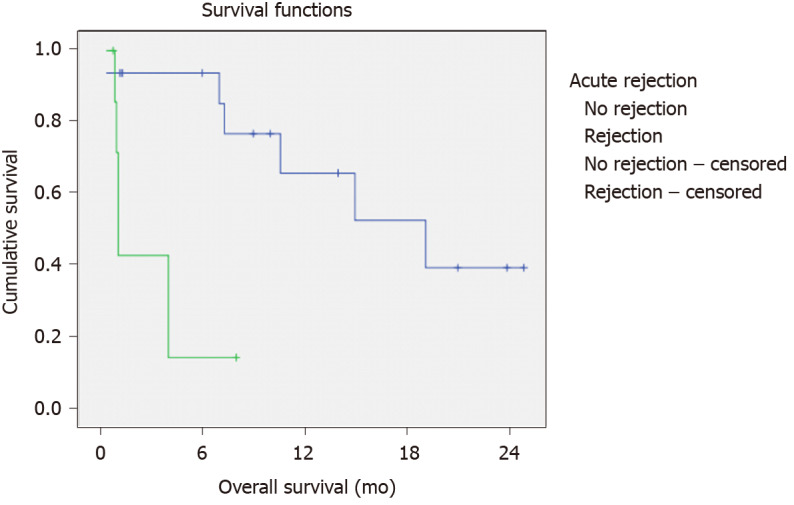
We identified 25 patients from 16 publications and 3 patients from our institutional database (total = 28). The rejection rate was 32% ( = 9). Early mortality occurred in 21% ( = 6) and was mostly related to acute rejection (18%, = 5). Patients who developed acute rejection were given immunotherapy earlier after transplantation (median 2.9 years 5.3 years, = 0.02) and their graft biopsies might be more frequently programmed death ligand-1-positive (100% 33%, = 0.053). Their PFS (1.0 ± 0.1 mo 3.5 ± 1.1 mo, = 0.02) and OS (1.0 ± 0.1 mo 19.2 ± 5.5 mo, = 0.001) compared inferiorly to patients without rejection. Among the 19 patients treated for HCC, the rejection rate was 32% ( = 6) and the overall objective response rate was 11%. The median PFS and OS were 2.5 ± 1.0 mo and 7.3 ± 2.7 mo after immunotherapy.
Rejection risk is the major obstacle to immunotherapy use in liver transplant recipients. Further studies on the potential risk factors of rejection are warranted.
肝移植后使用免疫疗法的安全性及其治疗肝移植后肝细胞癌(HCC)复发的疗效证据有限。
评估肝移植后免疫疗法的安全性及其治疗肝移植后HCC复发的疗效。
进行文献综述以确定先前接受肝移植并随后接受免疫疗法的患者。我们回顾了排斥反应率和排斥反应的危险因素。在接受HCC治疗的患者中,评估肿瘤学结局,包括客观缓解率、无进展生存期(PFS)和总生存期(OS)。
我们从16篇出版物中确定了25例患者,从我们机构的数据库中确定了3例患者(共28例)。排斥反应率为32%(n = 9)。早期死亡率为21%(n = 6),主要与急性排斥反应有关(18%,n = 5)。发生急性排斥反应的患者在移植后更早接受免疫疗法(中位时间2.9年对5.3年,P = 0.02),并且他们的移植肝活检可能更频繁地为程序性死亡配体-1阳性(100%对33%,P = 0.053)。与无排斥反应的患者相比,他们的PFS(1.0±0.1个月对3.5±1.1个月,P = 0.02)和OS(1.0±0.1个月对19.2±5.5个月,P = 0.001)较差。在19例接受HCC治疗的患者中,排斥反应率为32%(n = 例6),总体客观缓解率为11%。免疫疗法后的中位PFS和OS分别为2.5±1.0个月和7.3±2.7个月。
排斥反应风险是肝移植受者使用免疫疗法的主要障碍。有必要对排斥反应的潜在危险因素进行进一步研究。