Granlund Andreas Saine, Sørensen Michala Skovlund, Jensen Claus Lindkær, Bech Birthe Højlund, Petersen Michael Mørk
Musculoskeletal Tumor Section, Department of Orthopedic Surgery, Copenhagen University Hospital, Rigshospitalet, Copenhagen 2100, Denmark.
Department of Orthopedic Surgery, Copenhagen University Hospital, Copenhagen 2200, Denmark.
World J Orthop. 2021 Oct 18;12(10):760-767. doi: 10.5312/wjo.v12.i10.760.
Schwannoma is a benign, encapsulated and slowly growing tumor originating from Schwann cells and is rarely seen in the peripheral nerve system. Typical symptoms are soreness, radiating pain and sensory loss combined with a soft tissue mass.
To evaluate pre- and postoperative symptoms in patients operated for schwannomas in the extremities and investigate the rate of malignant transformation.
In this single center retrospective study design, all patients who had surgery for a benign schwannoma in the extremities from May 1997 to January 2018 were included. The location of the tumor in the extremities was divided into five groups; forearm, arm, shoulder, thigh and leg including foot. The locations of the tumor in the nerves were also categorized as either; proximal, distal, minor or major nerve. During the pre- and postoperative clinical evaluation, symptoms were classified as paresthesia, local pain, radiating pain, swelling, impairment of mobility/strength and asymptomatic tumors that were found incidentally (with magnetic resonance imaging). The patients were evaluated after surgery using the following categories: Asymptomatic or symptomatic patients (radiating and/or local pain) and those with complications. The follow up period was from the time of surgery until last examination of the particular physician. Multivariate logistic regression analysis was performed to identify independent prognostic factors for postoperative significant symptoms at follow-up.
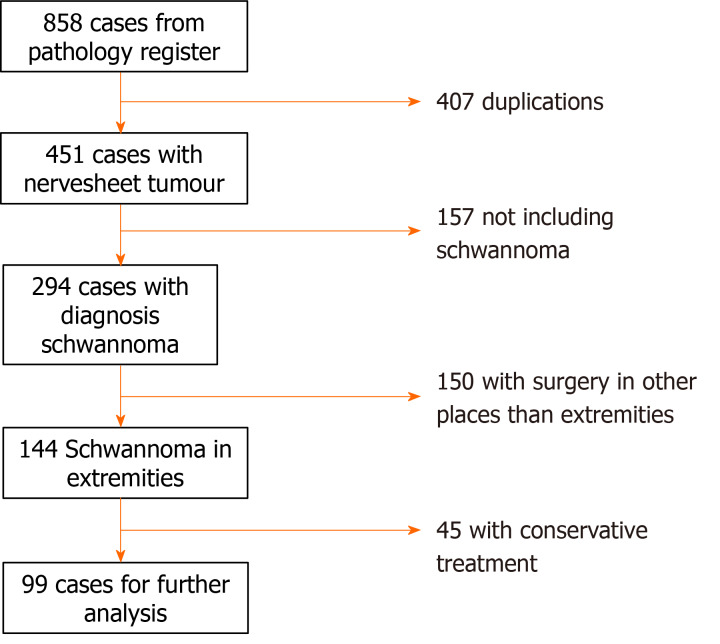
We identified 858 cases from the institutional pathology register. We excluded cases with duplicate diagnoses ( = 407), pathology not including schwannomas ( = 157), lesions involving the torso, spine and neck ( = 150) leaving 144 patients for further analysis. In this group 99 patients underwent surgery and there were five complications recorded: 2 infections (treated with antibiotics) and 3 nerve palsies (2 involving the radial nerve and one involving the median nerve) that recovered spontaneously. At the end of follow-up, 1.4 mo (range 0.5-76) postoperatively, we recorded a post-operative decrease in clinical symptoms: Local pain 76% (6/25), radiating pain 97% (2/45), swelling 20% (8/10). Symptoms of paresthesia increased by 2.8% (37/36) and there was no change in motor weakness before and after surgery 1% (1/1). Multivariate analysis showed that tumors located within minor nerves had a significantly higher prevalence of postoperative symptoms compared with tumors in major nerves (odds ratio: 2.63; confidence intervals: 1.22-6.42, = 0.029). One patient with schwannoma diagnosed by needle biopsy was diagnosed to have malignant transformation diagnosed in the surgically removed tumor. No local recurrences were reported.
Surgery of schwannomas can be conducted with low risk of postoperative complications, acceptable decrease in clinical symptoms and risk of malignant transformation is low.
神经鞘瘤是一种起源于施万细胞的良性、有包膜且生长缓慢的肿瘤,在周围神经系统中较为少见。典型症状为酸痛、放射痛和感觉丧失,并伴有软组织肿块。
评估接受四肢神经鞘瘤手术患者的术前和术后症状,并调查恶性转化的发生率。
在这项单中心回顾性研究设计中,纳入了1997年5月至2018年1月期间接受四肢良性神经鞘瘤手术的所有患者。肿瘤在四肢的位置分为五组:前臂、上臂、肩部、大腿和包括足部的小腿。肿瘤在神经中的位置也分为近端、远端、小神经或大神经。在术前和术后临床评估期间,症状分为感觉异常、局部疼痛、放射痛、肿胀、活动/力量受损以及偶然发现的无症状肿瘤(通过磁共振成像)。术后对患者进行如下分类评估:无症状或有症状患者(放射痛和/或局部疼痛)以及有并发症的患者。随访期从手术时间至特定医生的最后一次检查。进行多变量逻辑回归分析以确定随访时术后出现明显症状的独立预后因素。
我们从机构病理登记册中识别出858例病例。我们排除了重复诊断的病例(=407)、病理不包括神经鞘瘤的病例(=157)、累及躯干、脊柱和颈部的病变(=150),留下144例患者进行进一步分析。在这组患者中,99例接受了手术,记录到5例并发症:2例感染(用抗生素治疗)和3例神经麻痹(2例累及桡神经,1例累及正中神经),均自发恢复。在术后1.4个月(范围0.5 - 76个月)的随访结束时,我们记录到临床症状术后有所减轻:局部疼痛减轻76%(6/25),放射痛减轻97%(2/45),肿胀减轻20%(8/10)。感觉异常症状增加了2.8%(37/36),手术前后运动无力无变化(1%,1/1)。多变量分析显示,与大神经中的肿瘤相比,小神经内的肿瘤术后症状发生率显著更高(优势比:2.63;置信区间:1.22 - 6.42,P = 0.029)。1例经针吸活检诊断为神经鞘瘤的患者,在手术切除的肿瘤中被诊断为发生了恶性转化。未报告局部复发情况。
神经鞘瘤手术的术后并发症风险低,临床症状减轻程度可接受,恶性转化风险低。