Public Health Agency of Canada, Ottawa, Canada.
Public Health Agency of Canada, Ottawa, Canada.
Clin Microbiol Infect. 2022 Mar;28(3):426-432. doi: 10.1016/j.cmi.2021.10.013. Epub 2021 Oct 30.
The COVID-19 pandemic has had an effect on the incidence of infectious diseases and medical care. This study aimed to describe the impact of the COVID-19 pandemic on community-level antibiotic use.
Using national antibiotic dispensing data from IQVIA's CompuScript database, this ecological study investigated antibiotic dispensing through community retail pharmacies in Canada from November 2014 to October 2020. Analyses were stratified by age, sex, prescription origin and approximate indication.
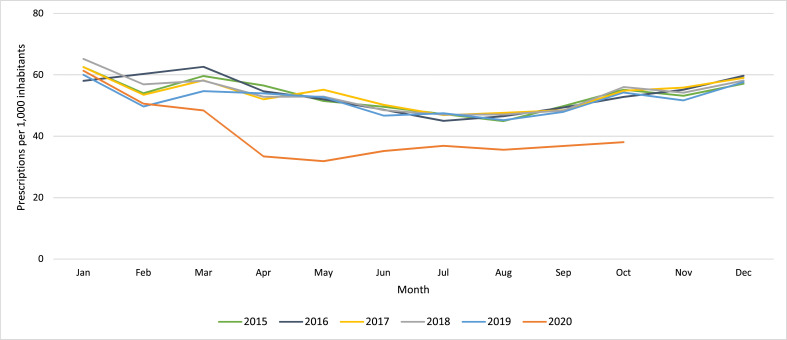
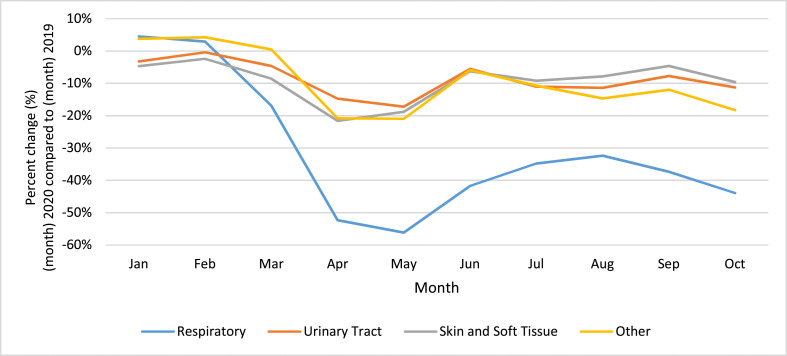
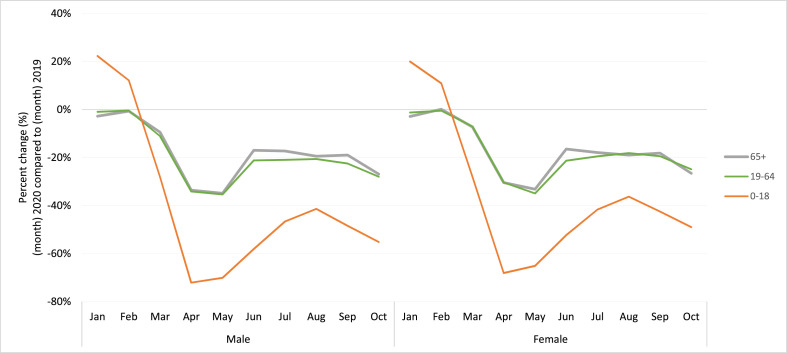
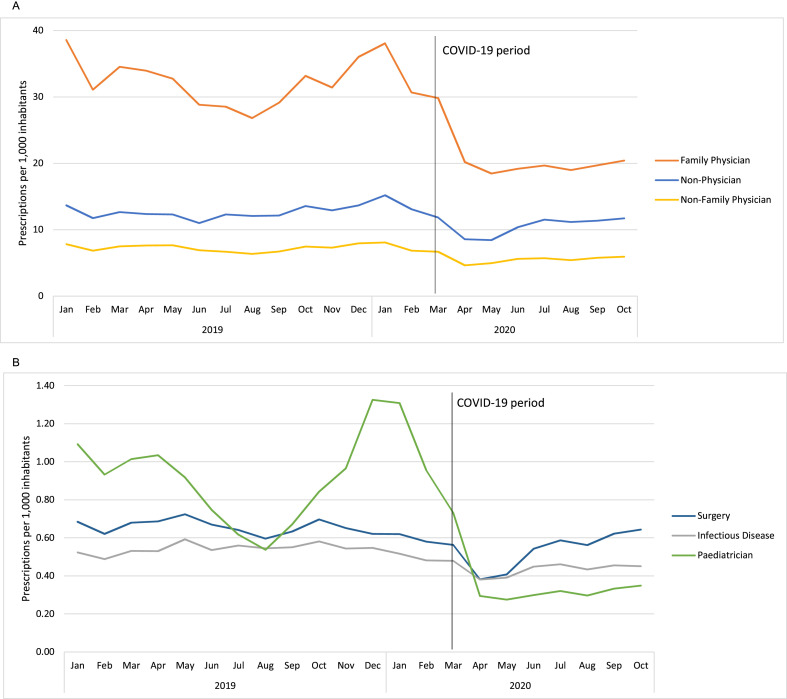
Adjusting for seasonality, the national rate of antibiotic dispensing in Canada decreased by 26.5% (50.4 to 37.0 average prescriptions per 1000 inhabitants) during the first 8 months of the Canadian COVID-19 period (March to October 2020), compared with the pre-COVID-19 period. Prescribing rates in children ≤18 years decreased from 43.7 to 12.2 prescriptions per 1000 inhabitants in males (-72%) and from 46.8 to 14.9 prescriptions per 1000 inhabitants in females (-68%) in April 2020. Rates in adults ≥65 decreased from 74.9 to 48.8 prescriptions per 1000 inhabitants in males (-35%) and from 91.7 to 61.3 prescriptions per 1000 inhabitants in females (-33%) in May 2020. Antibiotic prescriptions from family physicians experienced a greater decrease than from surgeons and infectious disease physicians. Prescribing rates for antibiotics for respiratory indications decreased by 56% in May 2020 (29.2 to 12.8 prescriptions per 1000 inhabitants), compared with prescribing rates for urinary tract infections (9.4 to 7.8 prescriptions per 1000 inhabitants; -17%) and skin and soft tissue infections (6.4 to 5.2 prescriptions per 1000 inhabitants; -19%).
The first 8 months of the COVID-19 pandemic reduced community antibiotic dispensing by 26.5% in Canada, compared with the marginal decrease of 3% in antibiotic consumption between 2015 and 2019. Further research is needed to understand the implications and long-term effects of the observed reductions on antibiotic use on antibiotic resistance in Canada.
新冠疫情对传染病发病率和医疗保健产生了影响。本研究旨在描述新冠疫情对社区层面抗生素使用的影响。
本生态研究使用 IQVIA 的 CompuScript 数据库中的全国抗生素配药数据,调查了 2014 年 11 月至 2020 年 10 月期间加拿大社区零售药店的抗生素配药情况。分析按年龄、性别、处方来源和近似指征进行分层。
调整季节性因素后,与新冠疫情前相比,加拿大新冠疫情的头 8 个月(2020 年 3 月至 10 月)全国抗生素配药率下降了 26.5%(每 1000 居民平均处方 50.4 至 37.0 张)。2020 年 4 月,18 岁以下儿童男性的处方率从 43.7 降至 12.2 张/1000 居民(-72%),女性从 46.8 降至 14.9 张/1000 居民(-68%)。2020 年 5 月,65 岁以上男性的配药率从 74.9 降至 48.8 张/1000 居民(-35%),女性从 91.7 降至 61.3 张/1000 居民(-33%)。家庭医生的抗生素处方降幅大于外科医生和传染病医生。用于呼吸道感染的抗生素处方率在 2020 年 5 月下降了 56%(每 1000 居民 29.2 至 12.8 张),而用于尿路感染的处方率下降了 17%(每 1000 居民 9.4 至 7.8 张),用于皮肤和软组织感染的处方率下降了 19%(每 1000 居民 6.4 至 5.2 张)。
与 2015 年至 2019 年抗生素消费下降 3%相比,新冠疫情的头 8 个月使加拿大社区抗生素配药减少了 26.5%。需要进一步研究以了解观察到的抗生素使用减少对加拿大抗生素耐药性的影响和长期影响。