Long Alex, Cartwright Martin, Reilly Charles C
Dept of Physiotherapy, King's College Hospital NHS Foundation Trust, London, UK.
School of Health Sciences, City, University of London, London, UK.
ERJ Open Res. 2021 Nov 8;7(4). doi: 10.1183/23120541.00211-2021. eCollection 2021 Oct.
Patients with COPD reduce physical activity to avoid the onset of breathlessness. Fan therapy can reduce breathlessness at rest, but the efficacy of fan therapy during exercise remains unknown in this population. The aim of the present study was to investigate 1) the effect of fan therapy on exercise-induced breathlessness and post-exercise recovery time in patients with COPD and 2) the acceptability of fan therapy during exercise; and 3) to assess the reproducibility of any observed improvements in outcome measures.
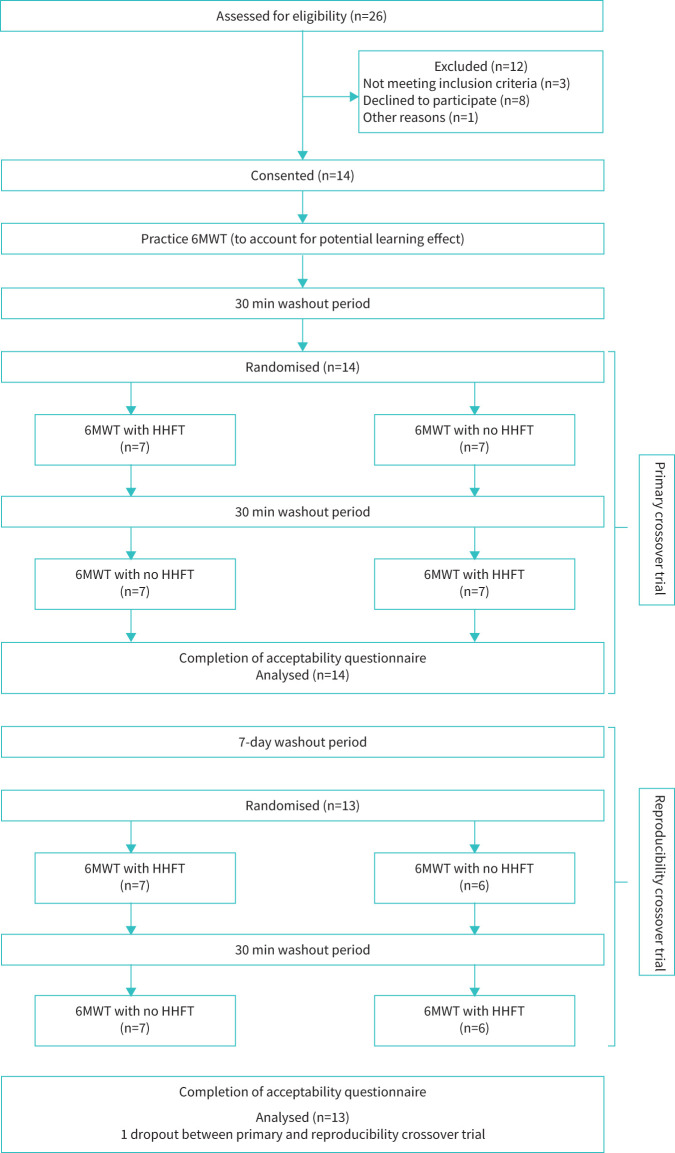
A pilot single-centre, randomised, controlled, crossover open (nonmasked) trial (clinicaltrials.gov NCT03137524) of fan therapy no fan therapy during 6-min walk test (6MWT) in patients with COPD and a modified Medical Research Council (mMRC) dyspnoea score ≥2. Breathlessness intensity was quantified before and on termination of the 6MWT, using the numerical rating scale (NRS) (0-10). Post-exertional recovery time was measured, defined as the time taken to return to baseline NRS breathlessness score. Oxygen saturation and heart rate were measure pre- and post-6MWT.
14 patients with COPD completed the trial per protocol (four male, 10 female; median (interquartile range (IQR)) age 66.50 (60.75 to 73.50) years); mMRC dyspnoea 3 (2 to 3)). Fan therapy resulted in lower exercise-induced breathlessness (ΔNRS; Δ modified Borg scale) (within-individual differences in medians (WIDiM) -1.00, IQR -2.00 to -0.50; p<0.01; WIDiM -0.25, IQR -2.00 to 0.00; p=0.02), greater distance walked (metres) during the 6MWT (WIDiM 21.25, IQR 12.75 to 31.88; p<0.01), and improved post-exertional breathlessness (NRS) recovery time (WIDiM -10.00, IQR -78.75 to 50.00; p<0.01). Fan therapy was deemed to be acceptable by 92% of participants.
Fan therapy was acceptable and provided symptomatic relief to patients with COPD during exercise. These data will inform larger pilot studies and efficacy studies of fan therapy during exercise.
慢性阻塞性肺疾病(COPD)患者会减少体力活动以避免气喘发作。风扇疗法可减轻静息时的气喘,但该疗法在运动期间对这一人群的疗效尚不清楚。本研究的目的是调查:1)风扇疗法对COPD患者运动诱发气喘及运动后恢复时间的影响;2)运动期间风扇疗法的可接受性;3)评估观察到的结局指标改善的可重复性。
一项针对COPD且改良医学研究委员会(mMRC)呼吸困难评分≥2的患者进行的单中心、随机、对照、交叉开放(非盲)试验(clinicaltrials.gov NCT03137524),在6分钟步行试验(6MWT)期间进行风扇疗法或无风扇疗法。在6MWT开始前和结束时,使用数字评分量表(NRS)(0 - 10)对气喘强度进行量化。测量运动后恢复时间,定义为恢复到基线NRS气喘评分所需的时间。在6MWT前后测量血氧饱和度和心率。
14例COPD患者按方案完成试验(4例男性,10例女性;年龄中位数(四分位间距(IQR))66.50(60.75至73.50)岁);mMRC呼吸困难评分为3(2至3))。风扇疗法使运动诱发的气喘减轻(ΔNRS;Δ改良Borg量表)(个体内中位数差异(WIDiM)-1.00,IQR -2.00至-0.50;p<0.01;WIDiM -0.25,IQR -2.00至0.00;p = 0.02),6MWT期间行走的距离更长(米)(WIDiM 21.25,IQR 12.75至31.88;p<0.01),运动后气喘(NRS)恢复时间缩短(WIDiM -10.00,IQR -78.75至50.00;p<0.01)。92%的参与者认为风扇疗法是可接受的。
风扇疗法是可接受的,并且在运动期间为COPD患者提供了症状缓解。这些数据将为更大规模的风扇疗法运动期间试点研究和疗效研究提供参考。