Navari Yasaman, Bagheri Amir Behzad, Akhavan Rezayat Arash, SeyedAlinaghi SeyedAhmad, Najafi Sara, Barzegary Alireza, Asadollahi-Amin Ali
School of Medicine Mashhad University of Medical Sciences Mashhad Iran.
Health Policy Research Center, Institute of Health Shiraz University of Medical Sciences Shiraz Iran.
Health Sci Rep. 2021 Nov 4;4(4):e427. doi: 10.1002/hsr2.427. eCollection 2021 Dec.
The kidney transplant patients who receive immunosuppressive and specific medication may lead to different mortality risk factors between kidney transplant patients with COVID-19 and the general population. We aimed to provide a model predictor and a risk analysis of mortality in kidney transplant COVID-19 positive patients.
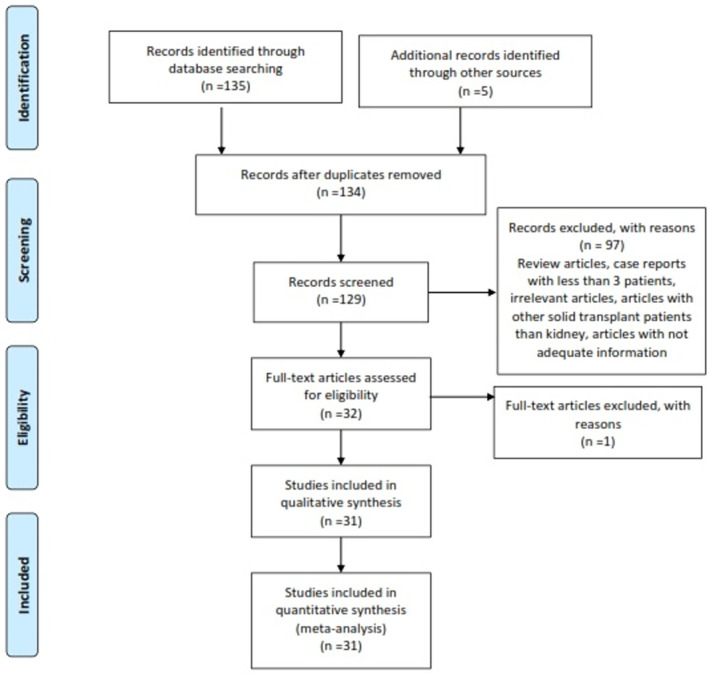
We performed our search using PubMed, MEDLINE, Web of Science, Scopus, and Google Scholar to identify English articles published from the beginning of December 2019 through August 2020. Excluded manuscripts had no full text, lacked information, were not the original article, or consisted of less than three cases. We gathered information about demographic information, comorbidities, COVID-19 symptoms, lung radiographic findings, history of medication therapy, and changes in the kidney maintenance therapy after confirming their COVID-19 on the data extraction forms.
We found a total of 31 eligible articles. We set a 10% mortality rate as our cutoff point. The most common sign and symptoms were cough (53.22 [29.42]), dyspnea (50.80 [24.55]). In the bivariate analysis, fatigue ( = .04, OR of 0.92; 95% CI: 0.85-1.00), hypertension ( = .07, OR of 1.03; 95% CI: 1.00-1.07), and dyspnea ( = .08, OR of 1.04; 95% CI: 1.00-1.09) showed a statistically significant relationship with increases in mortality.In multivariate regression analysis, an independent association was only found between hypertension and mortality ( = .035; AOR of 1.064; CL: 1.004-1.127).
Clinicians should pay special attention to modifiable risk factors for COVID-19 infection mortality, such as hypertension among kidney transplant patients, because it may be possible to decrease mortality by controlling these factors.
接受免疫抑制和特定药物治疗的肾移植患者,可能导致新冠病毒病(COVID-19)肾移植患者与普通人群之间存在不同的死亡风险因素。我们旨在提供一个模型预测指标,并对COVID-19阳性肾移植患者的死亡风险进行分析。
我们使用PubMed、MEDLINE、科学网、Scopus和谷歌学术进行检索,以识别2019年12月初至2020年8月发表的英文文章。排除的手稿没有全文、缺乏信息、不是原创文章或病例数少于3例。我们在数据提取表上收集了有关人口统计学信息、合并症、COVID-19症状、肺部影像学表现、药物治疗史以及确诊COVID-19后肾脏维持治疗变化的信息。
我们共找到31篇符合条件的文章。我们将10%的死亡率作为截断点。最常见的体征和症状是咳嗽(53.22 [29.42])、呼吸困难(50.80 [24.55])。在双变量分析中,疲劳(P = 0.04,OR为0.92;95%CI:0.85 - 1.00)、高血压(P = 0.07,OR为1.03;95%CI:1.00 - 1.07)和呼吸困难(P = 0.08,OR为1.04;95%CI:1.00 - 1.09)与死亡率增加呈统计学显著关系。在多变量回归分析中,仅发现高血压与死亡率之间存在独立关联(P = 0.035;AOR为1.064;CL:1.004 - 1.127)。
临床医生应特别关注COVID-19感染死亡率的可改变风险因素,如肾移植患者中的高血压,因为通过控制这些因素可能降低死亡率。