
TGF-β 通过依赖于 SDH/HIF1α 的方式保护骨肉瘤细胞免受化疗细胞毒性。
TGF-β protects osteosarcoma cells from chemotherapeutic cytotoxicity in a SDH/HIF1α dependent manner.
机构信息
Department of Orthopaedics, The Affiliated Hospital of Southwest Medical University, Luzhou, 646000, Sichuan, China.
Sichuan Provincial Laboratory of Orthopaedic Engineering, Luzhou, 646000, Sichuan, China.
出版信息
BMC Cancer. 2021 Nov 11;21(1):1200. doi: 10.1186/s12885-021-08954-7.
BACKGROUND
In the widespread adoption of chemotherapy, drug resistance has been the major obstacle to tumor elimination in cancer patients. Our aim was to explore the role of TGF-β in osteosarcoma-associated chemoresistance.
METHODS
We performed a cytotoxicity analysis of methotrexate (MTX) and cisplatin (CIS) in TGF-β-treated osteosarcoma cells. Then, the metabolite profile of the core metabolic energy pathways in Saos-2 and MG-63 cell extracts was analyzed by H-NMR. We detected the expression of succinate dehydrogenase (SDH), STAT1, and hypoxia-inducible factor 1α (HIF1α) in TGF-β-treated osteosarcoma cells and further tested the effects of these molecules on the cytotoxicity induced by chemotherapeutic agents. Using in vivo experiments, we examined the tumor growth and survival time of Saos-2-bearing mice treated with a combination of chemotherapeutic agents and a HIF1α inhibitor.
RESULTS
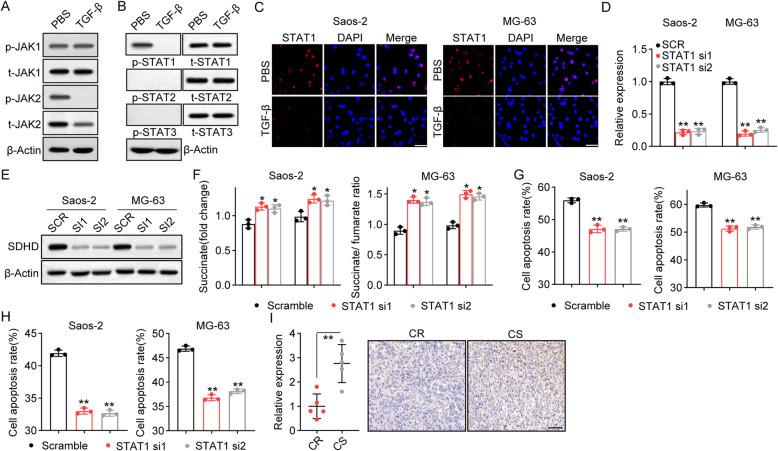
The metabolic analysis revealed enhanced succinate production in osteosarcoma cells after TGF-β treatment. We further found a decrease in SDH expression and an increase in HIF1α expression in TGF-β-treated osteosarcoma cells. Consistently, blockade of SDH efficiently enhanced the resistance of Saos-2 and MG-63 cells to MTX and CIS. Additionally, a HIF1α inhibitor significantly strengthened the anticancer efficacy of the chemotherapeutic drugs in mice with osteosarcoma cancer.
CONCLUSION
Our study demonstrated that TGF-β attenuated the expression of SDH by reducing the transcription factor STAT1. The reduction in SDH then caused the upregulation of HIF1α, thereby rerouting glucose metabolism and aggravating chemoresistance in osteosarcoma cells. Linking tumor cell metabolism to the formation of chemotherapy resistance, our study may guide the development of additional treatments for osteosarcoma.
背景
在化疗广泛应用的情况下,耐药性已成为癌症患者肿瘤消除的主要障碍。我们的目的是探讨 TGF-β 在骨肉瘤相关化疗耐药中的作用。
方法
我们对 TGF-β 处理的骨肉瘤细胞中的甲氨蝶呤(MTX)和顺铂(CIS)进行了细胞毒性分析。然后,通过 H-NMR 分析 Saos-2 和 MG-63 细胞提取物中核心代谢能量途径的代谢物谱。我们检测了 TGF-β 处理的骨肉瘤细胞中琥珀酸脱氢酶(SDH)、STAT1 和缺氧诱导因子 1α(HIF1α)的表达,并进一步测试了这些分子对化疗药物诱导的细胞毒性的影响。通过体内实验,我们检测了用化疗药物和 HIF1α 抑制剂联合治疗携带 Saos-2 肿瘤的小鼠的肿瘤生长和存活时间。
结果
代谢分析显示 TGF-β 处理后骨肉瘤细胞中琥珀酸的产生增加。我们进一步发现 TGF-β 处理的骨肉瘤细胞中 SDH 表达降低,HIF1α 表达增加。一致地,SDH 阻断有效地增强了 Saos-2 和 MG-63 细胞对 MTX 和 CIS 的耐药性。此外,HIF1α 抑制剂显著增强了骨肉瘤小鼠中化疗药物的抗癌疗效。
结论
我们的研究表明,TGF-β 通过降低转录因子 STAT1 来减弱 SDH 的表达。SDH 的减少导致 HIF1α 的上调,从而使葡萄糖代谢重新定向,并加重骨肉瘤细胞的化疗耐药性。将肿瘤细胞代谢与化疗耐药的形成联系起来,我们的研究可能为骨肉瘤的治疗提供新的思路。



 Zotero 插件