Grubhofer Florian, Ernstbrunner Lukas, Bachmann Elias, Wieser Karl, Borbas Paul, Bouaicha Samy, Warner Jon J P, Gerber Christian
Balgrist University Hospital, Department of Orthopedic Surgery, University of Zürich, Zürich, Switzerland.
Massachusetts General Hospital, Department of Orthopedic Surgery, Harvard Medical School, Boston, MA, USA.
JSES Int. 2021 Sep 11;5(6):1027-1033. doi: 10.1016/j.jseint.2021.07.011. eCollection 2021 Nov.
The treatment of complex proximal humerus fractures with hemiarthroplasty is associated with a high failure rate due to secondary displacement of the tuberosities. It was the aim of this in-vitro study to compare the mechanical stability of tuberosity reattachment obtained with the so-called "Cow-Hitch" (CH) cerclage compared with conventional tuberosity reattachment.
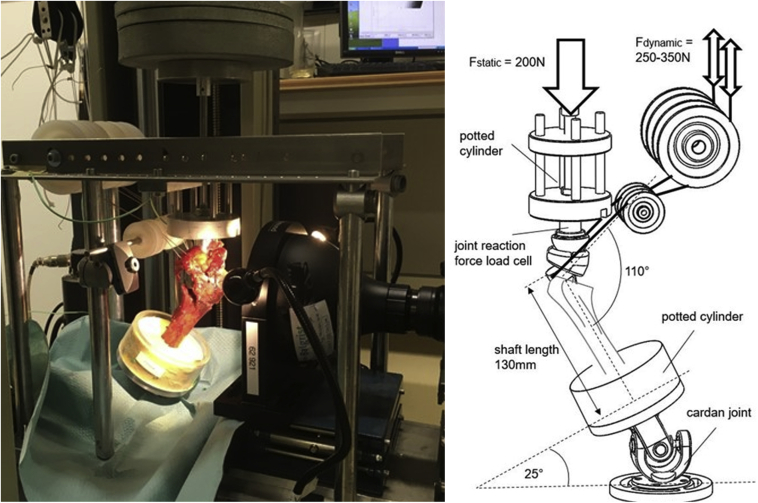
A 4-part proximal humerus fracture was created in 10 fresh-frozen, human cadaveric shoulders. The greater and lesser tuberosity were reattached to the hemiarthroplasty stem with in total 4 CH Cerclages in the Cow-Hitch group. The conventional technique-recommended for the tested implant-was used in the control group using 6 sutures. A total of 5000 loading cycles with forces of 350N were applied, while motion (in mm) of the tuberosities was recorded in 3 directions (anteroposterior = AP, mediolateral = ML, inferosuperior = IS) with a telecentric camera.
After 5000 loading cycles, the CH group showed less fragment displacement (AP: 2.3 ± 2.3 mm, ML: 1.8 ± 0.9 mm, IS: 1.3 ± 0.5 mm) than the conventional group (AP: 9.8 ± 12.3 mm, ML: 5.5 ± 5.6 mm, IS: 4.5 ± 4.7 mm). The differences were not statistically significant (AP: = .241; ML: = .159; IS: = .216). The lesser tuberosity fragment displacement in the CH group after 5000 cycles was less in the AP (2.3 ± 3.3 vs. 4.0 ± 2.8, = .359) and IS (1.9 ± 1.2 vs. 3.1 ± 1.8; = .189) directions but higher in the ML direction (7.2 ± 5.7 vs 6.3 ± 3.6, = .963).
In-vitro, "Cow-Hitch" cerclage results in mean greater tuberosity displacements of 2 mm and reliably prevents displacements greater than 5 mm. In contrast, the conventional fixation technique yields unreliable, variable stability with low to complete displacement upon cyclical loading.
由于结节的二次移位,采用半关节置换术治疗复杂的肱骨近端骨折失败率较高。本体外研究的目的是比较采用所谓“牛轭结”(CH)环扎术与传统结节重新附着术获得的结节重新附着的机械稳定性。
在10个新鲜冷冻的人体尸体肩部制造四部分肱骨近端骨折。在牛轭结组中,使用总共4个CH环扎带将大结节和小结节重新附着于半关节置换柄。对照组采用测试植入物推荐的传统技术,使用6根缝线。施加总共5000次350N力的加载循环,同时用远心相机记录结节在3个方向(前后=AP,内外侧=ML,上下=IS)的位移(以毫米为单位)。
在5000次加载循环后,CH组的骨折块移位(AP:2.3±2.3mm,ML:1.8±0.9mm,IS:1.3±0.5mm)小于传统组(AP:9.8±12.3mm,ML:5.5±5.6mm,IS:4.5±4.7mm)。差异无统计学意义(AP:=0.241;ML:=0.159;IS:=0.216)。CH组在5000次循环后小结节骨折块在AP方向(2.3±3.3对4.0±2.8,=0.359)和IS方向(1.9±1.2对3.1±1.8;=0.189)的移位较小,但在ML方向较高(7.2±5.7对6.3±3.6,=0.963)。
在体外,“牛轭结”环扎术导致大结节平均移位2mm,并可靠地防止移位大于5mm。相比之下,传统固定技术产生的稳定性不可靠、变化较大,在循环加载时会出现低至完全移位。