Sgarlata Eleonora, Chisari Clara Grazia, Toscano Simona, Finocchiaro Chiara, Lo Fermo Salvatore, Millefiorini Enrico, Patti Francesco
Department of Medicine, Stroke Unit, Umberto I Hospital, Siracusa, Italy.
Department of Medical and Surgical Sciences and Advanced Technologies "G.F. Ingrassia", Section of Neurosciences, University of Catania, Catania, Italy.
Curr Neuropharmacol. 2022;20(10):1978-1987. doi: 10.2174/1570159X19666211111123202.
Progressive Multifocal Leukoencephalopathy (PML) is an opportunistic infection caused by John Cunningham virus (JCV) reactivation, potentially associated with natalizumab (NTZ) treatment for Multiple Sclerosis (MS). The anti-JCV antibodies titre (JCV index) increases during NTZ treatment; however, the effects of other disease-modifying therapies (DMTs) on the JCV index have not been fully explored.
The aim of the study was to evaluate changes in the JCV index during treatment with several DMTs.
This longitudinal study evaluated the JCV index before starting DMT (T0) and during treatment with DMT (T1).
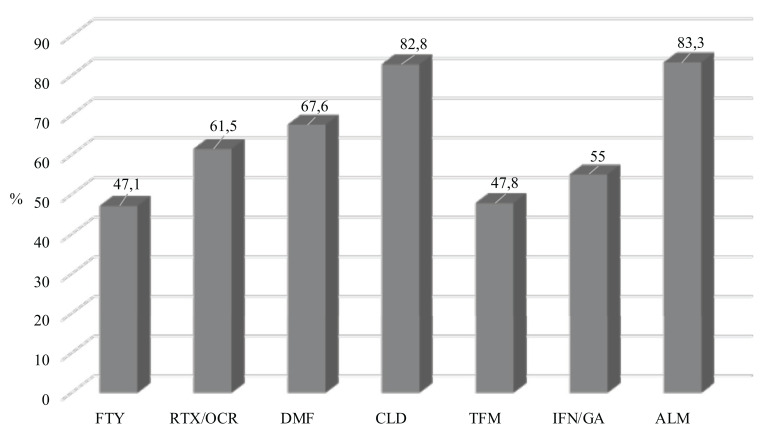
A total of 260 participants (65.4 % females, mean age 43 ± 11.3 ) were enrolled: 68 (26.2 %) treated with fingolimod (FTY), 65 (25 %) rituximab or ocrelizumab (RTX/OCR), 37 (14.2 %) dimethyl-fumarate (DMF), 29 (11.2 %) cladribine (CLD), 23 (8.8 %) teriflunomide (TFM), 20 (7.7 %) interferon or glatiramer acetate (IFN/GA), and 18 (6.9 %) alemtuzumab (ALM). At T1, the percentage of patients with JCV index <0.90 was found to be significantly increased in the ALM group (16.7 % versus 66.7 %, p = 0.05), while the percentage of patients with JCV index >1.51 was found to be significantly reduced in the RTX/OCR group (51.6 % versus 37.5 %, p = 0.04). In the FTY group, a significant reduction in the percentage of patients with JCV index <0.90 was also found (23.5 % versus 1.4 %, p = 0.0006). The mean JCV index was reduced in the RTX/OCR and ALM groups, while a significant increase was observed in the FTY group.
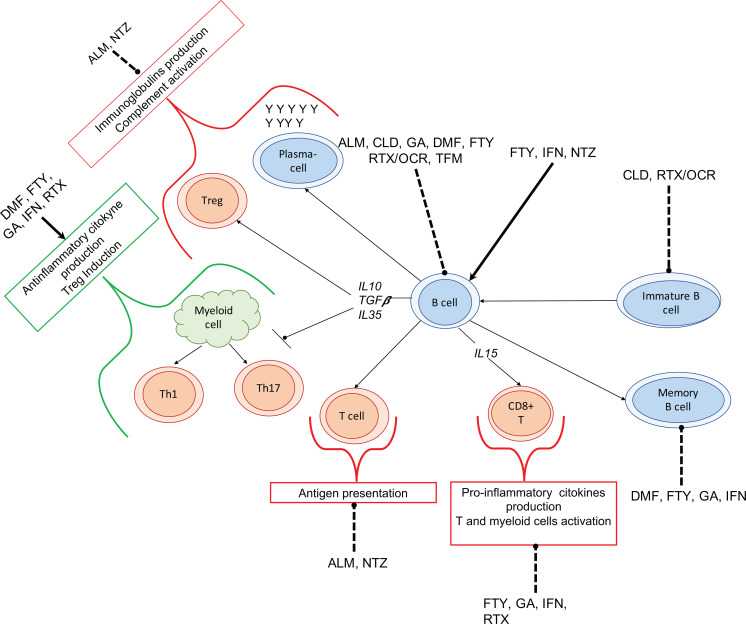
DMTs with a T and/or B depleting mechanism of action induced a significant reduction in the JCV index. These results may suggest new possible sequencing strategies potentially maximizing disease control while reducing the PML risk.
进行性多灶性白质脑病(PML)是由约翰·坎宁安病毒(JCV)激活引起的机会性感染,可能与用于治疗多发性硬化症(MS)的那他珠单抗(NTZ)治疗有关。在NTZ治疗期间抗JCV抗体滴度(JCV指数)会升高;然而,其他疾病修饰疗法(DMTs)对JCV指数的影响尚未得到充分研究。
本研究的目的是评估几种DMTs治疗期间JCV指数的变化。
这项纵向研究评估了开始DMT治疗前(T0)和DMT治疗期间(T1)的JCV指数。
共纳入260名参与者(65.4%为女性,平均年龄43±11.3岁):68名(26.2%)接受芬戈莫德(FTY)治疗,65名(25%)接受利妥昔单抗或奥瑞珠单抗(RTX/OCR)治疗,37名(14.2%)接受富马酸二甲酯(DMF)治疗,29名(11.2%)接受克拉屈滨(CLD)治疗,23名(8.8%)接受特立氟胺(TFM)治疗,20名(7.7%)接受干扰素或醋酸格拉替雷(IFN/GA)治疗,18名(6.9%)接受阿仑单抗(ALM)治疗。在T1时,发现ALM组中JCV指数<0.90的患者百分比显著增加(16.7%对66.7%,p = 0.05),而RTX/OCR组中JCV指数>1.51的患者百分比显著降低(51.6%对37.5%,p = 0.04)。在FTY组中,也发现JCV指数<0.90的患者百分比显著降低(23.5%对1.4%,p = 0.0006)。RTX/OCR组和ALM组的平均JCV指数降低,而FTY组观察到显著升高。
具有T和/或B细胞耗竭作用机制的DMTs可使JCV指数显著降低。这些结果可能提示新的可能的序贯策略,有可能在降低PML风险的同时最大限度地控制疾病。