Peng Yifan, Choi Suyeon, Kim Jonghyun, Wetzstein Gordon
Department of Electrical Engineering, Stanford University, 350 Jane Stanford Way, Stanford, CA 94305, USA.
NVIDIA, 2788 San Tomas Expressway, Santa Clara, CA 95051, USA.
Sci Adv. 2021 Nov 12;7(46):eabg5040. doi: 10.1126/sciadv.abg5040.
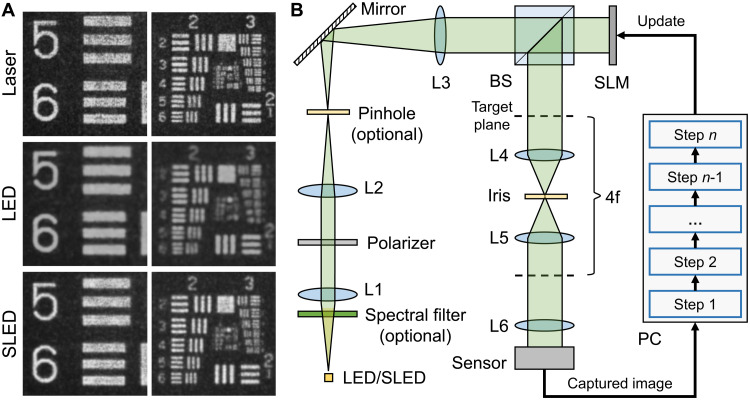
Computer-generated holography (CGH) holds transformative potential for a wide range of applications, including direct-view, virtual and augmented reality, and automotive display systems. While research on holographic displays has recently made impressive progress, image quality and eye safety of holographic displays are fundamentally limited by the speckle introduced by coherent light sources. Here, we develop an approach to CGH using partially coherent sources. For this purpose, we devise a wave propagation model for partially coherent light that is demonstrated in conjunction with a camera-in-the-loop calibration strategy. We evaluate this algorithm using light-emitting diodes (LEDs) and superluminescent LEDs (SLEDs) and demonstrate improved speckle characteristics of the resulting holograms compared with coherent lasers. SLEDs in particular are demonstrated to be promising light sources for holographic display applications, because of their potential to generate sharp and high-contrast two-dimensional (2D) and 3D images that are bright, eye safe, and almost free of speckle.
计算机生成全息术(CGH)在广泛的应用领域具有变革潜力,包括直视、虚拟现实和增强现实以及汽车显示系统。虽然全息显示的研究最近取得了令人瞩目的进展,但全息显示的图像质量和眼睛安全性从根本上受到相干光源引入的散斑的限制。在此,我们开发了一种使用部分相干光源的CGH方法。为此,我们设计了一种部分相干光的波传播模型,并结合回路相机校准策略进行了演示。我们使用发光二极管(LED)和超发光二极管(SLED)对该算法进行了评估,并证明与相干激光器相比,所得全息图的散斑特性有所改善。特别是SLED被证明是全息显示应用中有前景的光源,因为它们有潜力生成清晰、高对比度的二维(2D)和三维(3D)图像,这些图像明亮、对眼睛安全且几乎没有散斑。