Japan Young Epilepsy Section (YES-Japan), Kodaira, Tokyo, Japan; Department of Pediatrics, Wayne State University, Detroit, MI, USA.
Japan Young Epilepsy Section (YES-Japan), Kodaira, Tokyo, Japan; Department of Neurology, University Hospitals of Cleveland Medical Center, Case Western Reserve University, Cleveland, OH, USA.
Epilepsy Behav. 2021 Dec;125:108361. doi: 10.1016/j.yebeh.2021.108361. Epub 2021 Oct 5.
To identify the risk factors for psychological distress in electroencephalography (EEG) technicians during the coronavirus disease 2019 (COVID-19) pandemic.
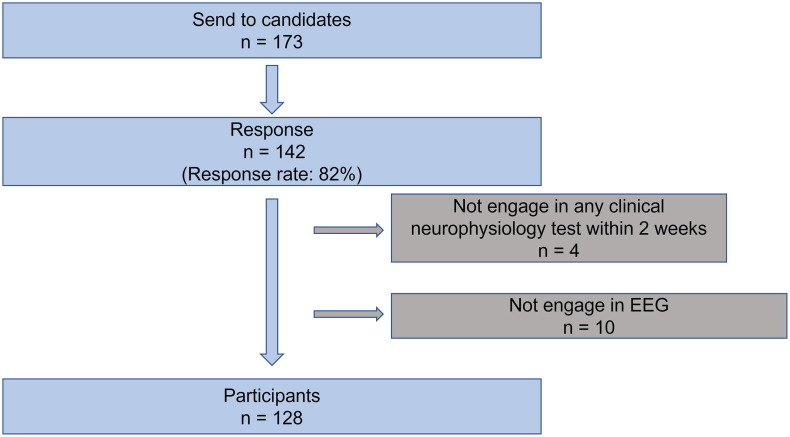
In this national-level cross-sectional survey initiated by Japan Young Epilepsy Section (YES-Japan), which is a national chapter of The Young Epilepsy Section of the International League Against Epilepsy (ILAE-YES), a questionnaire was administered to 173 technicians engaged in EEG at four clinics specializing in epilepsy care and 20 hospitals accredited as (quasi-) epilepsy centers or epilepsy training facilities in Japan from March 1 to April 30, 2021. We collected data on participants' profiles, information about work, and psychological distress outcome measurements, such as the K-6 and Tokyo Metropolitan Distress Scale for Pandemic (TMDP). Linear regression analysis was used to identify the risk factors for psychological distress. Factors that were significantly associated with psychological distress in the univariate analysis were subjected to multivariate analysis.
Among the 142 respondents (response rate: 82%), 128 were included in the final analysis. As many as 35.2% of EEG technicians have been under psychological distress. In multivariate linear regression analysis for K-6, female sex, examination for patients (suspected) with COVID-19, and change in salary or bonus were independent associated factors for psychological distress. Contrastingly, in multivariate linear regression analysis for TMDP, female sex, presence of cohabitants who had to be separated from the respondent due to this pandemic, and change in salary or bonus were independent associated factors for psychological distress.
We successfully identified the risk factors associated with psychological distress in EEG technicians during the COVID-19 pandemic. Our results may help in understanding the psychological stress in EEG technicians during the COVID-19 pandemic and improving the work environment, which is necessary to maintain the mental health of EEG technicians.
确定在 2019 年冠状病毒病(COVID-19)大流行期间脑电图(EEG)技术员心理困扰的危险因素。
本研究采用由日本青年癫痫学会(YES-Japan)发起的全国性横断面调查,这是国际抗癫痫联盟青年癫痫分会(ILAE-YES)的国家分会。该研究于 2021 年 3 月 1 日至 4 月 30 日向四家专门从事癫痫护理的诊所和 20 家被认证为(准)癫痫中心或癫痫培训设施的医院中的 173 名从事 EEG 的技术员发放问卷。我们收集了参与者的个人资料、工作信息和心理困扰结果测量(如 K-6 和东京都大流行应激量表(TMDP))数据。采用线性回归分析确定心理困扰的危险因素。在单因素分析中与心理困扰显著相关的因素被纳入多因素分析。
在 142 名回复者(回复率:82%)中,有 128 名被纳入最终分析。多达 35.2%的脑电图技术员存在心理困扰。在 K-6 的多变量线性回归分析中,女性、对(疑似)COVID-19 患者进行检查以及薪资或奖金的变化是心理困扰的独立相关因素。相反,在 TMDP 的多变量线性回归分析中,女性、因本次大流行而不得不与回复者分开的同居者的存在以及薪资或奖金的变化是心理困扰的独立相关因素。
我们成功确定了 COVID-19 大流行期间脑电图技术员心理困扰的相关危险因素。我们的研究结果有助于理解 COVID-19 大流行期间脑电图技术员的心理压力,并改善工作环境,这对于维护脑电图技术员的心理健康是必要的。