Shiyovich Arthur, Skalsky Keren, Steinmetz Tali, Ovdat Tal, Eisen Alon, Samara Abed, Beigel Roy, Gleitman Sagi, Kornowski Ran, Orvin Katia
Rabin Medical Center, Department of Cardiology, Faculty of Medicine, Tel-Aviv University, Tel Aviv 69978, Israel.
Rabin Medical Center, Department of Nephrology, Faculty of Medicine, Tel-Aviv University, Tel Aviv 69978, Israel.
J Clin Med. 2021 Oct 25;10(21):4931. doi: 10.3390/jcm10214931.
To evaluate the role of diabetes mellitus in the incidence, risk factors, and outcomes of AKI (acute kidney injury) in patients admitted with ACS (acute coronary syndrome).
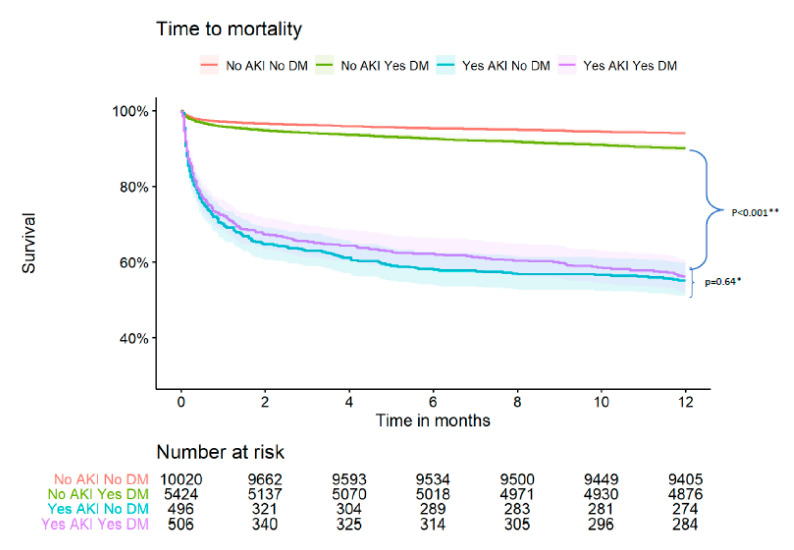
We performed a comparative evaluation of ACS patients with vs. without DM who developed AKI enrolled in the biennial ACS Israeli Surveys (ACSIS) between 2000 and 2018. AKI was defined as an absolute increase in serum creatinine (≥0.5 mg/dL) or above 1.5 mg/dL or new renal replacement therapy upon admission with ACS. Outcomes included 30-day major adverse cardiovascular events (MACE) and 1-year all-cause mortality.
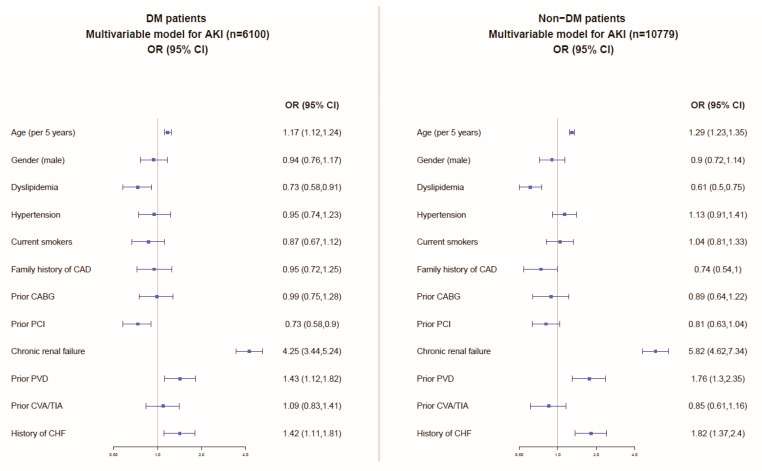
The current study included a total of 16,879 patients, median age 64 (IQR 54-74), 77% males, 36% with DM. The incidence of AKI was significantly higher among patients with vs. without DM (8.4% vs. 4.7%, < 0.001). The rates of 30-day MACE (40.8% vs. 13.4%, < 0.001) and 1-year mortality (43.7% vs. 10%, < 0.001) were significantly greater among diabetic patients who developed vs. those who did not develop AKI respectively, yet very similar among patients that developed AKI with vs. without DM (30-day MACE 40.8% vs. 40.3%, = 0.9 1-year mortality 43.7 vs. 44.8%, = 0.8, respectively). Multivariate analyses adjusted to potential confounders, showed similar independent predictors of AKI among patients with and without DM, comprising; older age, chronic kidney disease, congestive heart failure, and peripheral arterial disease.
Although patients with DM are at much greater risk for AKI when admitted with ACS, the independent predictors of AKI and the worse patient outcomes when AKI occurs, are similar irrespective to DM status.
评估糖尿病在急性冠状动脉综合征(ACS)患者急性肾损伤(AKI)的发生率、危险因素及预后中的作用。
我们对2000年至2018年参加两年一次的以色列急性冠状动脉综合征调查(ACSIS)且发生AKI的糖尿病ACS患者与非糖尿病ACS患者进行了比较评估。AKI定义为血清肌酐绝对升高(≥0.5mg/dL)或高于1.5mg/dL,或在因ACS入院时开始新的肾脏替代治疗。结局包括30天主要不良心血管事件(MACE)和1年全因死亡率。
本研究共纳入16879例患者,中位年龄64岁(四分位间距54 - 74岁),男性占77%,糖尿病患者占36%。糖尿病患者与非糖尿病患者相比,AKI的发生率显著更高(8.4%对4.7%,P<0.001)。发生AKI的糖尿病患者与未发生AKI的糖尿病患者相比,30天MACE发生率(40.8%对13.4%,P<0.001)和1年死亡率(43.7%对10%,P<0.001)显著更高,但发生AKI的糖尿病患者与非糖尿病患者相比则非常相似(30天MACE:40.8%对40.3%,P = 0.9;1年死亡率:43.7%对44.8%,P = 0.8)。对潜在混杂因素进行调整的多变量分析显示,糖尿病患者与非糖尿病患者中AKI的独立预测因素相似,包括年龄较大、慢性肾脏病、充血性心力衰竭和外周动脉疾病。
虽然糖尿病患者因ACS入院时发生AKI的风险要高得多,但无论糖尿病状态如何,AKI的独立预测因素以及AKI发生时较差的患者结局是相似的。