Benetos Georgios, Galanakos Spyros, Koutagiar Iosif, Skoumas Ioannis, Oikonomou Georgios, Drakopoulou Maria, Karmpalioti Maria, Katsi Vasiliki, Tsioufis Costas, Toutouzas Konstantinos
First Department of Cardiology, National & Kapodistrian University of Athens, 11527 Athens, Greece.
First Department of Cardiology, Hygheia Hospital, 15123 Marousi, Greece.
J Clin Med. 2021 Oct 27;10(21):5008. doi: 10.3390/jcm10215008.
Microwave radiometry (MWR) assesses non-invasive carotid artery temperatures reflecting inflammation. In the present study, we aimed to investigate the impact of hypolipidemic therapy either with simvastatin or with combination simvastatin plus ezetimibe on carotid artery temperatures of patients with familial hyperlipidemia syndromes (FHS).
Consecutive patients with diagnosis of either familial heterozygous hypercholesterolemia (heFH) or familial combined hyperlipidemia (FCH) were included in the study. Patients were assigned to either simvastatin 40 mg or simvastatin 40 mg plus ezetimibe 10 mg, according to the discretion of the physician. FHS patients who refused statin therapy were used as a control group. Common carotid intima-media thickness (ccIMT) was measured and ΔΤ (maximum-minimum) temperature measurements were performed across each carotid during MWR evaluation.
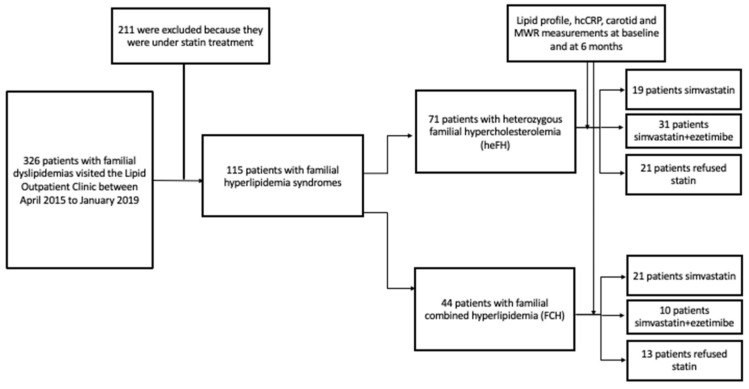
In total, 115 patients were included in the study. Of them, 40 patients received simvastatin (19 heFH and 21 FCH), 41 simvastatin + ezetimibe (31 heFH and 10 FCH), and 34 (21 heFH and 13 FCH) no statin. Carotid artery temperatures were significantly reduced at 6 months in FH patients who received hypolipidemic treatment (0.83 ± 0.34 versus 0.63 ± 0.24 °C, = 0.004 for simvastatin, 1.00 ± 0.38 versus 0.69 ± 0.23 °C, < 0.001 for simvastatin + ezetimibe), but no change was recorded in controls (0.72 ± 0.26 versus 0.70 ± 0.26 °C, = 0.86).
Hypolipidemic therapy reduced carotid temperatures in FHS patients.
微波辐射测量法(MWR)可评估反映炎症的无创颈动脉温度。在本研究中,我们旨在调查辛伐他汀或辛伐他汀联合依折麦布进行降脂治疗对家族性高脂血症综合征(FHS)患者颈动脉温度的影响。
连续纳入诊断为家族性杂合子高胆固醇血症(heFH)或家族性混合性高脂血症(FCH)的患者。根据医生的判断,患者被分配接受40mg辛伐他汀或40mg辛伐他汀加10mg依折麦布治疗。拒绝他汀类药物治疗的FHS患者作为对照组。测量颈总动脉内膜中层厚度(ccIMT),并在MWR评估期间对每个颈动脉进行ΔΤ(最高-最低)温度测量。
本研究共纳入115例患者。其中,40例患者接受辛伐他汀治疗(19例heFH和21例FCH),41例接受辛伐他汀+依折麦布治疗(31例heFH和10例FCH),34例(其中21例heFH和13例FCH)未接受他汀类药物治疗。接受降脂治疗的FH患者在6个月时颈动脉温度显著降低(辛伐他汀组为0.83±0.34对0.63±0.24°C,P = 0.004;辛伐他汀+依折麦布组为1.00±0.38对0.69±0.23°C,P<0.001),但对照组无变化(0.72±0.26对0.70±0.26°C,P = 0.86)。
降脂治疗降低了FHS患者的颈动脉温度。