Laboratory of Pathoneurochemistry, Department of Neurochemistry, Mossakowski Medical Research Institute, Polish Academy of Sciences, 5 Pawińskiego Str., 02-106 Warsaw, Poland.
Int J Mol Sci. 2021 Oct 20;22(21):11330. doi: 10.3390/ijms222111330.
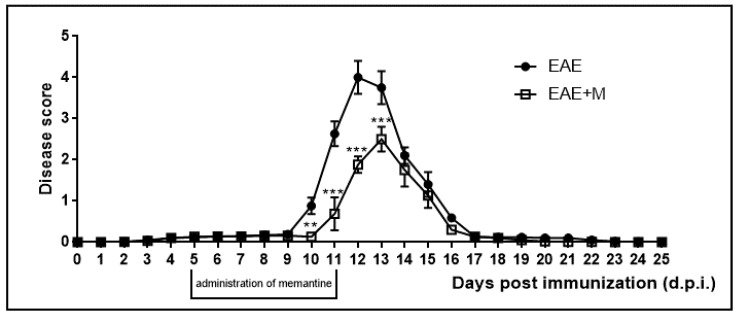
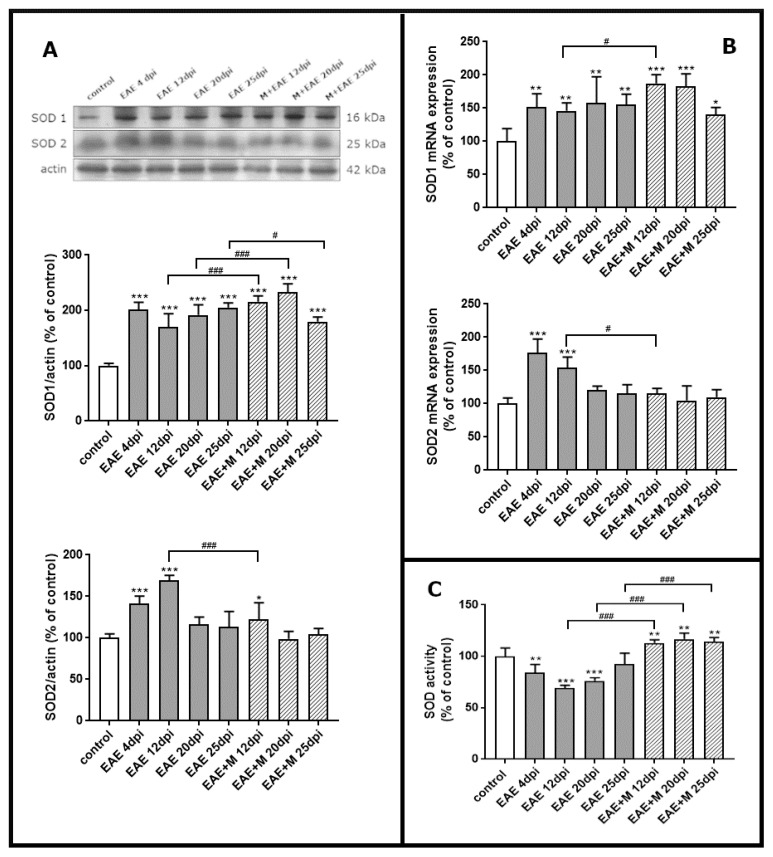
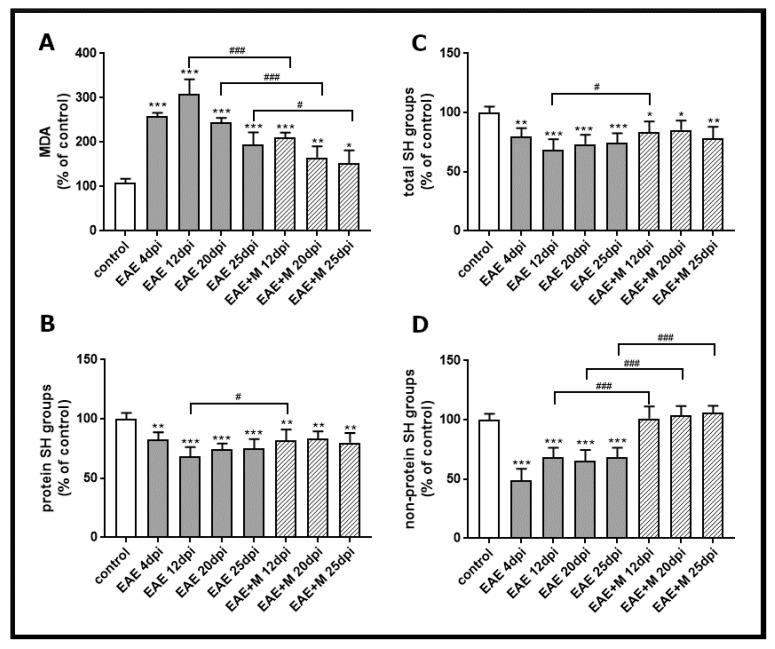
Experimental autoimmune encephalomyelitis (EAE) is an animal model most commonly used in research on the pathomechanisms of multiple sclerosis (MS). The inflammatory processes, glutamate excitotoxicity, and oxidative stress have been proposed as determinants accompanying demyelination and neuronal degeneration during the course of MS/EAE. The aim of the current study was to characterize the role of NMDA receptors in the induction of oxidative stress during the course of EAE. The effect of memantine, the uncompetitive NMDA receptor antagonist, on modulation of neurological deficits and oxidative stress in EAE rats was analyzed using several experimental approaches. We demonstrated that the expression of antioxidative enzymes (superoxide dismutases SOD1 and SOD2) were elevated in EAE rat brains. Under the same experimental conditions, we observed alterations in oxidative stress markers such as increased levels of malondialdehyde (MDA) and decreased levels of sulfhydryl (-SH) groups, both protein and non-protein (indicating protein damage), and a decline in reduced glutathione. Importantly, pharmacological inhibition of ionotropic NMDA glutamate receptors by their antagonist memantine improved the physical activity of EAE rats, alleviated neurological deficits such as paralysis of tail and hind limbs, and modulated oxidative stress parameters (MDA, -SH groups, SOD's). Furthermore, the current therapy aiming to suppress NMDAR-induced oxidative stress was partially effective when NMDAR's antagonist was administered at an early (asymptomatic) stage of EAE.
实验性自身免疫性脑脊髓炎(EAE)是研究多发性硬化症(MS)发病机制最常用的动物模型。在 MS/EAE 过程中,炎症过程、谷氨酸兴奋性毒性和氧化应激被认为是脱髓鞘和神经元变性伴随的决定因素。本研究旨在探讨 NMDA 受体在 EAE 过程中诱导氧化应激中的作用。使用几种实验方法分析了非竞争性 NMDA 受体拮抗剂美金刚对 EAE 大鼠神经功能缺损和氧化应激的调节作用。我们证明了抗氧化酶(超氧化物歧化酶 SOD1 和 SOD2)在 EAE 大鼠大脑中的表达升高。在相同的实验条件下,我们观察到氧化应激标志物的改变,如丙二醛(MDA)水平升高和巯基(-SH)基团水平降低,包括蛋白质和非蛋白质(表明蛋白质损伤),以及还原型谷胱甘肽水平下降。重要的是,通过其拮抗剂美金刚抑制离子型 NMDA 谷氨酸受体可改善 EAE 大鼠的活动能力,减轻瘫痪尾巴和后腿等神经功能缺损,并调节氧化应激参数(MDA、-SH 基团、SOD)。此外,当在 EAE 的早期(无症状)阶段给予 NMDA 受体拮抗剂时,旨在抑制 NMDAR 诱导的氧化应激的当前治疗方法部分有效。