School of Health Sciences, College of Health, Medicine and Wellbeing, University of New-Castle, Callaghan, NSW 2308, Australia.
Priority Research Centre for Stroke and Brain Injury, Hunter Medical Research Institute, New Lambton Heights, NSW 2308, Australia.
Int J Environ Res Public Health. 2021 Oct 30;18(21):11448. doi: 10.3390/ijerph182111448.
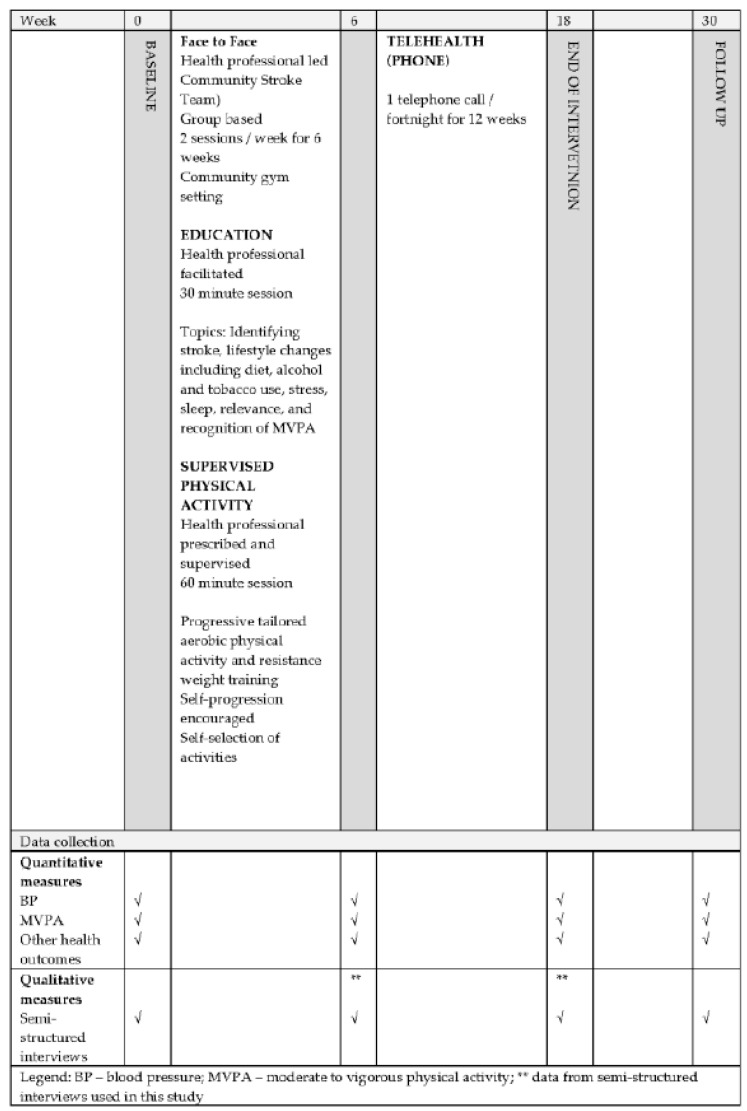
People who have had a transient ischemic attack (TIA) or mild stroke have a high risk of recurrent stroke. Secondary prevention programs providing support for meeting physical activity recommendations may reduce this risk. Most evidence for the feasibility and effectiveness of secondary stroke prevention arises from programs developed and tested in research institute settings with limited evidence for the acceptability of programs in 'real world' community settings. This qualitative descriptive study explored perceptions of participation in a secondary stroke prevention program (delivered by a community-based multidisciplinary health service team within a community gym) by adults with TIA or mild stroke. Data gathered via phone-based semi-structured interviews midway through the program, and at the end of the program, were analyzed using constructivist grounded theory methods. A total of 51 interviews from 30 participants produced two concepts. The first concept, "What it offered me", describes critical elements that shape participants' experience of the program. The second concept, "What I got out of it" describes perceived benefits of program participation. Participants perceived that experiences with peers in a health professional-led group program, held within a community-based gym, supported their goal of changing behaviour. Including these elements during the development of health service strategies to reduce recurrent stroke risk may strengthen program acceptability and subsequent effectiveness.
曾经历短暂性脑缺血发作(TIA)或轻度中风的人有很高的中风复发风险。为满足身体活动建议而提供支持的二级预防计划可能会降低这种风险。大多数关于二级中风预防的可行性和有效性的证据来自于在研究所环境中制定和测试的计划,而在“真实世界”社区环境中,这些计划的可接受性的证据有限。这项定性描述性研究探讨了 TIA 或轻度中风成年人对二级中风预防计划(由社区健身房内的社区多学科医疗服务团队提供)参与的看法。通过在计划进行到一半和结束时进行基于电话的半结构化访谈收集数据,并使用建构主义扎根理论方法进行分析。共有 30 名参与者的 51 次访谈产生了两个概念。第一个概念“它为我提供了什么”描述了塑造参与者对计划体验的关键要素。第二个概念“我从中得到了什么”描述了参与计划的好处。参与者认为,在以健康专业人员为领导的团体计划中与同龄人一起在社区健身房内进行的体验,支持了他们改变行为的目标。在制定减少中风复发风险的卫生服务策略时纳入这些要素,可能会增强计划的可接受性和随后的效果。