Department of Pediatrics, School of Medicine, University of Virginia, Charlottesville, VA 22903, USA.
Department of Paediatrics and Child Health, Aga Khan University, Karachi 74800, Pakistan.
Int J Environ Res Public Health. 2021 Nov 7;18(21):11691. doi: 10.3390/ijerph182111691.
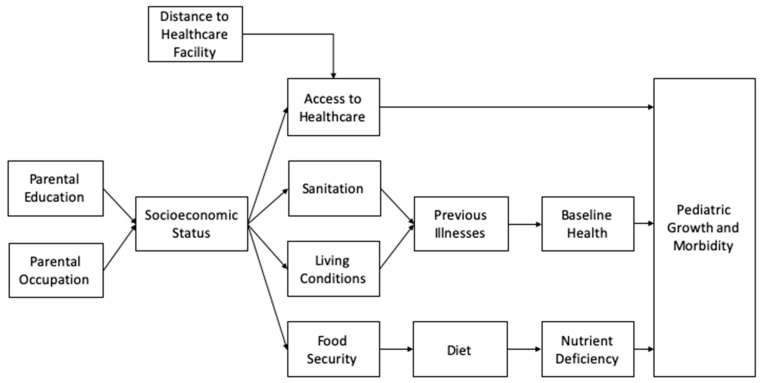
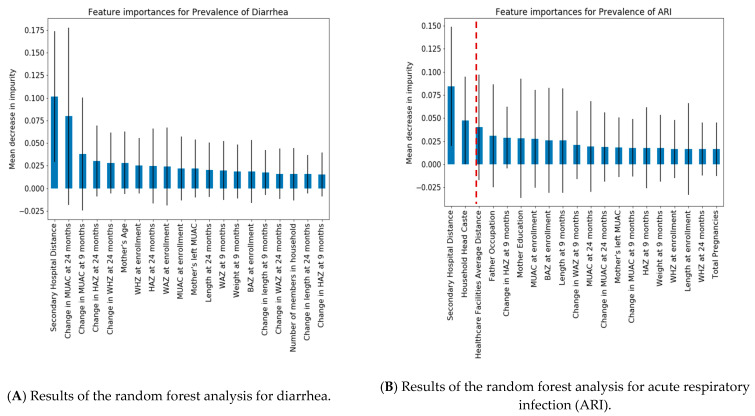
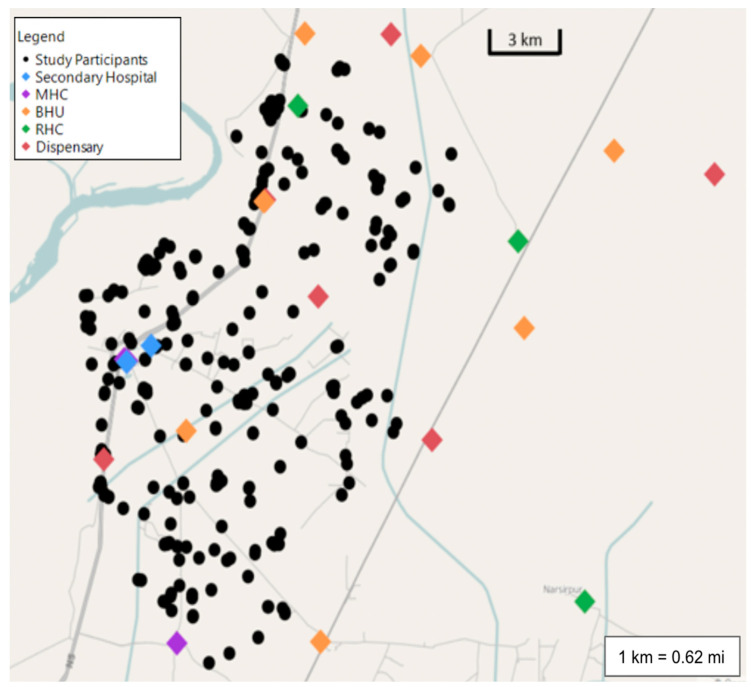
The relationship between environmental factors and child health is not well understood in rural Pakistan. This study characterized the environmental factors related to the morbidity of acute respiratory infections (ARIs), diarrhea, and growth using geographical information systems (GIS) technology. Anthropometric, address and disease prevalence data were collected through the SEEM (Study of Environmental Enteropathy and Malnutrition) study in Matiari, Pakistan. Publicly available map data were used to compile coordinates of healthcare facilities. A Pearson correlation coefficient () was used to calculate the correlation between distance from healthcare facilities and participant growth and morbidity. Other continuous variables influencing these outcomes were analyzed using a random forest regression model. In this study of 416 children, we found that participants living closer to secondary hospitals had a lower prevalence of ARI ( = 0.154, < 0.010) and diarrhea (r = 0.228, < 0.001) as well as participants living closer to Maternal Health Centers (MHCs): ARI ( = 0.185, < 0.002) and diarrhea ( = 0.223, < 0.001) compared to those living near primary facilities. Our random forest model showed that distance has high variable importance in the context of disease prevalence. Our results indicated that participants closer to more basic healthcare facilities reported a higher prevalence of both diarrhea and ARI than those near more urban facilities, highlighting potential public policy gaps in ameliorating rural health.
在巴基斯坦农村,环境因素与儿童健康之间的关系尚未得到充分了解。本研究使用地理信息系统(GIS)技术描述了与急性呼吸道感染(ARI)、腹泻和生长相关的环境因素。在巴基斯坦的 Matiari,通过 SEEM(环境肠病和营养不良研究)研究收集了人体测量、地址和疾病流行数据。公共地图数据被用来编制医疗设施的坐标。Pearson 相关系数()用于计算距离医疗设施与参与者生长和发病之间的相关性。使用随机森林回归模型分析了影响这些结果的其他连续变量。在这项对 416 名儿童的研究中,我们发现,居住在二级医院附近的参与者患 ARI( = 0.154, < 0.010)和腹泻(r = 0.228, < 0.001)的患病率较低,而居住在孕产妇保健中心(MHC)附近的参与者:ARI( = 0.185, < 0.002)和腹泻( = 0.223, < 0.001)与居住在初级设施附近的参与者相比。我们的随机森林模型表明,距离在疾病流行方面具有很高的变量重要性。我们的研究结果表明,与靠近城市设施的参与者相比,靠近基本医疗设施的参与者报告腹泻和 ARI 的患病率更高,这突显了改善农村健康方面的潜在公共政策差距。