Department of Paediatrics and Child Health, Aga Khan University, Karachi, Pakistan.
Department of Biological and Biomedical Sciences, Aga Khan University, Karachi, Pakistan.
BMC Pediatr. 2019 Jul 22;19(1):247. doi: 10.1186/s12887-019-1564-x.
Environmental Enteropathy (EE), characterized by alterations in intestinal structure, function, and immune activation, is believed to be an important contributor to childhood undernutrition and its associated morbidities, including stunting. Half of all global deaths in children < 5 years are attributable to under-nutrition, making the study of EE an area of critical priority.
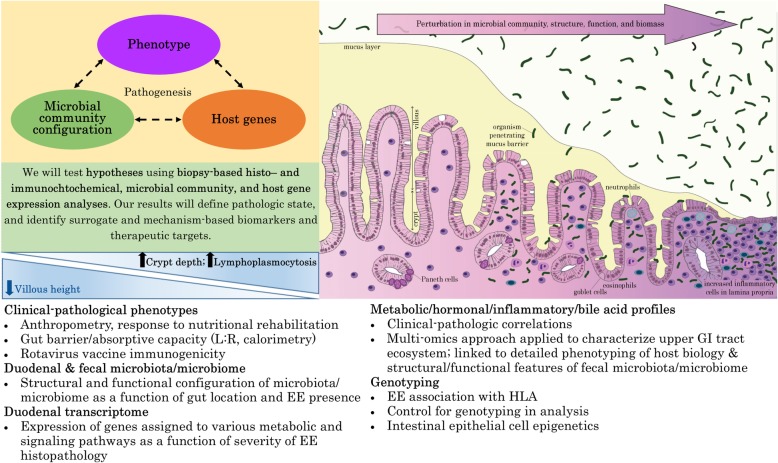
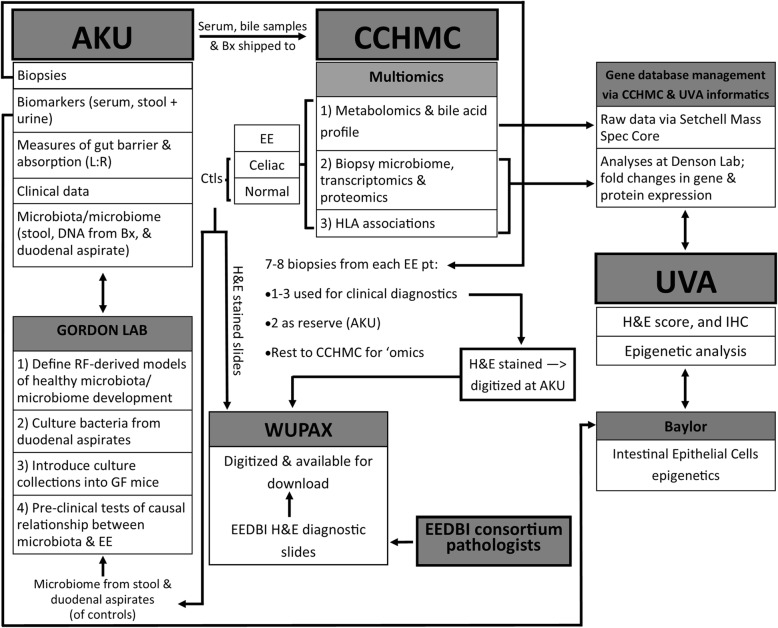
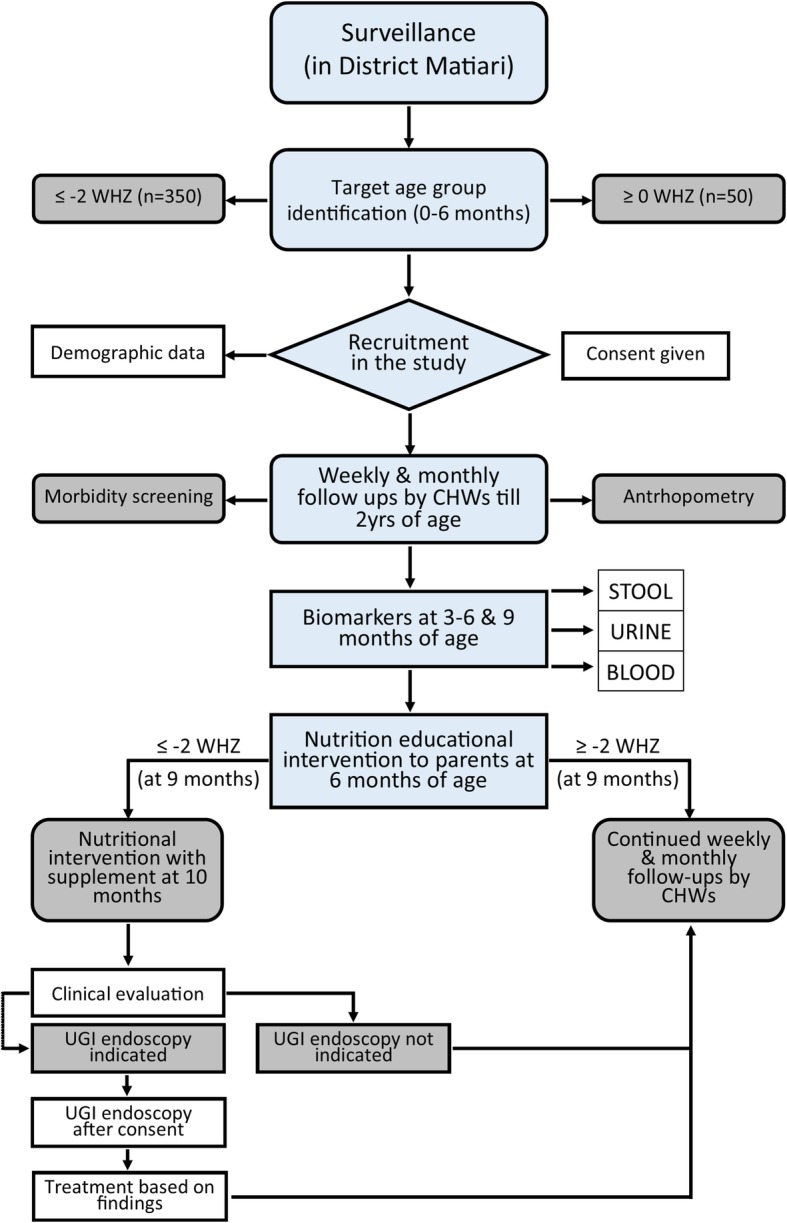
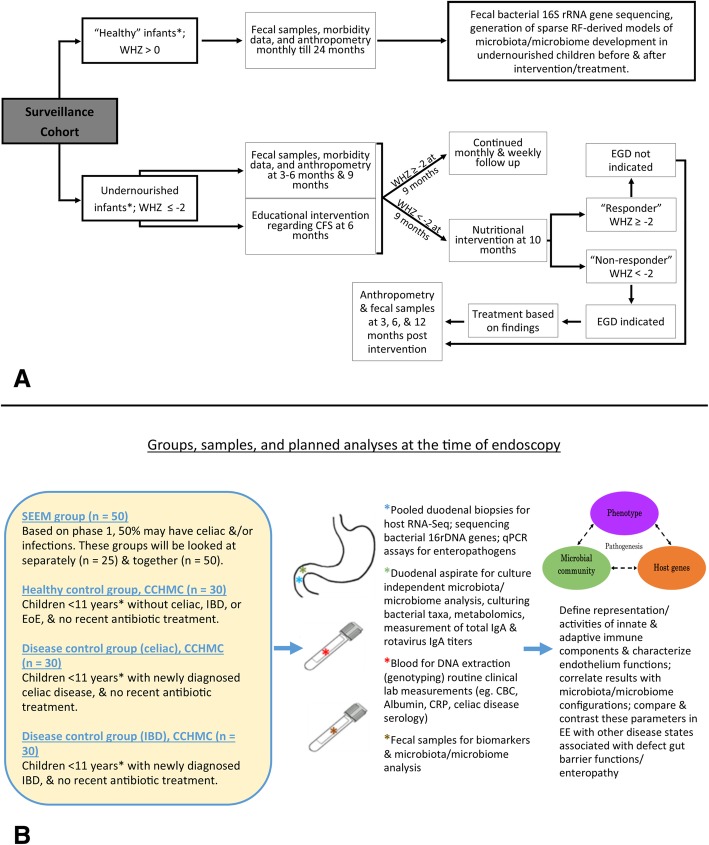
Community based intervention study, divided into two sub-studies, 1) Longitudinal analyses and 2) Biopsy studies for identification of EE features via omics analyses. Birth cohorts in Matiari, Pakistan established: moderately or severely malnourished (weight for height Z score (WHZ) < - 2) children, and well-nourished (WHZ > 0) children. Blood, urine, and fecal samples, for evaluation of potential biomarkers, will be collected at various time points from all participants (longitudinal analyses). Participants will receive appropriate educational and nutritional interventions; non-responders will undergo further evaluation to determine eligibility for further workup, including upper gastrointestinal endoscopy. Histopathological changes in duodenal biopsies will be compared with duodenal biopsies obtained from USA controls who have celiac disease, Crohn's disease, or who were found to have normal histopathology. RNA-Seq will be employed to characterize mucosal gene expression across groups. Duodenal biopsies, luminal aspirates from the duodenum, and fecal samples will be analyzed to define microbial community composition (omic analyses). The relationship between histopathology, mucosal gene expression, and community configuration will be assessed using a variety of bioinformatic tools to gain better understanding of disease pathogenesis and to identify mechanism-based biomarkers. Ethical review committees at all collaborating institutions have approved this study. All results will be made available to the scientific community.
Operational and ethical constraints for safely obtaining intestinal biopsies from children in resource-poor settings have led to a paucity of human tissue-based investigations to understand and reverse EE in vulnerable populations. Furthermore, EE biomarkers have rarely been correlated with gold standard histopathological confirmation. The Study of Environmental Enteropathy and Malnutrition (SEEM) is designed to better understand the pathophysiology, predictors, biomarkers, and potential management strategies of EE to inform strategies to eradicate this debilitating pathology and accelerate progress towards the 2030 Sustainable Development Goals.
Retrospectively registered; clinicaltrials.gov ID NCT03588013 .
环境肠病(EE)的特征是肠道结构、功能和免疫激活的改变,被认为是导致儿童营养不良及其相关疾病(包括发育迟缓)的重要因素。全球 5 岁以下儿童中有一半的死亡归因于营养不良,因此 EE 的研究是一个至关重要的优先事项。
以社区为基础的干预研究,分为两个子研究,1)纵向分析和 2)通过组学分析识别 EE 特征的活检研究。在巴基斯坦马蒂亚里建立了出生队列:中重度营养不良(身高体重 Z 评分(WHZ)< -2)儿童和营养良好(WHZ>0)儿童。将从所有参与者收集血液、尿液和粪便样本,以评估潜在的生物标志物(纵向分析)。参与者将接受适当的教育和营养干预;未应答者将进行进一步评估,以确定是否有资格进行进一步检查,包括上消化道内窥镜检查。十二指肠活检的组织病理学变化将与美国对照组的十二指肠活检进行比较,这些对照组患有乳糜泻、克罗恩病或发现组织病理学正常。RNA-Seq 将用于描述跨组的粘膜基因表达。将分析十二指肠活检、十二指肠内腔抽吸物和粪便样本,以定义微生物群落组成(组学分析)。将使用各种生物信息学工具评估组织病理学、粘膜基因表达和社区结构之间的关系,以更好地了解疾病发病机制并确定基于机制的生物标志物。所有合作机构的伦理审查委员会均批准了该研究。所有结果都将提供给科学界。
在资源匮乏的环境中安全获取儿童肠道活检的操作和伦理限制导致了人类组织学研究的缺乏,无法了解和逆转脆弱人群中的 EE。此外,EE 生物标志物很少与金标准组织病理学确认相关。环境肠病和营养不良研究(SEEM)旨在更好地了解 EE 的病理生理学、预测因素、生物标志物和潜在管理策略,为消除这种使人衰弱的病理提供信息,并加速实现 2030 年可持续发展目标的进展。
回顾性注册;clinicaltrials.gov ID NCT03588013。