Robots and Production System Department, University Politehnica of Bucharest, Splaiul Independenței 313, 060041 Bucharest, Romania.
Sensors (Basel). 2021 Nov 3;21(21):7329. doi: 10.3390/s21217329.
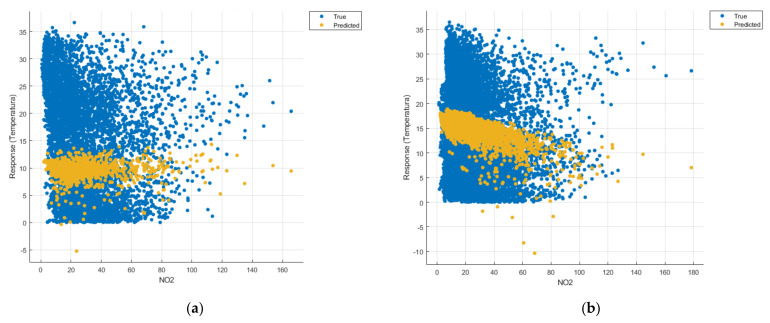
Air pollution has become the most important issue concerning human evolution in the last century, as the levels of toxic gases and particles present in the air create health problems and affect the ecosystems of the planet. Scientists and environmental organizations have been looking for new ways to combat and control the air pollution, developing new solutions as technologies evolves. In the last decade, devices able to observe and maintain pollution levels have become more accessible and less expensive, and with the appearance of the Internet of Things (IoT), new approaches for combating pollution were born. The focus of the research presented in this paper was predicting behaviours regarding the air quality index using machine learning. Data were collected from one of the six atmospheric stations set in relevant areas of Bucharest, Romania, to validate our model. Several algorithms were proposed to study the evolution of temperature depending on the level of pollution and on several pollution factors. In the end, the results generated by the algorithms are presented considering the types of pollutants for two distinct periods. Prediction errors were highlighted by the RMSE (Root Mean Square Error) for each of the three machine learning algorithms used.
空气污染已成为上个世纪人类进化过程中最重要的问题,因为空气中存在的有毒气体和颗粒水平会引发健康问题并影响地球的生态系统。科学家和环保组织一直在寻找新的方法来对抗和控制空气污染,随着技术的发展,他们不断开发新的解决方案。在过去十年中,能够观察和维持污染水平的设备变得更加普及和便宜,随着物联网(IoT)的出现,出现了新的污染治理方法。本文提出的研究重点是使用机器学习来预测空气质量指数的行为。数据是从罗马尼亚布加勒斯特相关地区的六个大气站中的一个收集的,以验证我们的模型。提出了几种算法来研究温度随污染水平和几个污染因素的变化而变化的情况。最后,根据两种不同时期的污染物类型,展示了算法产生的结果。通过每个三种使用的机器学习算法的均方根误差(RMSE)来突出预测误差。