Oncology Clinic, University Clinical Hospital Mostar, Mostar, Bosnia and Herzegovina.
Clinic of Oncology, Clinical Center University of Sarajevo, Sarajevo, Bosnia and Herzegovina.
Med Sci Monit. 2021 Nov 13;27:e932788. doi: 10.12659/MSM.932788.
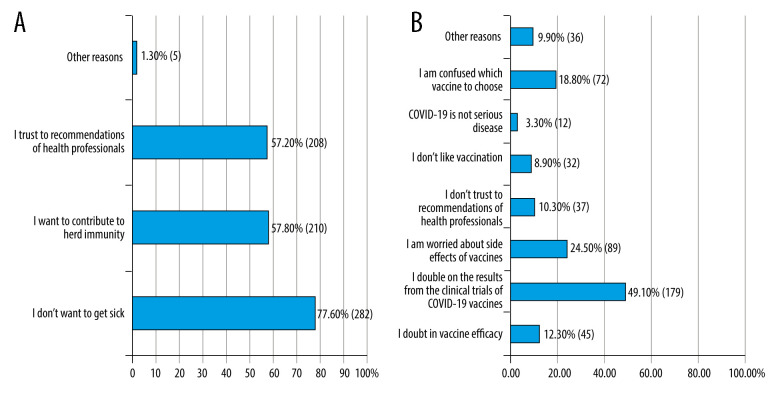
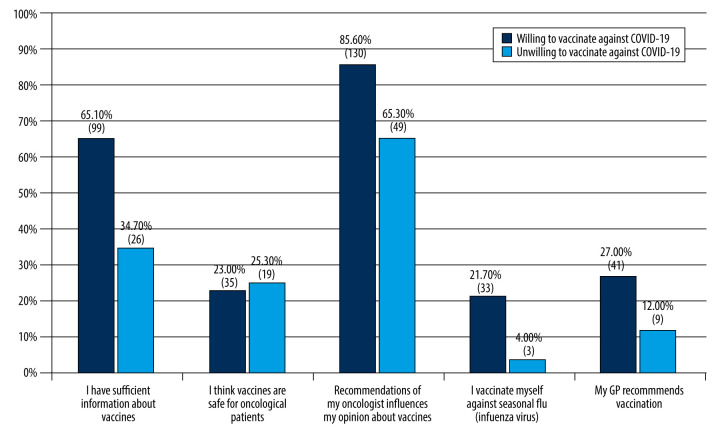
BACKGROUND The pandemic of Coronavirus infectious disease 2019 (COVID-19) poses a major public health challenge, and an effective vaccine is the potential mechanism to resolve this specific situation. The present study aimed to evaluate acceptance of COVID-19 vaccination among patients attending the Oncology Clinic of University Clinical Hospital Mostar. MATERIAL AND METHODS This cross-sectional observational study enrolled 364 patients with cancer from the Oncology Clinic of University Clinical Hospital Mostar during February 2021. Data were collected using a questionnaire that captured general information about the participants and their attitudes toward COVID-19 vaccination. RESULTS Of the participants, 41.8% answered "Yes" when asked if they would take the vaccine once it becomes available, 37.6% answered "Not sure", and 20.6% answered "No". For patients in favor of vaccination, the main reasons reported were fear of getting sick (77.6%), the desire to contribute to herd immunity (57.8%), and trusting the recommendations of health professionals (57.2%). The main reasons for the patients' vaccination -refusal/indecision were doubts about the results from clinical trials of COVID-19 vaccines (49.1%), concerns about adverse effects (24.5%), and confusion about the various vaccine options (19.8%). The majority of participants (82.4%) stated that recommendation by their oncologist could influence their decision about vaccination. Of the participants who indicated unwillingness (refusal or indecision) to be vaccinated against COVID-19, 65.3% stated that recommendation by their oncologist could influence their decision about vaccination. CONCLUSIONS The findings from the present study showed most patients had refused or were indecisive regarding immunization with COVID-19 vaccine. Increasing physician awareness of this situation may result in higher rates of vaccination.
2019 年冠状病毒传染病(COVID-19)大流行构成了重大公共卫生挑战,而有效的疫苗是解决这一特殊情况的潜在机制。本研究旨在评估在莫斯塔尔大学临床医院肿瘤诊所就诊的患者对 COVID-19 疫苗接种的接受程度。
本横断面观察性研究纳入了 2021 年 2 月在莫斯塔尔大学临床医院肿瘤诊所就诊的 364 名癌症患者。使用问卷收集参与者的一般信息及其对 COVID-19 疫苗接种的态度。
在被问及一旦疫苗可用是否会接种时,41.8%的参与者回答“是”,37.6%回答“不确定”,20.6%回答“否”。对于赞成接种疫苗的患者,报告的主要原因是担心生病(77.6%)、希望为群体免疫做出贡献(57.8%)和信任卫生专业人员的建议(57.2%)。患者拒绝/犹豫不决接种疫苗的主要原因是对 COVID-19 疫苗临床试验结果的怀疑(49.1%)、对不良反应的担忧(24.5%)和对各种疫苗选择的困惑(19.8%)。大多数参与者(82.4%)表示,肿瘤医生的建议可能会影响他们对疫苗接种的决定。在表示不愿意(拒绝或犹豫不决)接种 COVID-19 疫苗的参与者中,65.3%表示肿瘤医生的建议可能会影响他们对疫苗接种的决定。
本研究结果表明,大多数患者对 COVID-19 疫苗接种持拒绝或犹豫不决的态度。提高医生对这一情况的认识可能会导致更高的疫苗接种率。