Liu Shu, Zhang Yewei, Cui Shien, Song Dajiang, Li Bo, Chen Qian, Yao Guangyu, Gong Bin
Department of Breast Surgery, The Affiliated Hospital of Guizhou Medical University, Guiyang, 550001, Guizhou, People's Republic of China.
Guizhou Medical University, Guiyang, Guizhou, China.
Cancer Cell Int. 2021 Nov 13;21(1):605. doi: 10.1186/s12935-021-02301-3.
Breast cancer is a common cancer among women in the world. However, its pathogenesis is still to be determined. The role and molecular mechanism of Nucleosome Assembly Protein 1 Like 1 (NAP1L1) in breast cancer have not been reported. Elucidation of molecular mechanism might provide a novel therapeutic target for breast cancer treatment.
A bioinformatics analysis was conducted to determine the differential expression of NAP1L1 in breast cancer and find the potential biomarker that interacts with NAP1L1 and hepatoma-derived growth factor (HDGF). The expression of NAP1L1 in tissues was detected by using immunohistochemistry. Breast cancer cells were transfected with the corresponding lentiviral particles and siRNA. The efficiency of transfection was measured by RT-qPCR and western blotting. Then, MTT, Edu, plate clone formation, and subcutaneous tumorigenesis in nude mice were used to detect the cell proliferation in breast cancer. Furthermore, coimmunoprecipitation (Co-IP) assay and confocal microscopy were performed to explore the detailed molecular mechanism of NAP1L1 in breast cancer.
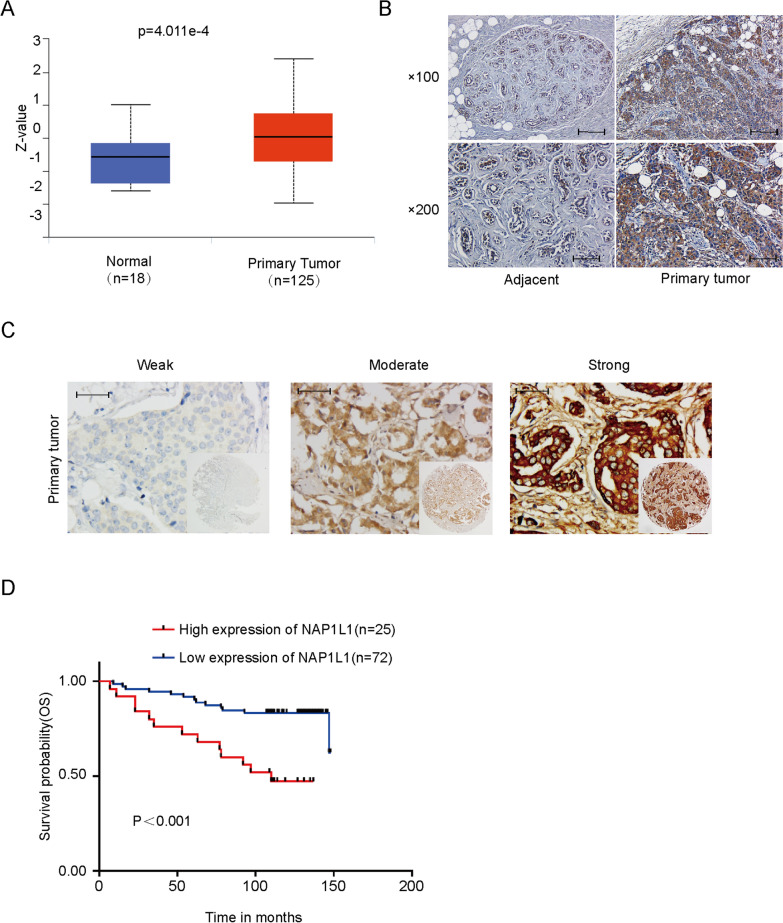
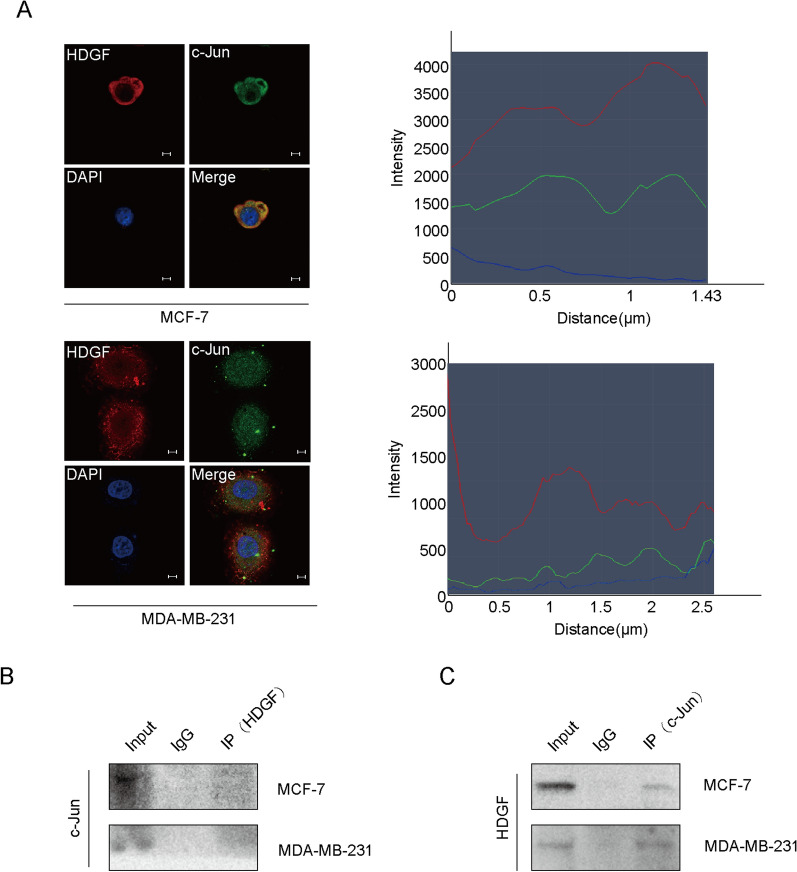
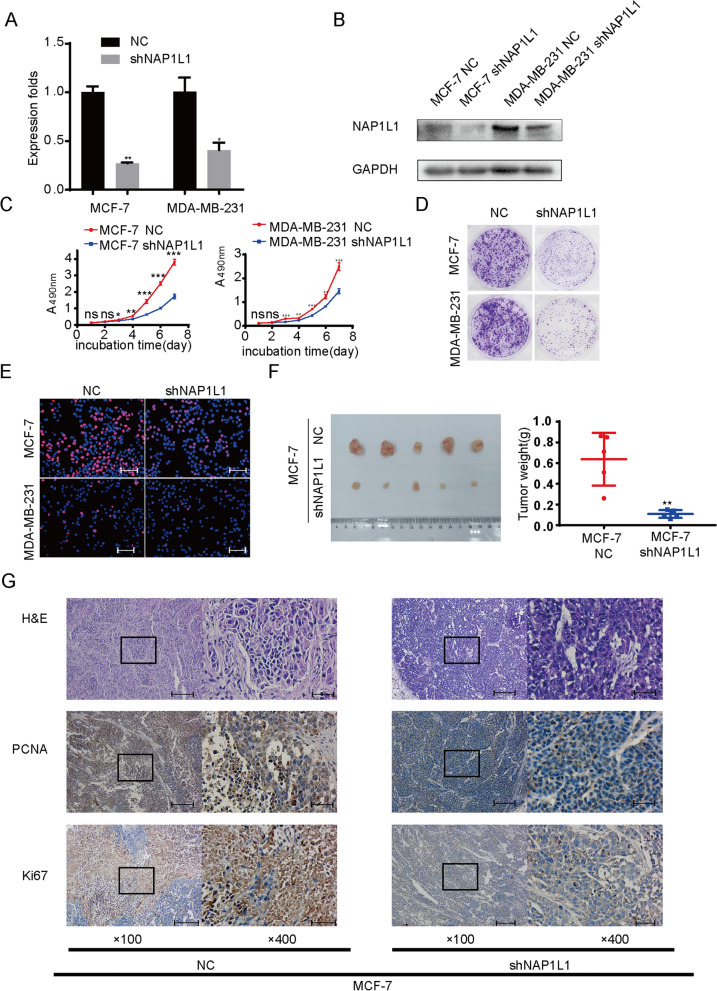
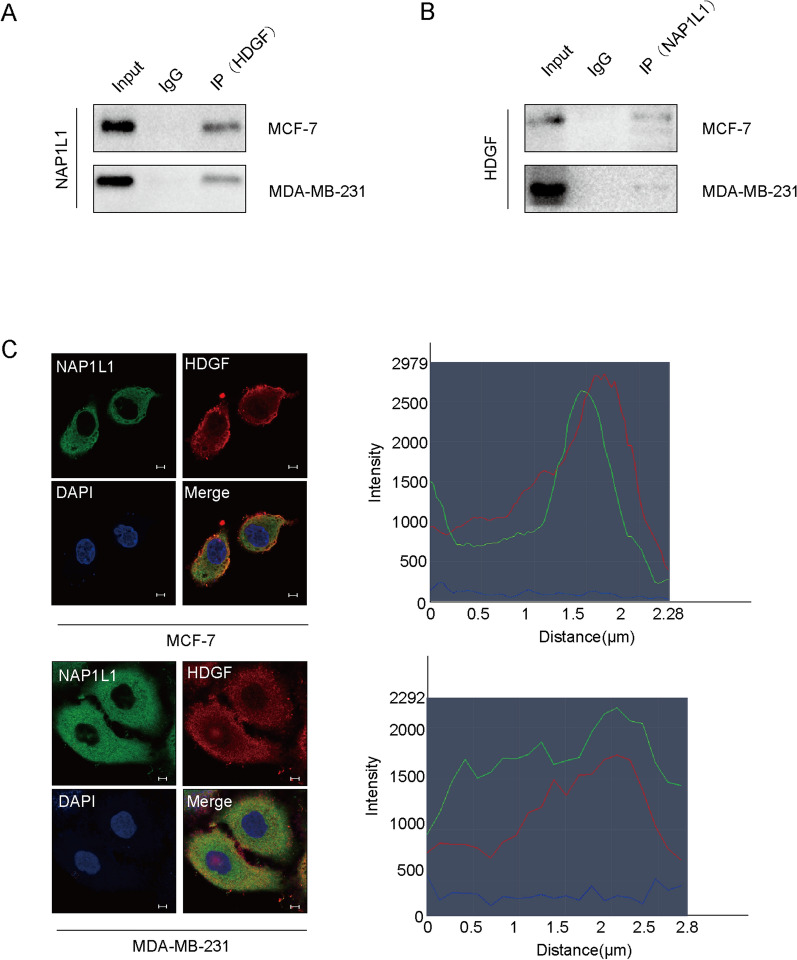
In this study, NAP1L1 protein was upregulated based on the Clinical Proteomic Tumor Analysis Consortium (CPTAC) database. Consistent with the prediction, immunohistochemistry staining showed that NAP1L1 protein expression was significantly increased in breast cancer tissues. Its elevated expression was an unfavorable factor for breast cancer clinical progression and poor prognosis. Stably or transiently knocking down NAP1L1 reduced the cell growth in vivo and in vitro via repressing the cell cycle signal in breast cancer. Furthermore, the molecular basis of NAP1L1-induced cell cycle signal was further studied. NAP1L1 interacted with the HDGF, an oncogenic factor for tumors, and the latter subsequently recruited the key oncogenic transcription factor c-Jun, which finally induced the expression of cell cycle promoter Cyclin D1(CCND1) and thus the cell growth of breast cancer.
Our data demonstrated that NAP1L1 functions as a potential oncogene via interacting with HDGF to recruit c-Jun in breast cancer.
乳腺癌是全球女性中常见的癌症。然而,其发病机制仍有待确定。核小体组装蛋白1样蛋白1(NAP1L1)在乳腺癌中的作用及分子机制尚未见报道。阐明分子机制可能为乳腺癌治疗提供新的治疗靶点。
进行生物信息学分析,以确定NAP1L1在乳腺癌中的差异表达,并寻找与NAP1L1和肝癌衍生生长因子(HDGF)相互作用的潜在生物标志物。采用免疫组织化学法检测组织中NAP1L1的表达。用相应的慢病毒颗粒和小干扰RNA转染乳腺癌细胞。通过逆转录定量聚合酶链反应(RT-qPCR)和蛋白质免疫印迹法检测转染效率。然后,采用MTT法、Edu法、平板克隆形成法和裸鼠皮下成瘤法检测乳腺癌细胞的增殖情况。此外,进行免疫共沉淀(Co-IP)分析和共聚焦显微镜检查,以探讨NAP1L1在乳腺癌中的详细分子机制。
在本研究中,基于临床蛋白质组肿瘤分析联盟(CPTAC)数据库,NAP1L1蛋白表达上调。与预测结果一致,免疫组织化学染色显示,乳腺癌组织中NAP1L1蛋白表达显著增加。其表达升高是乳腺癌临床进展和预后不良的不利因素。稳定或瞬时敲低NAP1L1可通过抑制乳腺癌细胞周期信号,降低体内外细胞生长。此外,进一步研究了NAP1L1诱导细胞周期信号的分子基础。NAP1L1与肿瘤致癌因子HDGF相互作用,后者随后招募关键致癌转录因子c-Jun,最终诱导细胞周期启动子细胞周期蛋白D1(CCND1)的表达,从而促进乳腺癌细胞生长。
我们的数据表明,NAP1L1在乳腺癌中通过与HDGF相互作用招募c-Jun发挥潜在癌基因的作用。