Department of Philosophy, Sociology, Education and Applied Psychology, FISPPA, University of Padua, Padua, Italy.
Human Inspired Technology Research Centre - HIT.
Eur J Neurol. 2022 Mar;29(3):691-697. doi: 10.1111/ene.15183. Epub 2021 Dec 5.
Many different factors have been hypothesized to modulate cognition in an aging population according to their functioning at baseline.
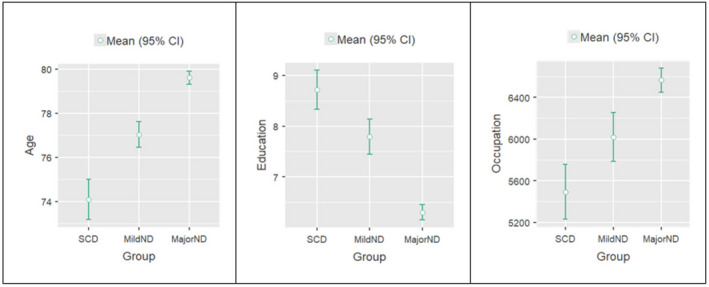
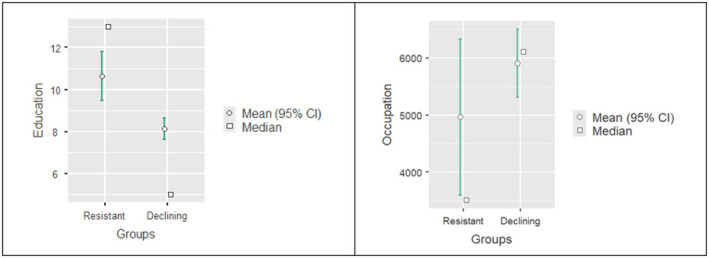
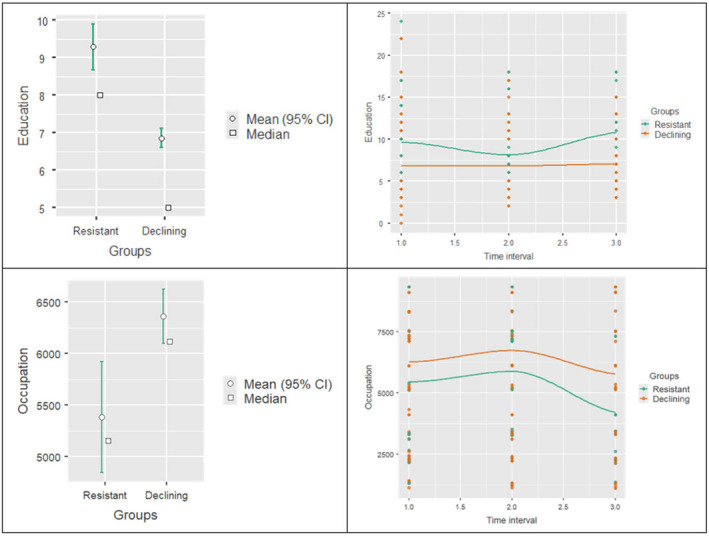
This retrospective study quantifies the relative contribution of age and sex as demographic factors, comorbidity, education and occupation (classified with the International Standard Classification of Occupation 2008) as cognitive reserve proxies in accounting for cognitive aging. All participants (3081) were evaluated at baseline with a complete neuropsychological test battery (T1) and those with unimpaired profiles were classified as subjective cognitive decline, those mildly impaired as mild neurocognitive decline and those severely impaired as major neurocognitive decline. From the first assessment 543 individuals were assessed a second time (T2), and 125 a third time (T3). Depending on whether they maintained or worsened their profile, based on their initial performance, participants were then classified as resistant or declining.
At baseline, all individuals showed education and occupation as the best predictors of performance, in addition to age. Furthermore, across assessments, the resistant had higher levels of education and occupation than the declining. In particular, the education and occupation predicted cognitive performance in all groups considered, from the subjective cognitive decline to the one with the most severely impaired participants.
This study highlights the role of working activity in protecting from cognitive decline across all fragile elderly groups and even more so the individuals who are at very high risk of decline.
许多不同的因素被假设可以根据其在基线时的功能来调节老年人群的认知能力。
本回顾性研究量化了年龄和性别作为人口统计学因素、共病、教育和职业(用 2008 年国际标准职业分类法分类)作为认知储备的替代指标,在解释认知老化方面的相对贡献。所有参与者(3081 人)在基线时接受了完整的神经心理学测试(T1),无认知障碍者被归类为主观认知下降,轻度认知障碍者为轻度认知神经衰退,严重认知障碍者为主要认知神经衰退。从第一次评估中,有 543 人进行了第二次评估(T2),125 人进行了第三次评估(T3)。根据他们的初始表现,根据他们的初始表现,参与者随后被分为抵抗或下降组。
在基线时,所有人都显示出教育和职业是表现的最佳预测因素,除了年龄。此外,在所有评估中,抵抗组的教育和职业水平均高于下降组。特别是,教育和职业在所有考虑的群体中,包括主观认知下降到参与者认知障碍最严重的群体,都预测了认知表现。
这项研究强调了工作活动在保护所有脆弱老年人群免受认知能力下降方面的作用,尤其是对那些认知能力下降风险极高的个体。