She Yingqi, Huang Qinfeng, Ye Zhen, Hu Yu, Wu Mingquan, Qin Kaihua, Wei Ailing, Yang Xin, Liu Yuyao, Zhang Cuihan, Ye Qiaobo
School of Basic Medical Sciences, Chengdu University of Traditional Chinese Medicine, Chengdu, China.
Department of Oncology, The First Affiliated Hospital, Guangxi University of Chinese Medicine, Chengdu, China.
Front Pharmacol. 2021 Oct 27;12:714287. doi: 10.3389/fphar.2021.714287. eCollection 2021.
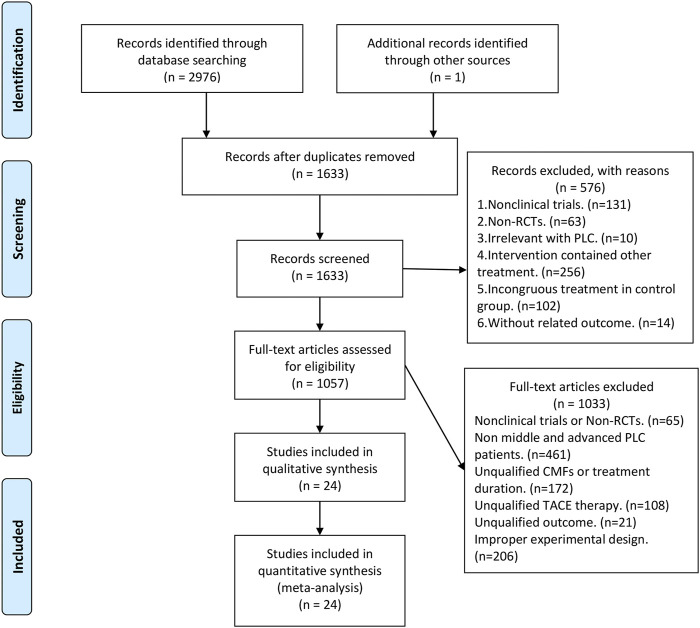
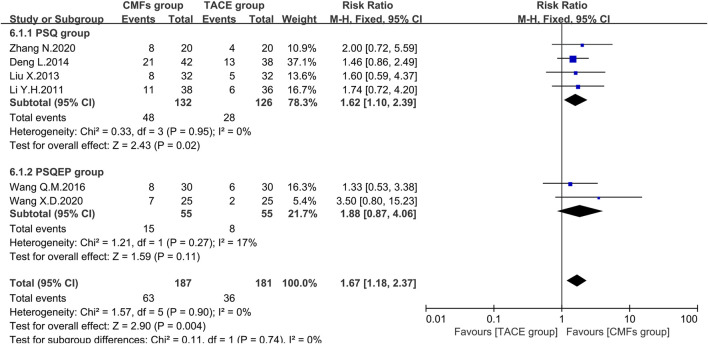
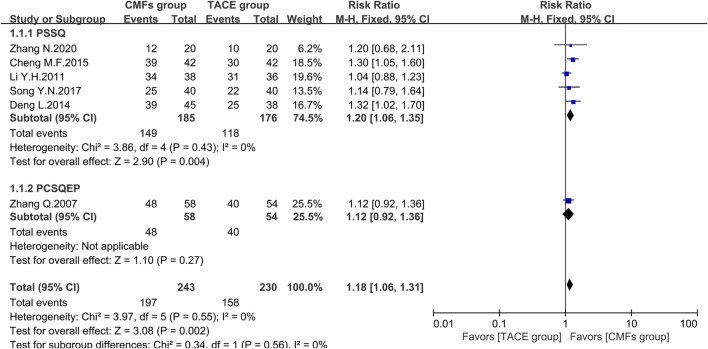
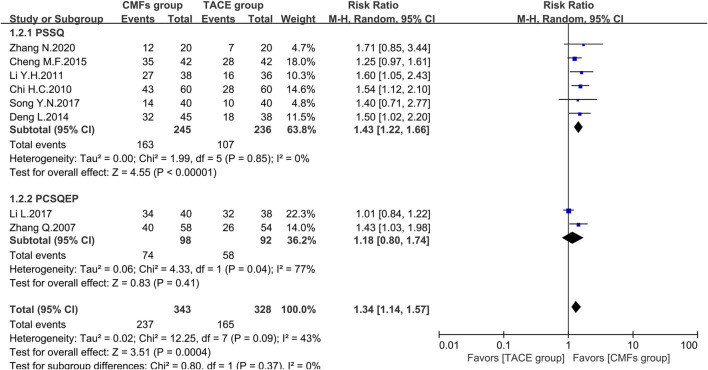
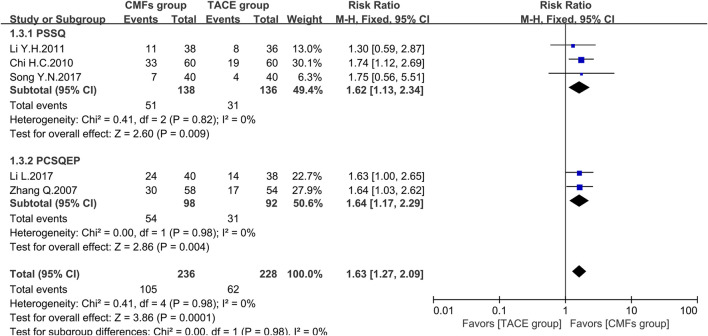
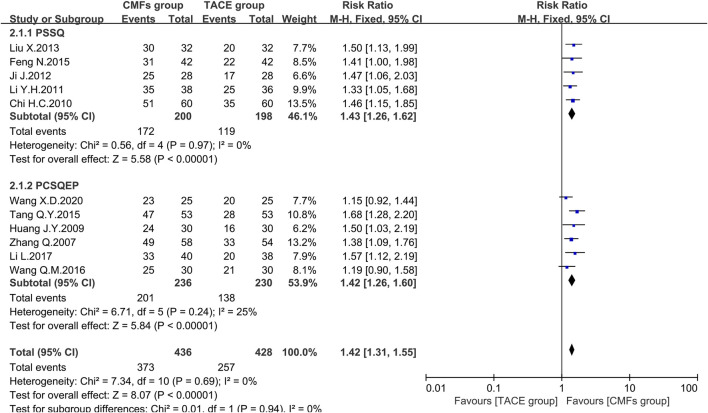
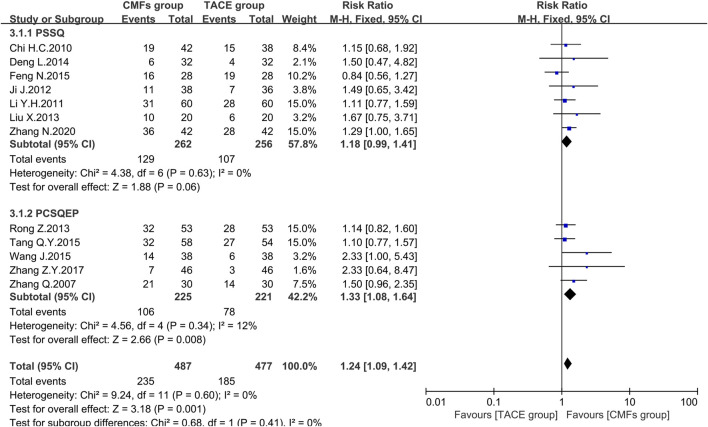
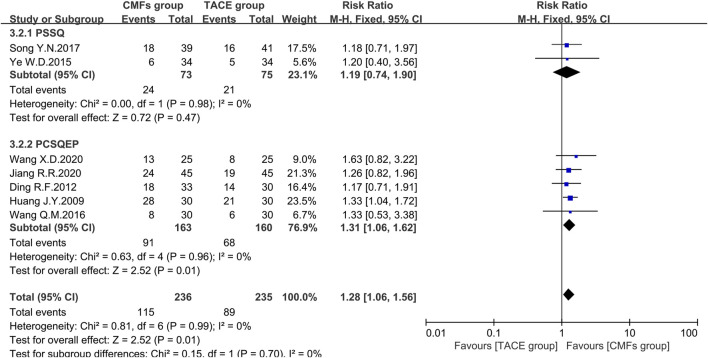
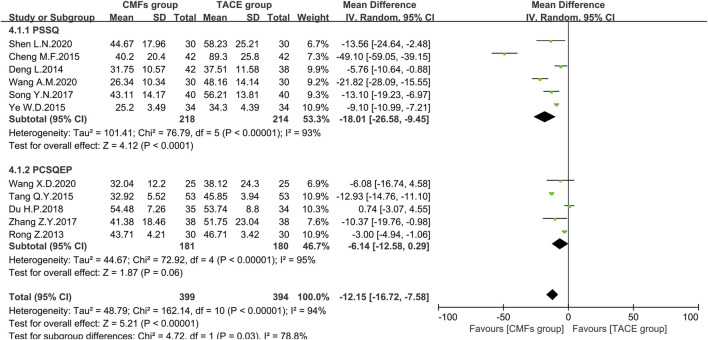
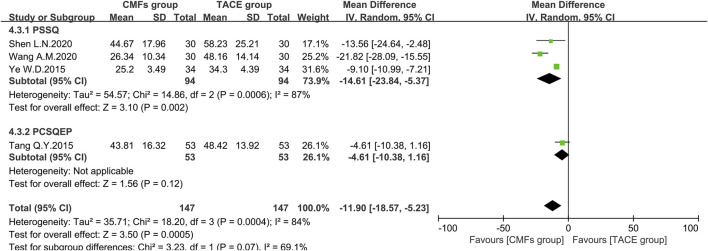
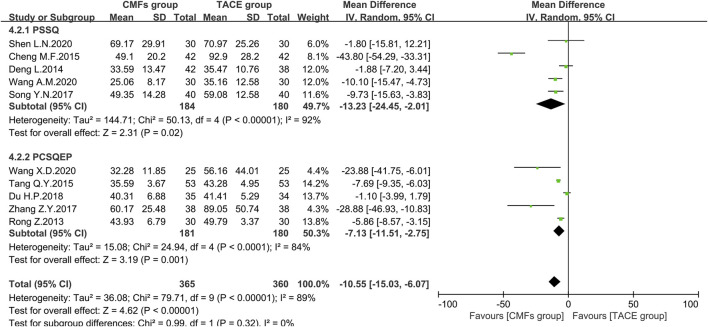
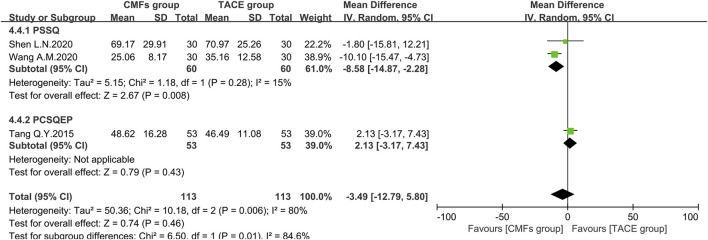
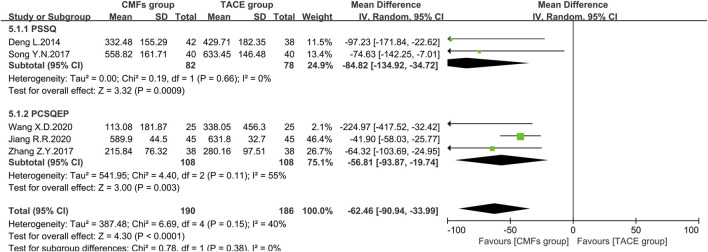
The combination of strengthening Qi and eliminating pathogens is an available therapeutic principle in traditional Chinese medicine (TCM) for primary liver cancer (PLC) at middle-advanced stage. However, there is a lack of reasonable evidence to support the proper application of this therapeutic principle. This meta-analysis aims to evaluate the efficacy and safety of Chinese medicinal formulas (CMFs), including two subgroup analyses of the principle of strengthening Qi and eliminating pathogens. Clinical trials were obtained through searching of EMBASE, Web of Science, PubMed, Cochrane Library, Chinese National Knowledge Infrastructure, Wanfang Database, Chinese Scientific Journal Database, Chinese Biomedical Literature Database, and two clinical trial registries. The randomized controlled trials with the combination of CMFs and transcatheter arterial chemoembolization (TACE) in the experiment group were acceptable, in contrast to the TACE alone in the control group. The statistics analysis was performed on Review Manager 5.4. A total of eligible 24 trials were accessed in this work. Overall, CMFs could improve the survival duration of 6 months, 1 year, and 2 years, Karnofsky Performance Status, tumor objective response rate (ORR), AFP, and symptom. In the subgroup analysis, trials complying with the principle of single strengthening Qi did not show any significant difference in increasing tumor ORR. Meanwhile, the principle of combined strengthening Qi and eliminating pathogens was uncertain in improving symptoms and 1-year and 2-year survival time. In addition, the outcome indexes of ALT and AST were heterogeneous. In last, the total occurrence of adverse events could not be reduced via using CMFs. Patients treated with CMFs exhibited liver injury, fever, and white blood cell decline, with mild events occurring more frequently and severe events occurring less. CMFs are an effective treatment method to cure PLC at the middle-advanced stage. Adopting the principle of single strengthening Qi presents better efficacy in the long term by prolonging the survival duration. Following the principle of combined strengthening Qi and eliminating pathogens could be more beneficial to patients in short term by lessening the tumor size. CMFs have the advantage of reducing certain serious adverse events.
扶正祛邪是中医治疗中晚期原发性肝癌(PLC)的有效治疗原则。然而,缺乏合理证据支持该治疗原则的恰当应用。本荟萃分析旨在评估中药方剂(CMFs)的疗效和安全性,包括对扶正祛邪原则的两项亚组分析。通过检索EMBASE、Web of Science、PubMed、Cochrane图书馆、中国知网、万方数据库、中国科学期刊数据库、中国生物医学文献数据库以及两个临床试验注册库获取临床试验。试验组采用CMFs联合经动脉化疗栓塞术(TACE)的随机对照试验是可接受的,对照组则单纯采用TACE。在Review Manager 5.4上进行统计分析。本研究共纳入24项符合条件的试验。总体而言,CMFs可改善6个月、1年和2年的生存期、卡氏功能状态、肿瘤客观缓解率(ORR)、甲胎蛋白(AFP)及症状。在亚组分析中,单纯遵循扶正原则的试验在提高肿瘤ORR方面未显示出显著差异。同时,扶正祛邪联合原则在改善症状及1年和2年生存时间方面尚不确定。此外,谷丙转氨酶(ALT)和谷草转氨酶(AST)的结果指标存在异质性。最后,使用CMFs并不能降低不良事件的总发生率。接受CMFs治疗的患者出现肝损伤、发热及白细胞减少,轻度事件发生频率更高,重度事件发生频率更低。CMFs是治疗中晚期PLC的有效方法。单纯采用扶正原则长期来看通过延长生存期疗效更佳。遵循扶正祛邪联合原则短期内通过缩小肿瘤大小可能对患者更有益。CMFs具有减少某些严重不良事件的优势。