Holding Anne Catherine, Moore Emily, Moore Amanda, Verner-Filion Jérémie, Ouellet-Morin Isabelle, Koestner Richard
Department of Psychology, McGill University.
Département des Sciences de l'Éducation, Université du Québec en Outaouais.
Clin Psychol Sci. 2021 Nov;9(6):1214-1221. doi: 10.1177/2167702621995214. Epub 2021 Apr 26.
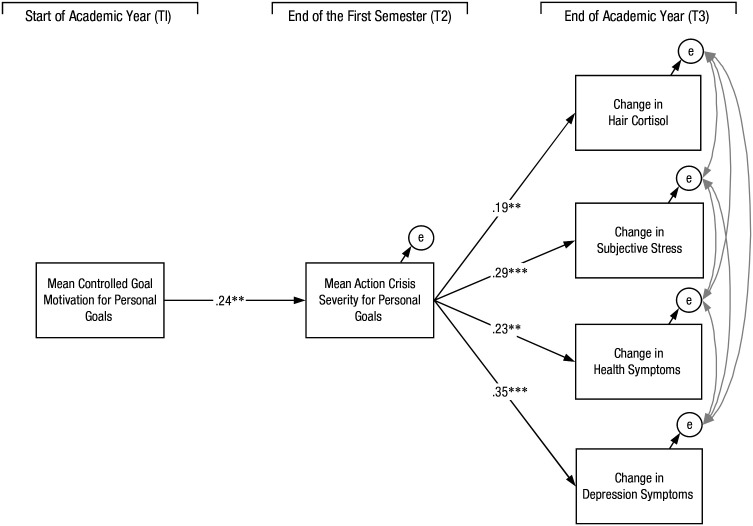
The action crisis is a critical phase in goal striving during which the goal pursuer feels conflicted about persevering with the goal or initiating disengagement. Recent research suggests that goal motivation, specifically controlled motivation (i.e., pursuing a goal out of obligation and pressure), increases the likelihood of experiencing action crises. In turn, action crises in goal pursuit have been linked to increases in depression symptoms and cortisol. In the present 8-month longitudinal study, we tracked university students' personal goals to examine whether the pursuit of controlled goals and the experience of action crises was associated with increasing levels of hair cortisol, perceived stress, poor health, and depression symptoms ( = 156). Structural equation modeling suggested that experiencing action crises in goal pursuit was associated with increases in markers of stress, depression, and ill-being. This effect was partially explained by controlled goal motivation. The clinical and theoretical implications of these findings are discussed.
行动危机是目标追求过程中的一个关键阶段,在此期间,目标追求者对于坚持目标还是开始放弃感到矛盾。最近的研究表明,目标动机,特别是控制性动机(即出于义务和压力追求目标),会增加经历行动危机的可能性。反过来,目标追求中的行动危机与抑郁症状和皮质醇的增加有关。在本项为期8个月的纵向研究中,我们追踪了大学生的个人目标,以检验追求控制性目标和行动危机的经历是否与头发皮质醇水平升高、感知压力、健康状况不佳和抑郁症状相关(n = 156)。结构方程模型表明,在目标追求中经历行动危机与压力、抑郁和幸福感指标的增加有关。这种效应部分由控制性目标动机解释。讨论了这些发现的临床和理论意义。