Department of Pediatrics, University of California, San Francisco.
Bakar Computational Health Sciences Institute, University of California, San Francisco.
JAMA Netw Open. 2021 Nov 1;4(11):e2133090. doi: 10.1001/jamanetworkopen.2021.33090.
Antidepressant use may be associated with reduced levels of several proinflammatory cytokines suggested to be involved with the development of severe COVID-19. An association between the use of selective serotonin reuptake inhibitors (SSRIs)-specifically fluoxetine hydrochloride and fluvoxamine maleate-with decreased mortality among patients with COVID-19 has been reported in recent studies; however, these studies had limited power due to their small size.
To investigate the association of SSRIs with outcomes in patients with COVID-19 by analyzing electronic health records (EHRs).
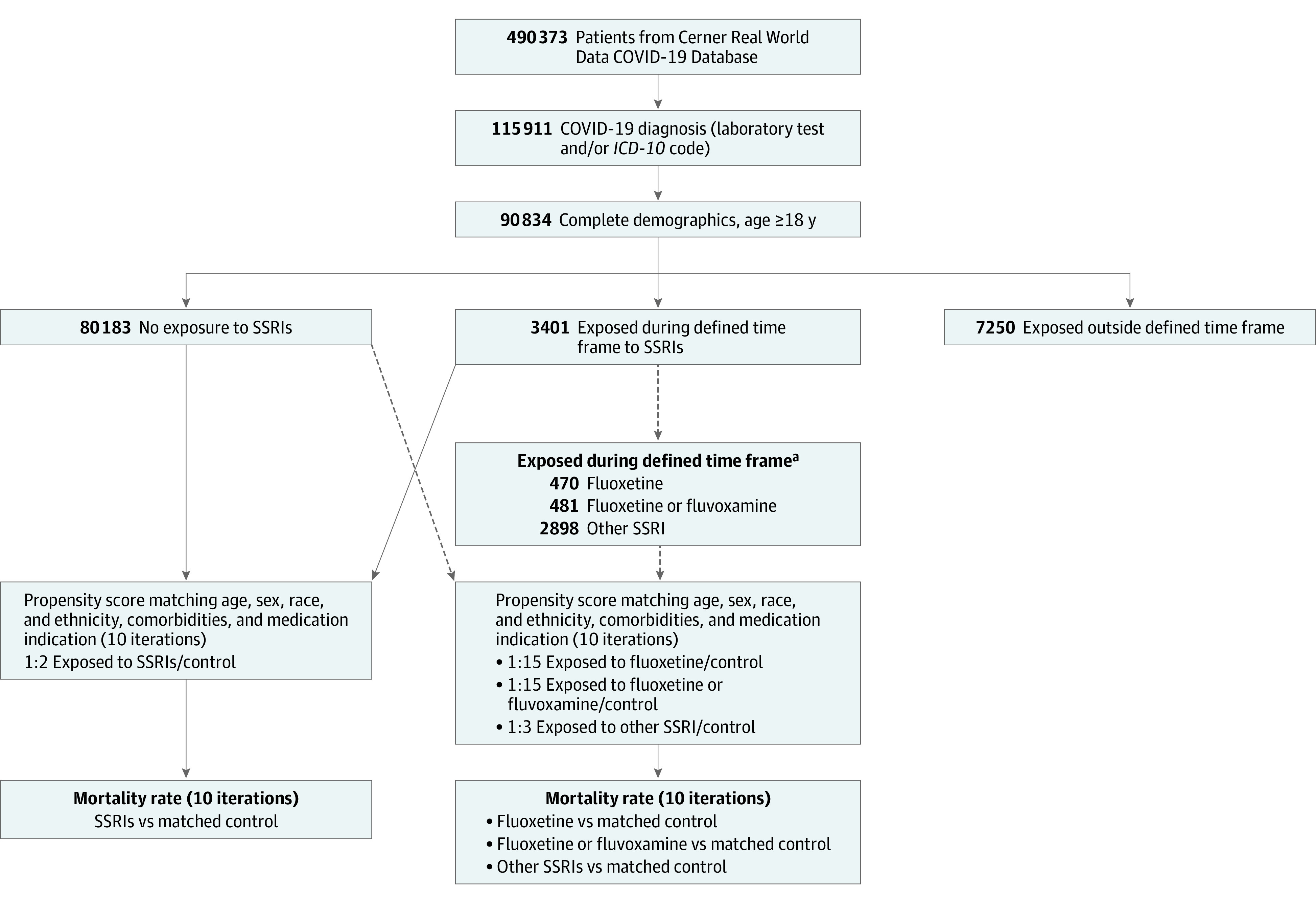
DESIGN, SETTING, AND PARTICIPANTS: This retrospective cohort study used propensity score matching by demographic characteristics, comorbidities, and medication indication to compare SSRI-treated patients with matched control patients not treated with SSRIs within a large EHR database representing a diverse population of 83 584 patients diagnosed with COVID-19 from January to September 2020 and with a duration of follow-up of as long as 8 months in 87 health care centers across the US.
Selective serotonin reuptake inhibitors and specifically (1) fluoxetine, (2) fluoxetine or fluvoxamine, and (3) other SSRIs (ie, not fluoxetine or fluvoxamine).
Death.
A total of 3401 adult patients with COVID-19 prescribed SSRIs (2033 women [59.8%]; mean [SD] age, 63.8 [18.1] years) were identified, with 470 receiving fluoxetine only (280 women [59.6%]; mean [SD] age, 58.5 [18.1] years), 481 receiving fluoxetine or fluvoxamine (285 women [59.3%]; mean [SD] age, 58.7 [18.0] years), and 2898 receiving other SSRIs (1733 women [59.8%]; mean [SD] age, 64.7 [18.0] years) within a defined time frame. When compared with matched untreated control patients, relative risk (RR) of mortality was reduced among patients prescribed any SSRI (497 of 3401 [14.6%] vs 1130 of 6802 [16.6%]; RR, 0.92 [95% CI, 0.85-0.99]; adjusted P = .03); fluoxetine (46 of 470 [9.8%] vs 937 of 7050 [13.3%]; RR, 0.72 [95% CI, 0.54-0.97]; adjusted P = .03); and fluoxetine or fluvoxamine (48 of 481 [10.0%] vs 956 of 7215 [13.3%]; RR, 0.74 [95% CI, 0.55-0.99]; adjusted P = .04). The association between receiving any SSRI that is not fluoxetine or fluvoxamine and risk of death was not statistically significant (447 of 2898 [15.4%] vs 1474 of 8694 [17.0%]; RR, 0.92 [95% CI, 0.84-1.00]; adjusted P = .06).
These results support evidence that SSRIs may be associated with reduced severity of COVID-19 reflected in the reduced RR of mortality. Further research and randomized clinical trials are needed to elucidate the effect of SSRIs generally, or more specifically of fluoxetine and fluvoxamine, on the severity of COVID-19 outcomes.
抗抑郁药的使用可能与几种促炎细胞因子的水平降低有关,这些细胞因子被认为与严重 COVID-19 的发展有关。最近的研究报告称,在 COVID-19 患者中,使用选择性 5-羟色胺再摄取抑制剂(SSRIs)-特别是盐酸氟西汀和马来酸氟伏沙明-与死亡率降低有关;然而,由于这些研究规模较小,其效力有限。
通过分析电子健康记录(EHR)来研究 SSRIs 与 COVID-19 患者结局的关联。
设计、设置和参与者:这项回顾性队列研究使用倾向评分匹配来比较患者的人口统计学特征、合并症和用药指征,在代表美国 87 家医疗中心的大型 EHR 数据库中,对 83584 名 COVID-19 患者进行了分析,这些患者的随访时间最长可达 8 个月。
选择性 5-羟色胺再摄取抑制剂,特别是(1)氟西汀,(2)氟西汀或氟伏沙明,和(3)其他 SSRIs(即不是氟西汀或氟伏沙明)。
死亡。
共确定了 3401 名 COVID-19 患者服用 SSRIs(2033 名女性[59.8%];平均[标准差]年龄,63.8[18.1]岁),其中 470 名服用氟西汀(280 名女性[59.6%];平均[标准差]年龄,58.5[18.1]岁),481 名服用氟西汀或氟伏沙明(285 名女性[59.3%];平均[标准差]年龄,58.7[18.0]岁),2898 名服用其他 SSRIs(1733 名女性[59.8%];平均[标准差]年龄,64.7[18.0]岁)。与匹配的未接受治疗的对照组患者相比,服用任何 SSRI 的患者死亡率相对风险(RR)降低(3401 名患者中的 497 名[14.6%]与 6802 名患者中的 1130 名[16.6%];RR,0.92[95%置信区间,0.85-0.99];调整后的 P =.03);氟西汀(470 名患者中的 46 名[9.8%]与 7050 名患者中的 937 名[13.3%];RR,0.72[95%置信区间,0.54-0.97];调整后的 P =.03);和氟西汀或氟伏沙明(481 名患者中的 48 名[10.0%]与 7215 名患者中的 956 名[13.3%];RR,0.74[95%置信区间,0.55-0.99];调整后的 P =.04)。然而,服用非氟西汀或氟伏沙明的任何 SSRI 与死亡风险之间的关联并不具有统计学意义(2898 名患者中的 447 名[15.4%]与 8694 名患者中的 1474 名[17.0%];RR,0.92[95%置信区间,0.84-1.00];调整后的 P =.06)。
这些结果支持了 SSRIs 可能与 COVID-19 严重程度降低有关的证据,这反映在死亡率的 RR 降低上。需要进一步的研究和随机临床试验来阐明 SSRIs 一般,或更具体地说,氟西汀和氟伏沙明对 COVID-19 结局的严重程度的影响。
