Department of Electrical Engineering, Wireless Communication Ecosystem Research Unit, Chulalongkorn University, Bangkok, Thailand.
Department of Electrical Engineering, University of Central Punjab, Lahore, Pakistan.
PLoS One. 2021 Nov 15;16(11):e0259438. doi: 10.1371/journal.pone.0259438. eCollection 2021.
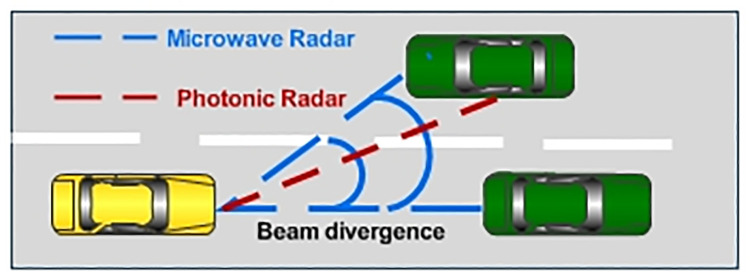
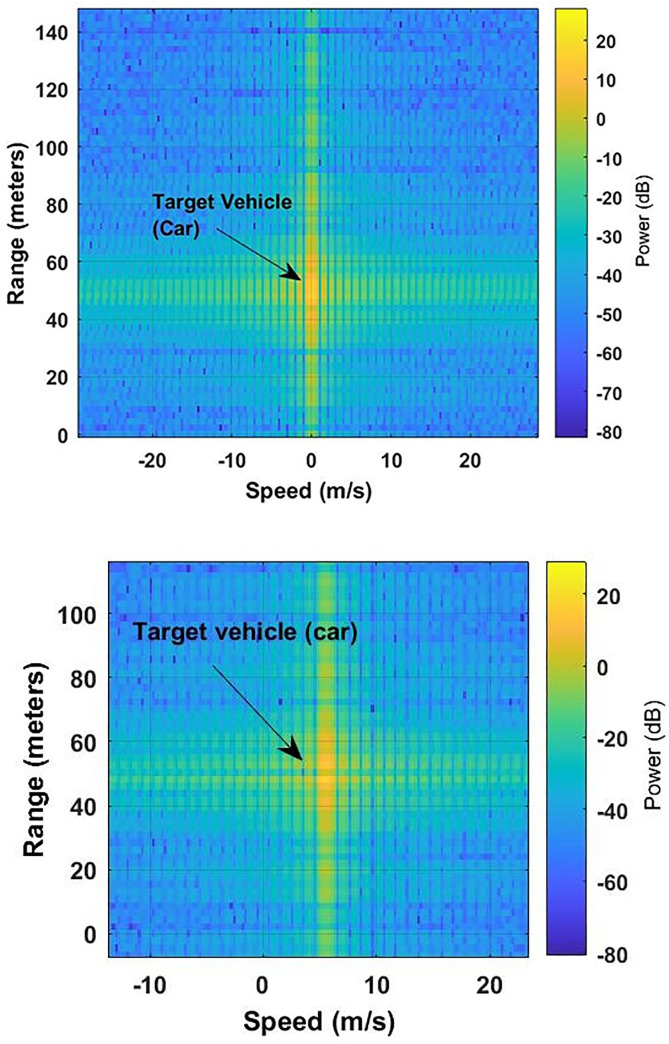
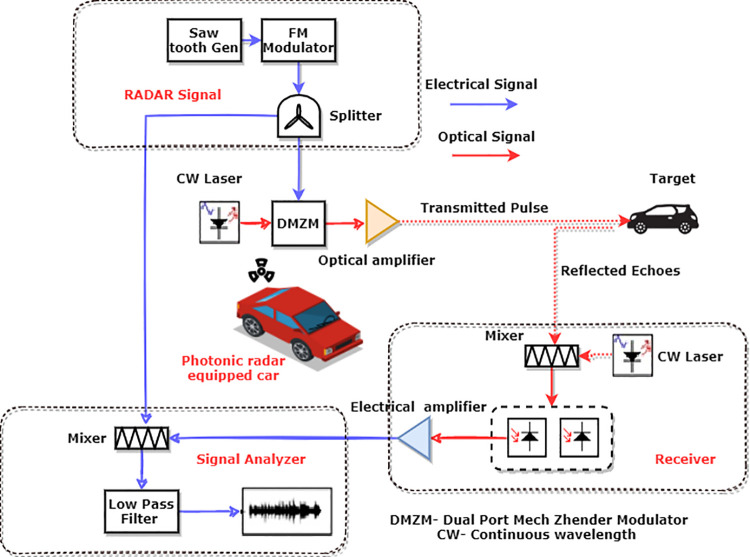
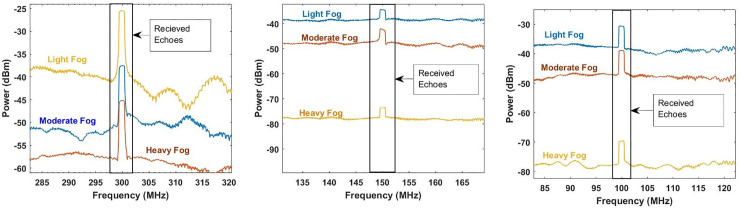
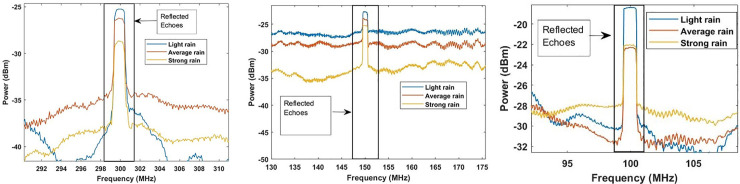
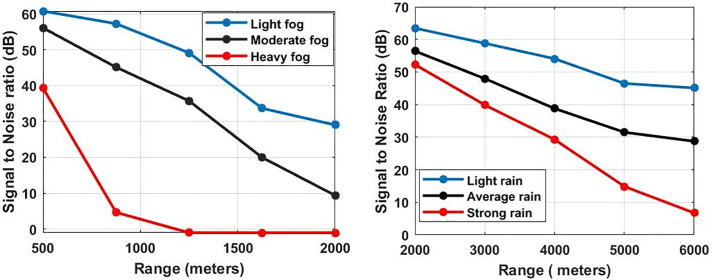
Autonomous vehicles are regarded as future transport mechanisms that drive the vehicles without the need of drivers. The photonic-based radar technology is a promising candidate for delivering attractive applications to autonomous vehicles such as self-parking assistance, navigation, recognition of traffic environment, etc. Alternatively, microwave radars are not able to meet the demand of next-generation autonomous vehicles due to its limited bandwidth availability. Moreover, the performance of microwave radars is limited by atmospheric fluctuation which causes severe attenuation at higher frequencies. In this work, we have developed coherent-based frequency-modulated photonic radar to detect target locations with longer distance. Furthermore, the performance of the proposed photonic radar is investigated under the impact of various atmospheric weather conditions, particularly fog and rain. The reported results show the achievement of significant signal to noise ratio (SNR) and received power of reflected echoes from the target for the proposed photonic radar under the influence of bad weather conditions. Moreover, a conventional radar is designed to establish the effectiveness of the proposed photonic radar by considering similar parameters such as frequency and sweep time.
自动驾驶车辆被认为是未来的交通机制,可以在不需要驾驶员的情况下驾驶车辆。基于光子的雷达技术是为自动驾驶车辆提供有吸引力的应用的有前途的候选者,例如自动泊车辅助、导航、交通环境识别等。相比之下,由于带宽有限,微波雷达无法满足下一代自动驾驶车辆的需求。此外,微波雷达的性能受到大气波动的限制,这会导致高频时严重衰减。在这项工作中,我们已经开发出基于相干的调频光子雷达,以检测更远距离的目标位置。此外,还研究了所提出的光子雷达在各种大气天气条件下的性能,特别是雾和雨。报告的结果表明,在恶劣天气条件下,所提出的光子雷达从目标反射回的回波实现了显著的信噪比 (SNR) 和接收功率。此外,通过考虑频率和扫描时间等类似参数,设计了一个常规雷达来验证所提出的光子雷达的有效性。