Zhang Dong-Yun, Huang Gai-Rong, Ku Jian-Wei, Zhao Xue-Ke, Song Xin, Xu Rui-Hua, Han Wen-Li, Zhou Fu-You, Wang Ran, Wei Meng-Xia, Wang Li-Dong
Department of Pathology, Nanyang Medical College, Nanyang 473061, Henan Province, China.
Department of Geriatrics, Henan People's Hospital, Zhengzhou 450003, Henan Province, China.
World J Clin Cases. 2021 Oct 26;9(30):9011-9022. doi: 10.12998/wjcc.v9.i30.9011.
Primary small cell carcinoma of the esophagus (PSCE) is a highly invasive malignant tumor with a poor prognosis compared with esophageal squamous cell carcinoma. Due to the limited samples size and the short follow-up time, there are few reports on elucidating the prognosis of PSCE, especially on the establishment and validation of a survival prediction nomogram model covering general information, pathological factors and specific biological proteins of PSCE patients.
To establish an effective nomogram to predict the overall survival (OS) probability for PSCE patients in China.
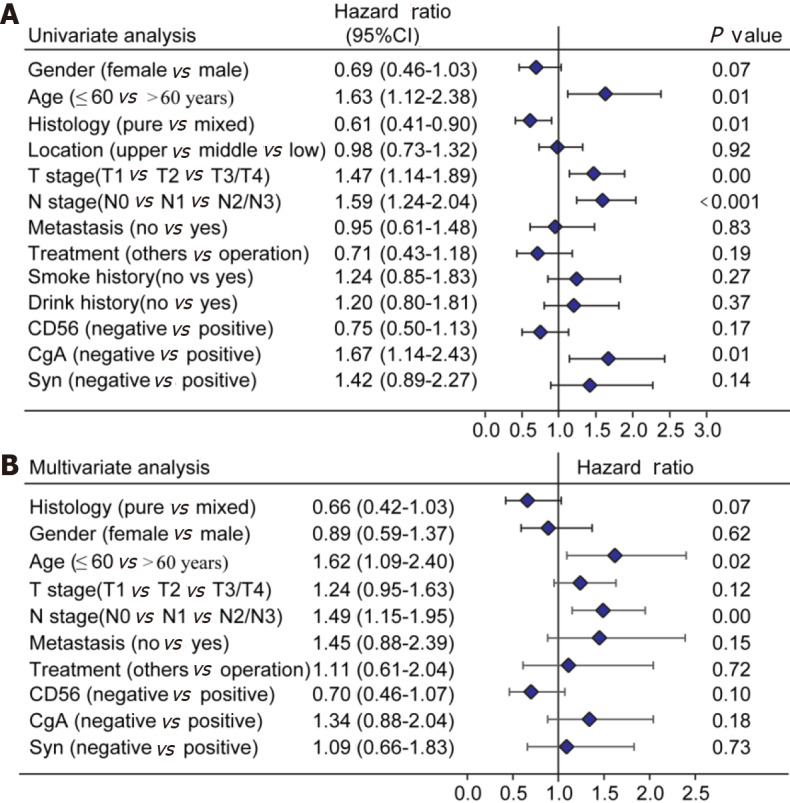
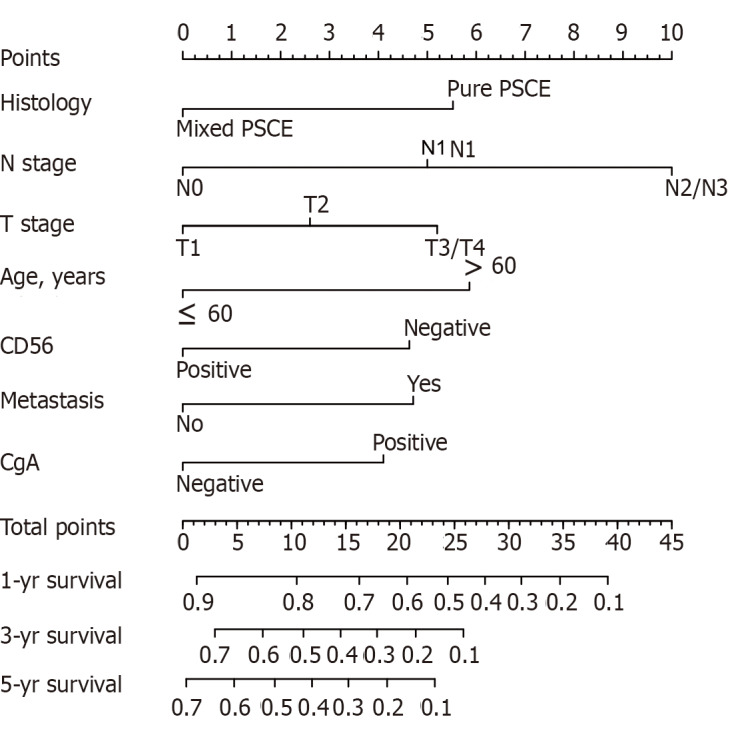
The nomogram was based on a retrospective study of 256 PSCE patients. Univariate analysis and multivariate Cox proportional hazards regression analysis were used to examine the prognostic factors associated with PSCE, and establish the model for predicting 1-, 3-, and 5-year OS based on the Akaike information criterion. Discrimination and validation were assessed by the concordance index (C-index) and calibration curve and decision curve analysis (DCA). Histology type, age, tumor invasion depth, lymph node invasion, detectable metastasis, chromogranin A, and neuronal cell adhesion molecule 56 were integrated into the model.
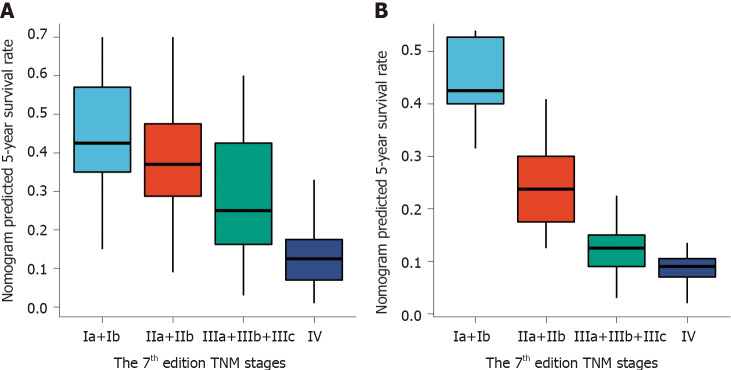
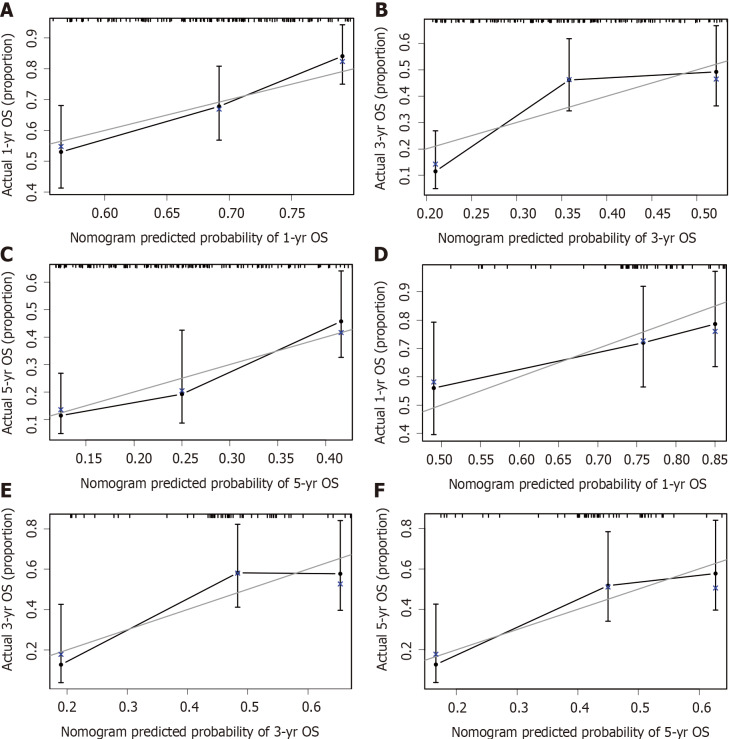
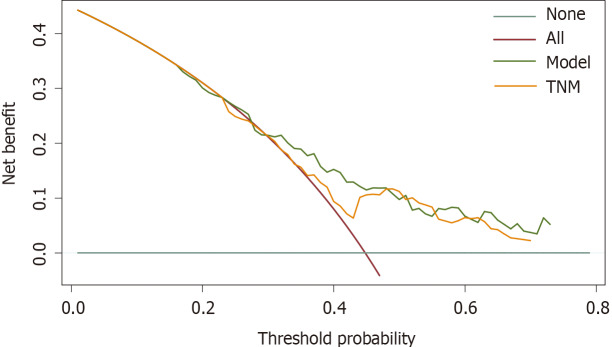
The C-index was prognostically superior to the 7 tumor node metastasis (TNM) staging in the primary cohort [0.659 (95%CI: 0.607-0.712) 0.591 (95%CI: 0.517-0.666), = 0.033] and in the validation cohort [0.700 (95%CI: 0.622-0.778) 0.605 (95%CI: 0.490-0.721), = 0.041]. Good calibration curves were observed for the prediction probabilities of 1-, 3-, and 5-year OS in both cohorts. DCA analysis showed that our nomogram model had a higher overall net benefit compared to the 7 TNM staging .
Our nomogram can be used to predict the survival probability of PSCE patients, which can help clinicians to make individualized survival predictions.
原发性食管小细胞癌(PSCE)是一种侵袭性很强的恶性肿瘤,与食管鳞状细胞癌相比预后较差。由于样本量有限且随访时间短,关于阐明PSCE预后的报道较少,尤其是关于建立和验证涵盖PSCE患者一般信息、病理因素和特定生物蛋白的生存预测列线图模型的报道。
建立一种有效的列线图,以预测中国PSCE患者的总生存(OS)概率。
该列线图基于对256例PSCE患者的回顾性研究。采用单因素分析和多因素Cox比例风险回归分析来检验与PSCE相关的预后因素,并根据赤池信息准则建立预测1年、3年和5年OS的模型。通过一致性指数(C指数)、校准曲线和决策曲线分析(DCA)评估区分度和验证情况。将组织学类型、年龄、肿瘤浸润深度、淋巴结浸润、可检测到的转移、嗜铬粒蛋白A和神经元细胞黏附分子56纳入模型。
在原发性队列中,C指数在预后方面优于7种肿瘤淋巴结转移(TNM)分期[0.659(95%CI:0.607 - 0.712)对0.591(95%CI:0.517 - 0.666),P = 0.033],在验证队列中也是如此[0.700(95%CI:0.622 - 0.778)对0.605(95%CI:0.490 - 0.721),P = 0.041]。在两个队列中,1年、3年和5年OS预测概率的校准曲线均良好。DCA分析表明,与7种TNM分期相比,我们的列线图模型具有更高的总体净效益。
我们的列线图可用于预测PSCE患者的生存概率,有助于临床医生进行个体化生存预测。