Department of Rheumatology, University College London Hospitals NHS Foundation Trust.
Centre for Rheumatology and Bloomsbury Rheumatology Unit, University College London.
Rheumatology (Oxford). 2022 Jul 6;61(7):2894-2904. doi: 10.1093/rheumatology/keab827.
To investigate key factors that may contribute to the variability of rituximab-mediated peripheral and renal B cell depletion (BCD) in SLE.
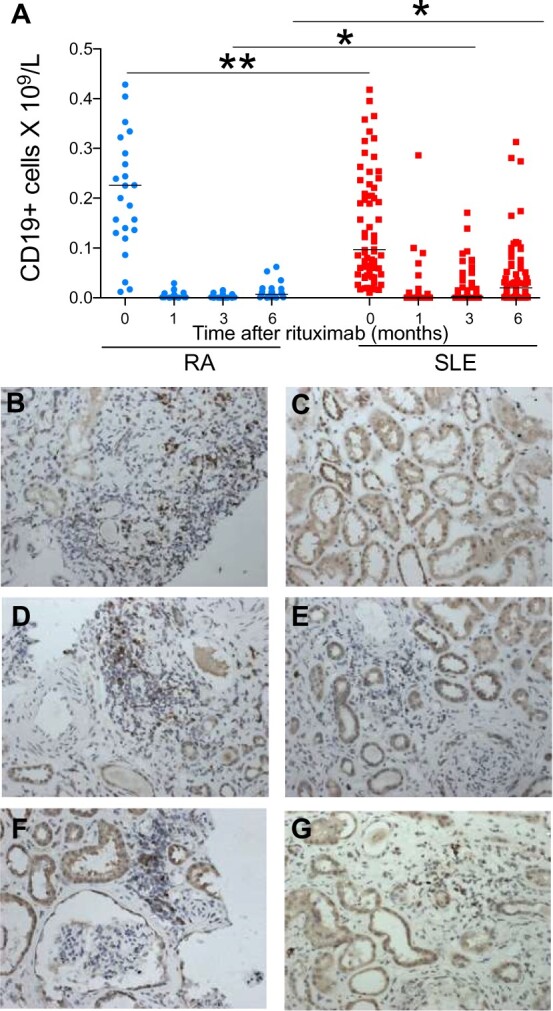
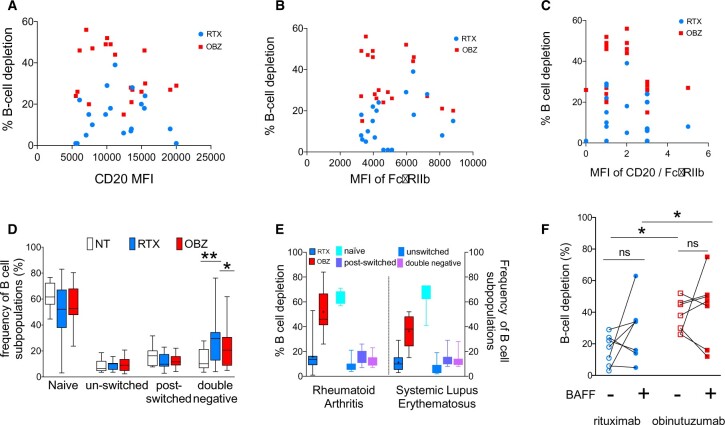
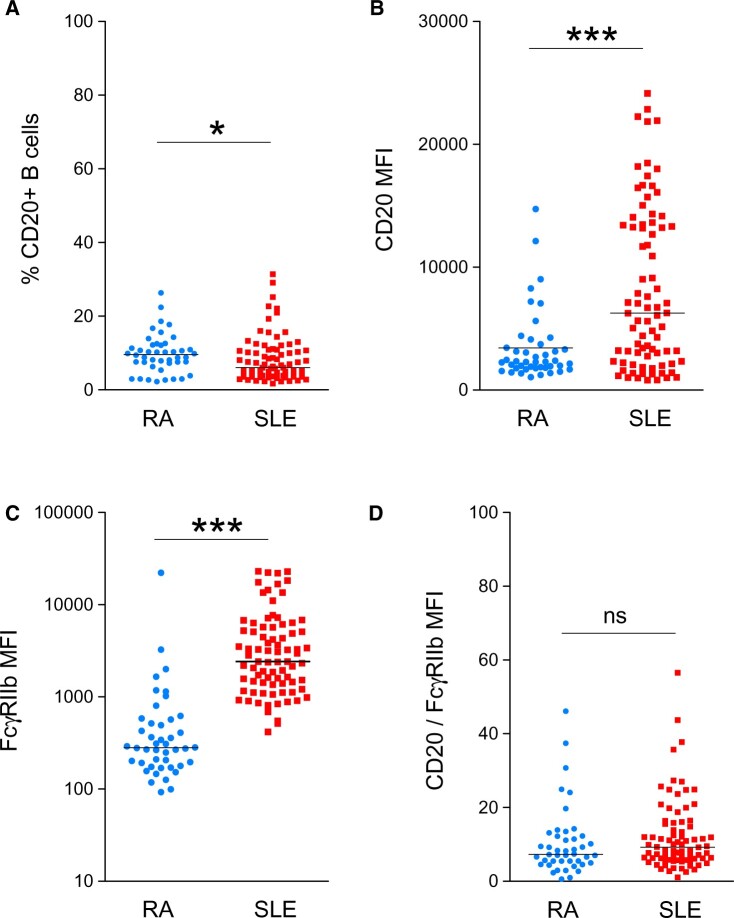
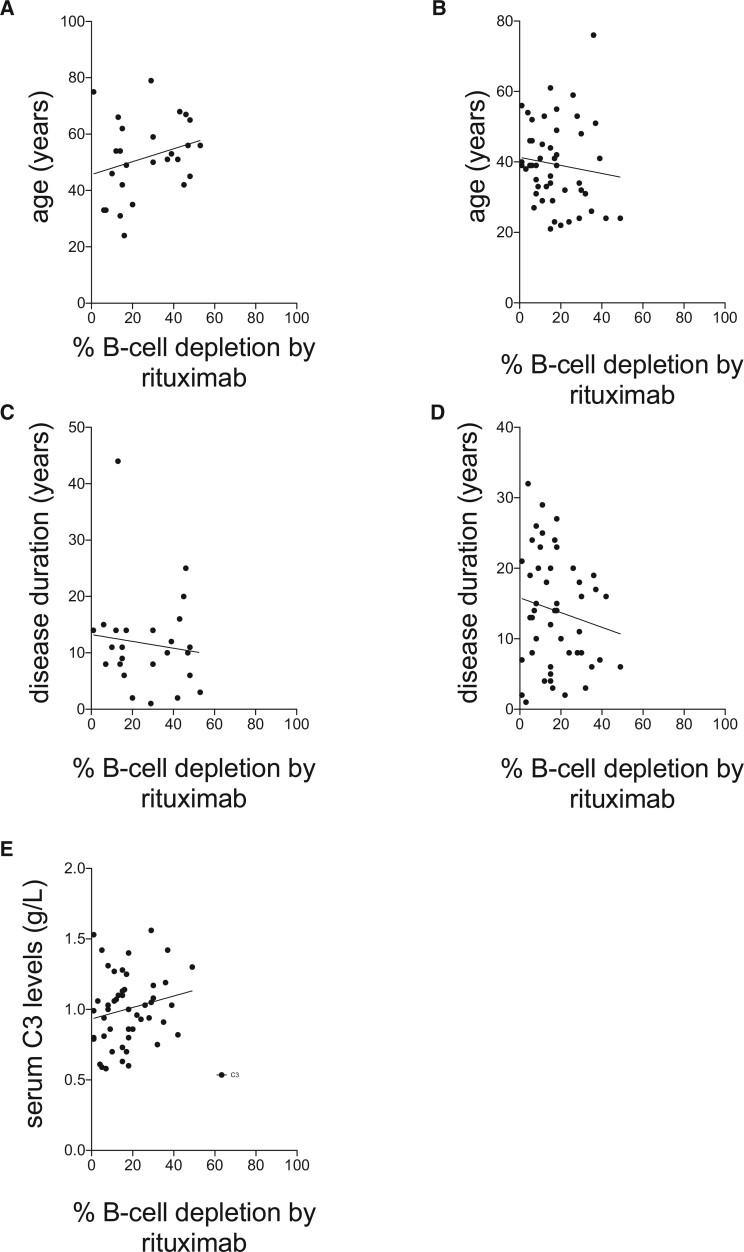
We analysed: (i) CD19+ B cell counts in patients with SLE before and 1, 2, 3 and 6 months after treatment with rituximab, comparing them with RA patients; (ii) the presence of B cells in renal biopsies after rituximab therapy; (iii) whether the duration of BCD correlated with patient demographics and B cell expression of CD20 and FcγRIIb; and (iv) the effect of B cell activation factor (BAFF) on the efficiency of rituximab and obinutuzumab at inducing BCD in whole blood assays, in vitro.
In SLE (n = 71), the duration of BCD was shorter compared with RA (n = 27). B cells were detectable in renal biopsy samples (n = 6) after treatment with rituximab in all patients with poor response while peripheral blood B cells remained low or undetectable in the same patients. There were no significant relationships between peripheral BCD and patient age, disease duration, serum C3 levels or the level of expression of B cell surface proteins CD20 and FcγRIIb. Obinutuzumab was more efficient than rituximab at inducing BCD in whole blood assays, regardless of excess BAFF.
BCD in SLE is less efficient than in RA. Renal B cell presence following rituximab treatment was associated with poor outcomes. No significant relationships between any measured B cell related, clinical or laboratory parameters and the efficiency of BCD by rituximab was found. Obinutuzumab was superior to rituximab at inducing BCD.
探究可能导致系统性红斑狼疮(SLE)患者体内利妥昔单抗介导的外周血和肾脏 B 细胞耗竭(BCD)变异性的关键因素。
我们分析了:(i)接受利妥昔单抗治疗前后 SLE 患者的 CD19+B 细胞计数,并与类风湿关节炎(RA)患者进行了比较;(ii)利妥昔单抗治疗后肾脏活检标本中 B 细胞的存在情况;(iii)BCD 的持续时间是否与患者的人口统计学特征以及 B 细胞表达 CD20 和 FcγRIIb 有关;以及(iv)B 细胞激活因子(BAFF)对利妥昔单抗和奥滨尤妥珠单抗在体外全血实验中诱导 BCD 效率的影响。
在 SLE 患者(n=71)中,BCD 的持续时间较 RA 患者(n=27)更短。在所有治疗反应不佳的患者中,肾脏活检标本中仍可检测到 B 细胞(n=6),而在同一患者的外周血 B 细胞仍处于低水平或无法检测到。外周血 BCD 与患者年龄、疾病持续时间、血清 C3 水平或 B 细胞表面蛋白 CD20 和 FcγRIIb 的表达水平之间均无显著相关性。无论是否存在过量的 BAFF,奥滨尤妥珠单抗在全血实验中诱导 BCD 的效率均优于利妥昔单抗。
SLE 患者的 BCD 效率低于 RA 患者。利妥昔单抗治疗后肾脏中 B 细胞的存在与不良预后相关。未发现任何与 BCD 效率相关的 B 细胞相关、临床或实验室参数之间存在显著相关性。奥滨尤妥珠单抗在诱导 BCD 方面优于利妥昔单抗。