Frantz Robert P, Benza Raymond L, Channick Richard N, Chin Kelly, Howard Luke S, McLaughlin Vallerie V, Sitbon Olivier, Zamanian Roham T, Hemnes Anna R, Cravets Matt, Bruey Jean-Marie, Roscigno Robert, Mottola David, Elman Erin, Zisman Lawrence S, Ghofrani Hossein-Ardeschir
Mayo Clinic, Rochester, MN, USA.
Ohio State University, Columbus, OH, USA.
Pulm Circ. 2021 Nov 11;11(4):20458940211057071. doi: 10.1177/20458940211057071. eCollection 2021 Oct-Dec.
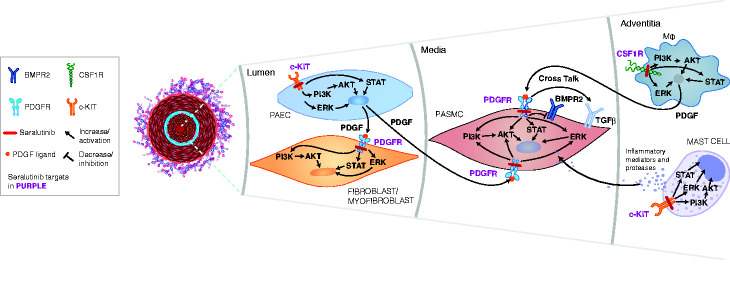
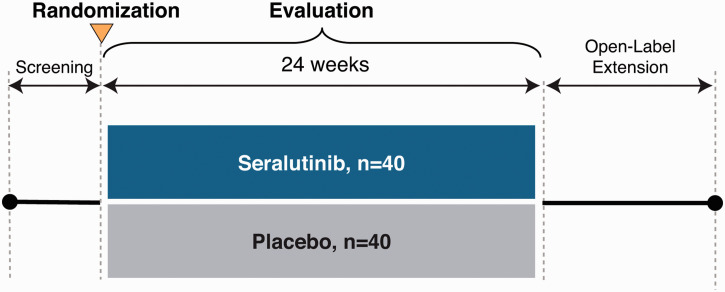
Aberrant kinase signaling that involves platelet-derived growth factor receptor (PDGFR) α/β, colony stimulating factor 1 receptor (CSF1R), and stem cell factor receptor (c-KIT) pathways may be responsible for vascular remodeling in pulmonary arterial hypertension. Targeting these specific pathways may potentially reverse the pathological inflammation, cellular proliferation, and fibrosis associated with pulmonary arterial hypertension progression. Seralutinib (formerly known as GB002) is a novel, potent, clinical stage inhibitor of PDGFRα/β, CSF1R, and c-KIT delivered via inhalation that is being developed for patients with pulmonary arterial hypertension. Here, we report on an ongoing Phase 2 randomized, double-blind, placebo-controlled trial (NCT04456998) evaluating the efficacy and safety of seralutinib in subjects with World Health Organization Group 1 Pulmonary Hypertension who are classified as Functional Class II or III. A total of 80 subjects will be enrolled and randomized to receive either study drug or placebo for 24 weeks followed by an optional 72-week open-label extension study. The primary endpoint is the change from baseline to Week 24 in pulmonary vascular resistance by right heart catheterization. The secondary endpoint is the change in distance from baseline to Week 24 achieved in the 6-min walk test. A computerized tomography sub-study will examine the effect of seralutinib on pulmonary vascular remodelling. A separate heart rate monitoring sub-study will examine the effect of seralutinib on cardiac effort during the 6-min walk test.
涉及血小板衍生生长因子受体(PDGFR)α/β、集落刺激因子1受体(CSF1R)和干细胞因子受体(c-KIT)途径的异常激酶信号传导可能是肺动脉高压中血管重塑的原因。针对这些特定途径可能会逆转与肺动脉高压进展相关的病理性炎症、细胞增殖和纤维化。塞拉鲁替尼(原名GB002)是一种新型、强效的临床阶段PDGFRα/β、CSF1R和c-KIT抑制剂,通过吸入给药,正在为肺动脉高压患者开发。在此,我们报告一项正在进行的2期随机、双盲、安慰剂对照试验(NCT04456998),评估塞拉鲁替尼在世界卫生组织第1组肺动脉高压、功能分级为II级或III级的受试者中的疗效和安全性。总共将招募80名受试者,随机接受研究药物或安慰剂治疗24周,随后进行为期72周的可选开放标签扩展研究。主要终点是通过右心导管检查从基线到第24周肺血管阻力的变化。次要终点是6分钟步行试验中从基线到第24周距离的变化。一项计算机断层扫描子研究将检查塞拉鲁替尼对肺血管重塑的影响。一项单独的心率监测子研究将检查塞拉鲁替尼在6分钟步行试验期间对心脏负荷的影响。